Keys November

In honor of my favorite month, here is one of my very first originals  written for piano and voice.

Written and performed by Diana Hereld in November, 2008. Recorded  and engineered by Kenton Schultz.

keys november

What’s wrong with all you people here
With all your eyes sewn closed
Please remove that vacant mask
Your eyes are all sewn closed
Proudly she does walk on by
She don’t need your air
It’s over she’s estranged them now
She couldn’t hide the care

Pain has no face now
It’s not enough to bleed
If it’s all about the show and tell
She can’t be all you need

Painfully he scrubs her wrist
While she looks away
Funny how you’d never know
From how she takes the day

So once again she’ll lay down
And beg the world pass by
She’s so confused ’cause every night
She’s sleeping with the Lie

WHEN ALL IS SAID AND DONE NOW IT’S ALL ABOUT THE TRUTH THAT TAKES YOU HOME

…come and see her slowly fade watch her fall away people speaking never knew from how she took the day crime and punishment she tried maybe it’s not too late of all she’s learned she surely knows that love can conquer fate…

Angel, Down We Go Together (cover)

Angel, Down We Go Together

(originally recorded by S. P. Morrissey, 1987)

Angel, angel
Don’t take your life tonight
I know they take and that they take in turn
And they give you nothing real for yourself in return
But when they’ve used you and they’ve broken you
And wasted all your money
And cast your shell aside
And when they’ve bought you and they’ve sold you
And they’ve billed you for the pleasure
And they’ve made your parents cry
I will be here, oh, believe me
I will be here, believe me
Angel, don’t take your life
Some people have got no pride
They do not understand the urgency of life
But I love you more than life
I love you more than life

Nella Traduzione: Mike Patton’s Ore D’Amore

With the amount of spontaneity I seem to have exhibited over the past couple of weeks in posting posture, I suppose I’m right on schedule to next share instructions on how to best cater a Mongolian barbecue!  More appropriately, this may be a splendid example of my style of procrastination at its fullest: writing on anything and everything except the one thing I need be. Ah, well, just one more, right?

In my not-so-subtle defense, this is something I’ve needed to do for ages. I’ve only known the genius that is Mike Patton for 4 years now, and of his Italian tour de force even less. I find it funny actually that the same thing that had me pay him heed in the first place has now brought me back with the same respect and admiration: his grasp of the Italian language. This man does not just speak Italian, nor does he simply sing in Italian; he is fluent in the language and sound itself. Being blessed with the combination of absolute pitch, a general aptitude for languages and having spent a considerable amount of time in Milan and Florence, I’m fairly confident in my judgment of his mastery.

Until I am able to properly cover this song (no small feat given his immense orchestrations and extensive vocal range, even for a male) I have decided to translate it. If you’ll permit, I attempted go against the typical “grain” of translating Italian songs to English by providing a bit more literal than figurative translation. I have also tried to keep the verb tenses accurate, which is sadly uncommon in many current popular music translations of any artist. It is very possible that because of this, just for fun, I will go on to translate the entire album. We’ll see. Until then:  please enjoy my favorite song of his, Ore D’Amore.

Hours of Love

Hours of love I have not because we are not lovers anymore
I don’t have these moments
I don’t speak (unless I must) and I don’t ask anyone to stay with me
It is only you that I want, only you
Your place was here, close to me
I’m not able to look where you are not
My eyes on yours: and then…and then…
Hours of love I have not because we are not lovers anymore
After you, I have never loved again.
It is only you I see, only you
Your place was here, close to me
I’m not able to look where you are not
My eyes on yours: and then…and then…
Hours of love I have not because we are not lovers anymore
After you, I have never loved again
Hours of love I have not because we are not lovers anymore.
.
.
Ore D’Amore written by Mike Patton
Ore d’amore non ho per non innamorarmi più
Io non ho che momenti
Parlo soltanto se devo e non chiedo a nessuna mai di restare con me
È solo te che vorrei, soltanto te
Il tuo posto era quì vicino a me
Guardare non so dove non sei
Gli occhi miei sopra ai tuoi e poi, e poi…
Ore d’amore non ho per non innamorarmi più
Dopo te non ho amato mai.
È solo te che vorrei, soltanto te
Il tuo posto era quì vicino a me
Guardare non so dove non sei
Gli occhi miei sopra ai tuoi e poi, e poi…
Ore non ho per non innamorarmi più
Dopo te non ho amato mai
Ore non ho per non innamorarmi più!

Down The Line: Don’t Let The Darkness Eat You Up

I’ve been thinking a bit lately about the personal varying affect of art in general, be it the written word, a piece of music or stenciling on the wall. It’s kind of interesting to get into the motive (as much as one can ‘get into’ the motive) of the love and affectation of any type of aesthetic stimulus. Why do we gaze into any object for an extended amount of time? It can be used as object of analysis, as a stepping stone to greater inspiration for our own output, or lastly, what I find to be the case most often with myself: its amount and height of mental and emotional affectation.

As a musician myself, the vast majority of music I enjoy stems from one of the above: critiquing a performance of Chopin’s Valse Op. 64 No. 2 to better my technical grace as a pianist, listening to acoustic ditties (otherwise known as masterpieces) by Sufjan or Joanna in attempt to improve my songwriting, or dancing around to the Arcade Fire because, well, sometimes a little “Rebellion (Lies)” is all you need on the way home from a tiring day.

However, there are the occasional hidden gems one stumbles upon from time to time that kill in all three categories and beyond. I’ve found “Down The Line” by Swedish-Argentine José González to be one of these. As object of analysis, it’s rhythmic and percussive accents, simple vocal line and walking bass are perfectly fitting. As inspiration, I’m not sure I need to go into much detail here- it’s the concept of ‘beauty in simplicity’ at its finest. In “Notes of a Dirty Old Man,” Charles Bukowski says An intellectual is a man who says a simple thing in a difficult way; an artist is a man who says a difficult thing in a simple way.” José has done this. I can’t and won’t begin to disclose what these unadorned verses mean to me, but maybe you can see for yourself.


I see problems down the line

I know that I’m right.

There was a dirt upon your hands
doing the same mistake twice
making the same mistake twice

Come on over, don’t be so caught up
It’s not about compromising.
I see problems down the line
I know that I’m right

I see darkness down the line
I know it’s hard to fight.
There was a dirt upon your hands
doing the same mistake twice
making the same mistake twice.

Come on over, be so caught up, it’s all about colonizing.

I see problems down the line
I know that I’m right.

Don’t let the darkness eat you up  

Hegel, Valéry, Aesthetics and Existentialism: In Response to Mademoiselle

“He who wishes to record his dream has to be awake.”

            -Paul Valéry

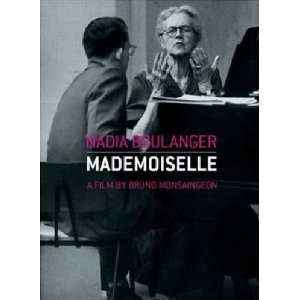
            Mademoiselle, published in 1981 by Bruno Monsaingeon and translated from the original French by Robyn Marsack, is a compilation of conversations of the great musician and teacher, Nadia Boulanger. These dialogues with Monsaingeon took place during the final five years of Boulanger’s life, as she became closer and closer to death. It seems fitting, then, to be a time of reflection on the relationships arisen, mistakes ill-profited from, and lessons realized. In Boulanger’s ninety-two years, she became an incredibly accomplished pianist, prolific conductor, and remarkable teacher of music. Some of her most acclaimed students included Aaron Copland, Roy Harris and Virgil Thompson-and therefore it can truly be said that she “changed the face of American music.”[1]

Characteristic from the onset until the very end of this publication is the apparent amount of charisma, devotion and passion Boulanger exhibited through her music and life, despite the physical setbacks present. One specific constituent to her character was her driven and unwavering view of herself in the lack of contentment she found in her own music. When conversing about the difference between a masterpiece and a simply respectable composition, she was asked to explain the criterion. She states, “For me, this always comes back to faith. As I accept God, I accept emotion. I also accept masterpieces…I believe that there are conditions without which masterpieces cannot be achieved, but I also believe that what defines a masterpiece cannot be pinned down.” There is much wisdom to be seen in this: it is necessarily true. It returns Hegel’s rational and even empirical question of aesthetics: What makes something beautiful? What constitutes good art? The answer can be nothing but subjective and relative to the perceiver, and yet I would agree that masterpieces are borne under but certain conditions. To paraphrase Hegel, nothing great has ever been accomplished without passion.

Another important notion Boulanger emphatically stood for lay in the realm of desire. If one’s desire is such that it may be tainted by lack of opportunity, want of time or simple laziness, the desire had truly no stock in the first place. She speaks of Plato and Schubert, and the greats throughout the age. They are remembered for being truly great, and why; because of their sheer dedication, stanch discipline and distinctive passion to create, to know, to be. Boulanger states earlier on in the work that she believes if one does not value existence, they cannot play well, think well, or live well. If one is not engaged consciously; if one is not thinking, he temporarily exists in vain, he has lost himself. Whether we rely on Hamlet’s “Words without thought to Heaven never go,” or the deductive Cogito of Descartes, whatever one is doing, it must be with purpose, and it must be with discipline.

Lastly, the ideal I have found to be of most exhilarating worth is the basic early existential concept of freedom, responsibility and choice. It continues on from the above: we are what we do; we end only where our actions lead us. She speaks of different types of people-ones who exist in a simply content state in their everyday lives, lacking attention and self-awareness. There are others, then, who live in an entirely different place: one of extreme focus, attentiveness and in possession of an extraordinary need to develop. When the latter engage in literature, a piece of music or in some sort of academia, they are engaged. One such as this is interested by their very nature. Life is entirely what we may draw from it, never the other way around. Ingrained in humanity is the potential to produce; to create great things. But one may not have only talent, or only technique, one must have the devout ardency and will to arrive. Valéry stated specifically, “It depends on you, o passer-by, whether I am tomb or treasury. It depends on you, friend; do not enter without desire.”

            In personal response, I found the conclusion of the dialogue to be incredibly poignant, and sadly little-known truth. The main metaphysical questions-how do we know, what do we know, and what can we know-about life, love and music, she answers with painful yet simplistic candor. It is the Socratic coming of age, and it is but the very wise who may say:


                        “You’re pushing me…You’re asking me to lay down truths…I’m simply amazed to have some intuitions…I have to admit that I do not know. And when I say I do not know, I am proclaiming a great victory for thought. I do not know, therefore I think along better and more essential lines, because when I do know, I am aware that it’s only in a human measure. I know all the notes, do re mi so…semi-quavers and so on…I can analyse everything. But one page, one line, one bar of Schubert, I do not know.”


[1] Monsaingeon, Bruno. Mademoiselle. (London: Carcanet Press Limited, 1985) 13.

She’s Lost Control: Amygdala Hijack?!

She’s Lost Control

In considering the why, and now the how of better implementing tools made available in music psychology, I am consistently struck by how very complex our musical preferences and responses are as humans.While avoiding the attempt to craft any groundbreaking expository theories,  I’d like to visit a motivation of mine in the field whilst bringing attention to an old Joy Division favorite. First, I will disaggregate the various schools of thought that overlap in this field of music psychology.  What do the following have in common?

1. Existential and phenomenological psychology

2. Jungian personality dichotomies

3. Psychological resilience

4. Malabou’s concept of neuroplasticity

5. Psychoanalysis

6. Advances in the neurological study of fear

7. Critical understandings of cultural and societal treatments of emotion

8. Music

In addition to composing the framework of my greatest motivators toward an existential understanding of life, I’d posit that not only do they contribute to the eventual pragmatic method I seek to establish in a clinical therapeutic setting, they are necessary in totality. The more I engage a dialogue regarding the concept as a whole, the more I am struck by just how much need be taken into consideration as well as shedding some light into my peculiar distaste for ‘music therapy’ as a solitary solution. Though music therapy practices have occasionally been proven effective for various wellness processes in young children as well as adults, I remain skeptical. I would argue that one need explore deeper into the psyche, history and personality of the patient. Far too often we see music therapy studies carried out on young adults in particular that prove completely blanketed – with the total exclusion of considerations such as gender, individual neuronal histories and variance in personality.

To come quickly to the point, I recently posed a vital question: In the occurrence of a (negative) amygdala “takeover”, what is the immediate goal? Is it to utilize music to objectify the patient’s feelings, or to quickly placate and soothe the individual’s distress (particularly if the patient suffers a history of auto-destructive behavior)? My response to the above is both, but objectively more as well. Here are a few thoughts to consider which barely skim the surface in composing the process of discerning what type of method and music should be used:

  1. History of Mental Illness (i.e. What are the immediate concerns? Has the patient demonstrated a capability or propensity for harm to self or others?)
  2. Medical and Psychiatric History (Has there been any type of surgery or modification in brain chemistry or anatomy?)
  3. Socioeconomic Background (What types of music to which the patient been exposed as a part of their ‘nurture’ upbringing, and the extent of music appreciation in their cultural worldview?)
  4. Religious/Familial/Educational background (i.e. unconscious and conscious conditioning-in what context has the patient learned or been taught to treat music? Is it a daily ritual, mainly a social luxury, rite of a religious tradition, utilized in education, etc.)
  5. Personality (What characteristics of extroverted or introverted personality types are being displayed?)
  6. Musical Preferences and Affect Regulation (How and to what extent are they affected by repetition, unfamiliar versus familiar rhythms and meters, Eastern/Western depictions of consonance and dissonance, ‘major’ versus ‘minor’ tonalities, etc.)
  7. Musical Propensity and Skill in Practice or Performance
  8. Existential values and spiritual/moral motivations of the patient

On the tip of the iceberg of gaining a general understanding of the patient, we see already that the answer lies beyond sitting down with a troubled teenage male, playing a bit of Mendelssohn and assuming to illicit the disclosure of an exhaustive account for discord with his father. Establishing a rapport and fluency over the course of time, making the effort to implement music he responds to, and eventually gain an empathetic understanding of how to meet him on his level, however, is something I’m interested in.

I’d like to now return for a moment to the ultimate motivator and the necessity for this type of process. When I speak of the amygdala hijack, I am referring to the very instance in which the fight or flight response occurs. Although the ‘limbic system’ was long perceived to be an emotional center of the brain, the amygdala has been found to be the main ‘limbic’ area involved clearly implicated in the processing of threats. A ‘hijack’ occurs when our brain responds to threats; devoid of reasonable consideration or logic. Typically, when we are presented a stimulus, three events occur: we sense (visual, aural, olfactory, touch, etc.), we process, and we react. These occur in rapid succession. At the moment the threat is processed, the amygdala can override the neo-cortex, a center of higher thinking which deals with sensory perception and motor commands, and initiate an impulsive response (which holds the potential of negatively producing instances of destructive behavior and emotional irrationality). Because it is easier for the amygdala to control the neo-cortex by arousing various brain areas than it is for the neo-cortex to control the amygdala, the ability to shut down anxiety producing hormones and emotions is no simple feat, and proves an exquisite challenge in undertakings of crafting a therapy.

One theory (enter elements of LeDoux, Goleman and Damasio) is that if we can slow or somehow manipulate this hijack process, we may buy ourselves the time it takes to properly process the stimulus, and respond in an appropriate, healthy fashion. LeDoux was hopeful about the possibility of learning to control the amygdala’s impulsive role in emotional outbursts: “Once your emotional system learns something, it seems you never let it go. What therapy does is teach you how to control it – it teaches your neocortex how to inhibit your amygdala. The propensity to act is suppressed, while your basic emotion about it remains in a subdued form.” My theory? We can do it with music.

In closing, I’d like to briefly provide an example of my conviction that the above considerations are essential for a beneficial psychologist/patient relationship. It would seem safe to assume that were we to randomly sample a group of 1,000 healthy, typically functioning women age 18-30, and narrow from there the women who have an extensive knowledge and listening history of the English ‘post-punk’ band Joy Division, we would be presented with an entire spectrum of emotional affect regarding participant’s specific and individual musical associations. Obviously this study is strictly hypothetical primarily in that were we to stop there, the comorbidity and variables would be obscene. My point is, it is almost guaranteed that there will be few in this clinical group who associate exclusively a strictly negative or strictly positive sentiment, and valence and arousal reaction to any one specific selected musical styling of Joy Division. Human experiences, associations and implicit reactions are unique, thus requiring a highly individualized method of interplay. I leave you now with a narrative appropriate to the study itself, with the hope of one day creating a methodical approach designed to alleviate the anxious and distressed of this very sentiment.

Why Beauty Exists: The Neuroscience of Curiosity

I’ve come across a wonderful post over at Lapidarium Notes this morning and cannot help but share. Originally written by Jonah Lehrer in his blog (The Frontal Cortex) Jonah puts forth an speculative (albeit intriguing) theory as to the literal faculty of why beauty exists.

Upon initial reading, I’m taken back to working through my introductory thought process on Hegel’s Philosophy of Art. At first glance, to be completely honest, not only does it seem a bit of a narcissistically beaten-horse, I’ve simply come so near to believing (more than once) that the whole discussion is better left to Kantian scholars of aesthetics; and for the good of the academy, I simply best stay out of it. Au contraire, enter the reason I love plasticity and neuroscience in the first place: with a little dissection, a lot of faith and a very open mind-the potential of our neuronal comprehension is, at this point at least, limitless.

It also brings into play a fundamental reason why I become giddy at the overlap of philosophy, psychology and neuroscience: pragmatism! “Speculative” as Jonah’s theory may be, the minute you bring in data from fMRI and PET scanners, things become a bit more serious. Neuroscience (for me) is a way of turning  highly theoretical abstracts (philosophy) into possibly more practical endeavors (clinical psychology).  Now, before I am the target of hate emails, I am not saying philosophy is not practical, by all means, I find it very much so. I’m speaking in the context more in the arena of bettering the all-encompassing, easily accessible acculturation of society by means we may find in a clinical (or neurologically educational) setting. Jonah has done (as per usual) a splendid job of combining the concepts of arousal, the ‘mental itch’ that is the curiosity of an inquisitive mind, and the usefulness of beauty as learning signal, emotional reminder, and motivational force.

Before I go on and let Jonah explain the study far better than myself, I will say one thing more. Ironically enough, I pin the very moment I knew I wanted to study music and neuroscience concurrently to him. I remember so clearly-a friend had sent me a blank email, except for the link to the post. I often ignore such things, but the respect I had for them academically prompted me to do otherwise. I’ll never forget that evening sitting at my laptop at the local pizza joint reading that article and knowing this is what I had to do. The post, entitled The Neuroscience of Music, can be found here.

The following is taken directly from Jonah’s blog post Why Does Beauty Exist?

Curiosity

“Here’s my (extremely speculative) theory: Beauty is a particularly potent and intense form of curiosity. It’s a learning signal urging us to keep on paying attention, an emotional reminder that there’s something here worth figuring out. Art hijacks this ancient instinct: If we’re looking at a Rothko, that twinge of beauty in the mOFC is telling us that this painting isn’t just a blob of color; if we’re listening to a Beethoven symphony, the feeling of beauty keeps us fixated on the notes, trying to find the underlying pattern; if we’re reading a poem, a particularly beautiful line slows down our reading, so that we might pause and figure out what the line actually means. Put another way, beauty is a motivational force that helps modulate conscious awareness. The problem beauty solves is the problem of trying to figure out which sensations are worth making sense of and which ones can be easily ignored.

Let’s begin with the neuroscience of curiosity, that weak form of beauty. There’s an interesting recent study from the lab of Colin Camerer at Caltech, led by Min Jeong Kang. (…)

The first thing the scientists discovered is that curiosity obeys an inverted U-shaped curve, so that we’re most curious when we know a little about a subject (our curiosity has been piqued) but not too much (we’re still uncertain about the answer). This supports the information gap theory of curiosity, which was first developed by George Loewenstein of Carnegie-Mellon in the early 90s. According to Loewenstein, curiosity is rather simple: It comes when we feel a gap “between what we know and what we want to know”. This gap has emotional consequences: it feels like a mental itch. We seek out new knowledge because we that’s how we scratch the itch.

The fMRI data nicely extended this information gap model of curiosity. It turns out that, in the moments after the question was first asked, subjects showed a substantial increase in brain activity in three separate areas: the left caudate, the prefrontal cortex and the parahippocampal gyri. The most interesting finding is the activation of the caudate, which seems to sit at the intersection of new knowledge and positive emotions. (For instance, the caudate has been shown to be activated by various kinds of learning that involve feedback, while it’s also been closely linked to various parts of the dopamine reward pathway.) The lesson is that our desire for more information – the cause of curiosity – begins as a dopaminergic craving, rooted in the same primal pathway that responds to sex, drugs and rock and roll.

I see beauty as a form of curiosity that exists in response to sensation, and not just information. It’s what happens when we see something and, even though we can’t explain why, want to see more. But here’s the interesting bit: the hook of beauty, like the hook of curiosity, is a response to an incompleteness. It’s what happens when we sense something missing, when there’s a unresolved gap, when a pattern is almost there, but not quite. I’m thinking here of that wise Leonard Cohen line: “There’s a crack in everything – that’s how the light gets in.” Well, a beautiful thing has been cracked in just the right way. (Italics mine)

Beautiful music and the brain

The best way to reveal the link between curiosity and beauty is with music. Why do we perceive certain musical sounds as beautiful? On the one hand, music is a purely abstract art form, devoid of language or explicit ideas. The stories it tells are all subtlety and subtext; there is no content to get curious about. And yet, even though music says little, it still manages to touch us deep, to tittilate some universal dorsal hairs.

We can now begin to understand where these feelings come from, why a mass of vibrating air hurtling through space can trigger such intense perceptions of beauty. Consider this recent paper in Nature Neuroscience by a team ofMontreal researchers. (…)

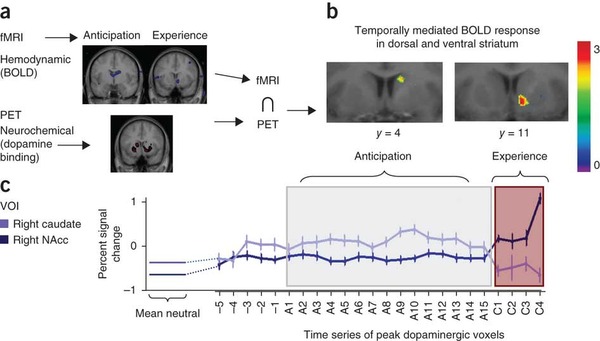
Because the scientists were combining methodologies (PET and fMRI) they were able to obtain a precise portrait of music in the brain. The first thing they discovered (using ligand-based PET) is that beautiful music triggers the release of dopamine in both the dorsal and ventral striatum. This isn’t particularly surprising: these regions have long been associated with the response to pleasurable stimuli. The more interesting finding emerged from a close study of the timing of this response, as the scientists looked to see what was happening in the seconds before the subjects got the chills.
I won’t go into the precise neural correlates – let’s just say that you should thank your right nucleus accumbens the next time you listen to your favorite song – but want to instead focus on an interesting distinction observed in the experiment:
fMRI and PET results,

In essence, the scientists found that our favorite moments in the music – those sublimely beautiful bits that give us the chills – were preceeded by a prolonged increase of activity in the caudate, the same brain area involved in curiosity. They call this the “anticipatory phase,” as we await the arrival of our favorite part:

Immediately before the climax of emotional responses there was evidence for relatively greater dopamine activity in the caudate. This subregion of the striatum is interconnected with sensory, motor and associative regions of the brain and has been typically implicated in learning of stimulus-response associations and in mediating the reinforcing qualities of rewarding stimuli such as food.

In other words, the abstract pitches have become a primal reward cue, the cultural equivalent of a bell that makes us drool. Here is their summary:

The anticipatory phase, set off by temporal cues signaling that a potentially pleasurable auditory sequence is coming, can trigger expectations of euphoric emotional states and create a sense of wanting and reward prediction. This reward is entirely abstract and may involve such factors as suspended expectations and a sense of resolution. Indeed, composers and performers frequently take advantage of such phenomena, and manipulate emotional arousal by violating expectations in certain ways or by delaying the predicted outcome (for example, by inserting unexpected notes or slowing tempo) before the resolution to heighten the motivation for completion.

While music can often seem (at least to the outsider) like an intricate pattern of pitches – it’s art at its most mathematical – it turns out that the most important part of every song or symphony is when the patterns break down, when the sound becomes unpredictable. If the music is too obvious, it is annoyingly boring, like an alarm clock. (Numerous studies, after all, have demonstrated that dopamine neurons quickly adapt to predictable rewards. If we know what’s going to happen next, then we don’t get excited.) This is why composers introduce the tonic note in the beginning of the song and then studiously avoid it until the end. They want to make us curious, to create a beautiful gap between what we hear and what we want to hear.

To demonstrate this psychological principle, the musicologist Leonard Meyer, in his classic book Emotion and Meaning in Music (1956), analyzed the 5th movement of Beethoven’s String Quartet in C-sharp minor, Op. 131. Meyer wanted to show how music is defined by its flirtation with – but not submission to – our expectations of order. To prove his point, Meyer dissected fifty measures of Beethoven’s masterpiece, showing how Beethoven begins with the clear statement of a rhythmic and harmonic pattern and then, in an intricate tonal dance, carefully avoids repeating it. What Beethoven does instead is suggest variations of the pattern. He is its evasive shadow. If E major is the tonic, Beethoven will play incomplete versions of the E major chord, always careful to avoid its straight expression. He wants to preserve an element of uncertainty in his music, making our brains exceedingly curious for the one chord he refuses to give us. Beethoven saves that chord for the end.

According to Meyer, it is the suspenseful tension of music (arising out of our unfulfilled expectations) that is the source of the music’s beauty. While earlier theories of music focused on the way a noise can refer to the real world of images and experiences (its “connotative” meaning), Meyer argued that the emotions we find in music come from the unfolding events of the music itself. This “embodied meaning” arises from the patterns the symphony invokes and then ignores, from the ambiguity it creates inside its own form. “For the human mind,” Meyer writes, “such states of doubt and confusion are abhorrent. When confronted with them, the mind attempts to resolve them into clarity and certainty.” And so we wait, expectantly, for the resolution of E major, for Beethoven’s established pattern to be completed. This nervous anticipation, says Meyer, “is the whole raison d’etre of the passage, for its purpose is precisely to delay the cadence in the tonic.” The uncertainty – that crack in the melody – makes the feeling.

Why the feeling of beauty is useful

What I like about this speculation is that it begins to explain why the feeling of beauty is useful. The aesthetic emotion might have begun as a cognitive signal telling us to keep on looking, because there is a pattern here that we can figure out it. In other words, it’s a sort of a metacognitive hunch, a response to complexity that isn’t incomprehensible. Although we can’t quite decipher this sensation – and it doesn’t matter if the sensation is a painting or a symphony –the beauty keeps us from looking away, tickling those dopaminergic neurons and dorsal hairs. Like curiosity, beauty is a motivational force, an emotional reaction not to the perfect or the complete, but to the imperfect and incomplete. We know just enough to know that we want to know more; there is something here, we just don’t what. That’s why we call it beautiful.”

 Jonah Lehrer, American journalist who writes on the topics of psychology, neuroscience, and the relationship between science and the humanities, Why Does Beauty Exist?, Wired science, July 18, 2011
When The Bottles Break

In light of the decision to begin sharing bits of my personal work when it relates to music as a whole, here is another bit from my reel. I opted to shoot the first 16mm music video in my undergrad film department in lieu of my senior vocal recital. I have never regretted it.


Song written and performed by Thomas Villarreal

Directed by Diana Hereld

Photography by Dave Sweetman

Production Asst. Savannah Shealy

Feat. Nicole Wilson-Murphy


Edited by Diana Hereld

Photography by Josh Dowdy

“Dance Class” written and performed by Asche and Spencer for the film “Stay.”


A Little Night Music

It has come to my attention that with everything going on as of late, not only have I been incredibly slack on writing and recording my own music, I’ve never posted any on my blog. Which is silly, really, as I have always been and will always be a vocalist above all else. Though I do teach voice and piano most days of the week, it’s very important to me that I keep up my personal progress as a musician and writer. I will now begin posting my own work on this medium more often in effort to further encourage myself to do so!

The following taken from the 1998 Cabaret revival, written by John Kander and originally performed by Alan Cumming

I Don’t Care Much

Sleep Gets Your Ghost

Since the commencement of this blog, I have attempted to somewhat remain on task (“task” being the broad field of music education, research and psychology), mainly because I have a prior blog where I’ve long expressed more personal content, including musical/artistic/poetic/academic recommendations. As The Spirit Wanes was created largely to facilitate informal research and stimulate preparation for grad school. However, I have consulted the gods, and now feel it’s okay-appropriate even-to share something of this caliber when I come across it.

The following was shown to me by an old friend a couple of weeks ago, and I must admit my initial impression was somewhat indifferent, at least as far as Dyer’s vocals were concerned. I’ve recently given it another go, and find I can now listen to little else. From intro forward, its syncopated melodies and play on a popular progression are undeniable. It is rare I find chromatically dissonant harmonies more intoxicating, creatively pleasing and yet somehow undemanding.  If that is not enough, the vocals, which I found initially unimpressive, are assertive and secure. It has reminded me of one of my greatest strengths and ultimate failures as a vocalist-I am far too harsh the critic. And for the lyrics? I’ve been slain. Beautiful.

Sleep Gets Your Ghost” – Buke and Gass

Who says i’m dying in the lack of luck and love
Convinced that seeing does a better job believe me
Feels so weak it starts to wear out at my feet
Don’t just whine about the way it works out now
You gave up, how sad
How could you say to me I couldn’t wait for you?
I couldn’t wait for…

Ghost in my head when I dream
Ghost on my tongue in between sleep
I am afraid I’ll never wake up
I am afraid I’ll never wake up 

Wake up when the stars are high
Are you ready for the world? 

For our live-lovers, the entirety of their Tiny Desk Concert may be found here.