Cattivo Maestro, A Revolt That Never Ends, and OWS

“I always thought that becoming a professor would mean teaching freedom and exercising freedom. I was wrong.”

-Antonio Negri, A Revolt That Never Ends 


And a brief glance into Negri and Hardt on OWS, published October 11, 2011:

Confronting the crisis and seeing clearly the way it is being managed by the current political system, young people populating the various encampments are, with an unexpected maturity, beginning to pose a challenging question: If democracy — that is, the democracy we have been given — is staggering under the blows of the economic crisis and is powerless to assert the will and interests of the multitude, then is now perhaps the moment to consider that form of democracy obsolete?


Full article may be found here: The Fight for ‘Real Democracy’ at the Heart of Occupy Wall Street

Damasio: Prophetic Tones in Descartes’ Error

The postcriptum of Descartes’ Error contained an idea which pointed to the future of neurobiological research: the mechanisms of basic homeostasis constitute a blueprint for the cultural development of the human values which permit us to judge actions as good or evil, and classify objects as beautiful or ugly. At the time, writing about this idea gave me hope that a two-way bridge could be established between neurobiology and the humanities, thus providing the way for a better understanding of human conflict and for a more comprehensive account of creativity. I am pleased to report that some progress has been made toward building that sort of bridge. For example, some of us are actively investigating the brain states associated with moral reasoning while others are trying to discover what the brain does during aesthetic experiences. The intent is not ethics or aesthetics to brain circuitry but rather explore the threads that interconnect neurobiology to culture. I am even more hopeful today that such a seemingly utopian bridge can become reality and optimistic that we will enjoy its benefits without having to wait another century.

-Antonio Damasio, Descartes’ Error (preface, 2005)

Hegel, Valéry, Aesthetics and Existentialism: In Response to Mademoiselle

“He who wishes to record his dream has to be awake.”

            -Paul Valéry

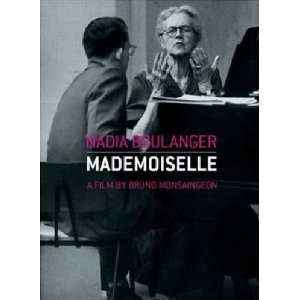
            Mademoiselle, published in 1981 by Bruno Monsaingeon and translated from the original French by Robyn Marsack, is a compilation of conversations of the great musician and teacher, Nadia Boulanger. These dialogues with Monsaingeon took place during the final five years of Boulanger’s life, as she became closer and closer to death. It seems fitting, then, to be a time of reflection on the relationships arisen, mistakes ill-profited from, and lessons realized. In Boulanger’s ninety-two years, she became an incredibly accomplished pianist, prolific conductor, and remarkable teacher of music. Some of her most acclaimed students included Aaron Copland, Roy Harris and Virgil Thompson-and therefore it can truly be said that she “changed the face of American music.”[1]

Characteristic from the onset until the very end of this publication is the apparent amount of charisma, devotion and passion Boulanger exhibited through her music and life, despite the physical setbacks present. One specific constituent to her character was her driven and unwavering view of herself in the lack of contentment she found in her own music. When conversing about the difference between a masterpiece and a simply respectable composition, she was asked to explain the criterion. She states, “For me, this always comes back to faith. As I accept God, I accept emotion. I also accept masterpieces…I believe that there are conditions without which masterpieces cannot be achieved, but I also believe that what defines a masterpiece cannot be pinned down.” There is much wisdom to be seen in this: it is necessarily true. It returns Hegel’s rational and even empirical question of aesthetics: What makes something beautiful? What constitutes good art? The answer can be nothing but subjective and relative to the perceiver, and yet I would agree that masterpieces are borne under but certain conditions. To paraphrase Hegel, nothing great has ever been accomplished without passion.

Another important notion Boulanger emphatically stood for lay in the realm of desire. If one’s desire is such that it may be tainted by lack of opportunity, want of time or simple laziness, the desire had truly no stock in the first place. She speaks of Plato and Schubert, and the greats throughout the age. They are remembered for being truly great, and why; because of their sheer dedication, stanch discipline and distinctive passion to create, to know, to be. Boulanger states earlier on in the work that she believes if one does not value existence, they cannot play well, think well, or live well. If one is not engaged consciously; if one is not thinking, he temporarily exists in vain, he has lost himself. Whether we rely on Hamlet’s “Words without thought to Heaven never go,” or the deductive Cogito of Descartes, whatever one is doing, it must be with purpose, and it must be with discipline.

Lastly, the ideal I have found to be of most exhilarating worth is the basic early existential concept of freedom, responsibility and choice. It continues on from the above: we are what we do; we end only where our actions lead us. She speaks of different types of people-ones who exist in a simply content state in their everyday lives, lacking attention and self-awareness. There are others, then, who live in an entirely different place: one of extreme focus, attentiveness and in possession of an extraordinary need to develop. When the latter engage in literature, a piece of music or in some sort of academia, they are engaged. One such as this is interested by their very nature. Life is entirely what we may draw from it, never the other way around. Ingrained in humanity is the potential to produce; to create great things. But one may not have only talent, or only technique, one must have the devout ardency and will to arrive. Valéry stated specifically, “It depends on you, o passer-by, whether I am tomb or treasury. It depends on you, friend; do not enter without desire.”

            In personal response, I found the conclusion of the dialogue to be incredibly poignant, and sadly little-known truth. The main metaphysical questions-how do we know, what do we know, and what can we know-about life, love and music, she answers with painful yet simplistic candor. It is the Socratic coming of age, and it is but the very wise who may say:


                        “You’re pushing me…You’re asking me to lay down truths…I’m simply amazed to have some intuitions…I have to admit that I do not know. And when I say I do not know, I am proclaiming a great victory for thought. I do not know, therefore I think along better and more essential lines, because when I do know, I am aware that it’s only in a human measure. I know all the notes, do re mi so…semi-quavers and so on…I can analyse everything. But one page, one line, one bar of Schubert, I do not know.”


[1] Monsaingeon, Bruno. Mademoiselle. (London: Carcanet Press Limited, 1985) 13.
The Condition of Truth – Dr. Cornel West at Wilshire Blvd Temple

In the midst of my involvement with Occupy Los Angeles, working my way through Philosophy in the Present (Zizek and Badiou) and exploring various political ideologies and how they function, I recently attended a talk by Dr. Cornel West and Tavis Smiley. Prior to attending, I did a quick bit of research into West’s CV. One of the more interesting interviews I found was conducted by Jonathan Judaken and Jennifer L. Geddes, speaking with him largely in regard to ‘intellectual life’.

You know the idea that the ‘condition of truth is to allow suffering to speak’ actually comes from the next-to-last line of the section called “The Speculative Moment” in Adorno’s Negative Dialectics. He said the condition of truth is to allow suffering to speak. That’s very much like Hebrew scripture, very Judaic, and I resonate with that even though he’s got a secular mode of it and a very sophisticated, negative, dialectical way of conceiving it. But he’s always looking for the defeated. It’s important to focus on the most vulnerable, the widow, the stranger. It comes very much out of Hebrew scripture, couched in their very stories and narrative…As you speak a truth, you can do it with a generosity but also with a bite. You speak the truth, expose the lies, but most importantly, you bear witness.

Two of my favorite quotes by West came in response from a woman from the audience: a professor of religion at a local evangelical Christian college. She asked, simply, “Why, Dr. West, if we are all ‘in the faith,’ why do we read the bible so differently, especially in regards to the poor? How is it that there so many on the right and left that cannot see and agree on how we are to treat the poor?”

His response is as follows:

A) “Unfortunately, there are some who’d rather drink the kool aid than be washed in the blood!”

He then more soberly approached the audience and asked,

B) “Do you read the bible as a book of facts, or a book of truth?”

I loved this. It resonated within me-especially thinking personally of  my religious/spiritual background. Though I’ll never ‘abandon my faith,’ I’m fear I’m guilty all too often for casting aside the truth that may be found in scripture.

Throughout the continuation of talks by both Smiley and West joined by Rabbi Steven Leder, I was amazed at how many times I simply felt chills run down my body. Calling things to my attention such as “The new poor are the former middle class” and “This is not a political posturing of the future-our democracy is at stake” (West) proved not only enlightening, but also motivated me to decide to get back down to Occupy LA as soon I can. An illustration I thought was very cool was the picture he painted in retort to the following question:

 “Do the poor have power?

                                                             “Look at Hip-Hop.”

 I truly thought this was fantastic-anyone knows the roots to the present state of this industry can see how the culture of any society would not be the same without the near-impoverished demographic. Just look at how it started. We have the term “Starving Artist” for a reason! Brilliant. In conclusion, I’d like to add one last thing I took from last night, and it’s in regard to every political disagreement, and now occupation I have ever been apart of. I’ve never encountered opposition from friends, family members and academic advisors in regards to my political/ethical ideologies like I have during the past couple of years. I am thinking now of my stances on the Egyptian people under Hosni Mubarack. Of those who were imprisoned at Abu Ghraib. Of Troy Davis. And now, of the occupiers around the entire world. But Dr. West has said it before, and he said it last night:

          ‎”There are some fights ain’t worth fighting even if you win; there are other fights you have to fight even if you lose.”

Dr. Cornel West

As The Spirit Wanes, or The Hope of Plasticity

“As the spirit wanes, the form appears.”

I first came across these words four years ago, in the art blog of a dear friend. I’ve been in love with Charles H. Bukowski ever since. Though his lifestyle was not one I’d recommend, I cannot convey the number of times I found him not only utterly poignant, but encouraging.

When I began this blog, I promised to explain why I chose those specific words as my title. I suppose the “form” is finally fighting its way to the surface. There is no decorative or esoteric way to say this: the past few months have been the most challenging of my life. I never imagined that so many diverse manifestations of loss and grief existed. During the two weeks leading to August, I lost three separate individuals, all whom I loved very deeply. My father’s death has been the most horrifying by far.

During his final weeks in the oncology ward, I witnessed quite a few examples of how people deal with fear, pain and grief: often to a paralyzing extent. I’ll always remember Kay, the beautiful old woman staying with her husband in the room next to my dad’s. I must have walked past her room twenty times before I found the courage to say hello, and offer her a hug and condolences. We spoke a few times during my stay-why is it so hard, we wondered, to just let go? Love and death are the two most naturally-occurring phenomena we can know, and yet they never fail to leave us cold and nearly unable to breathe.

So why Music psychology? Why neuroscience or philosophy? Why “as the spirit wanes?” Though I experienced a good deal of physical and mental pain in the last year, I feel as if I have almost been numb a vast portion of the time. A sort of desperate numbness, to be sure, but numbness nevertheless. I was unaware of the potential for evolution, development, and vitality all around me. I do not know what’s happened, but then I suppose I do. My spirit has never been so broken, so trampled, or terrifically damaged. I have not been myself the past year, and I’m ready for it to change. The concepts I have recently come to grasp not only allow but demand for revolution such as this.

I’ll never forget during my junior year of college, I was required to take a philosophy course. I dreaded it beyond all else. Though my mother had given me exposure to Jungian psychology from the cradle, in terms of philosophy, I felt my brain just might not “work” that way.

However, within a day of the class I was addicted and desperate for more. I had been re-exposed to the most basic form of existentialism: if we are responsible for our actions, we also then have the freedom not only to choose, but to transcend. As someone who’d grown up alongside the great crusade of mania and depression, this was news to me. What did they mean, I could choose? Though I’d eventually declined, I’d once been told I might benefit from medication to control depression and emotionally-destructive impulses. Medication or not: for the very first time in my life, I found a freedom to transcend my demons: psychical, neural and emotional. I certainly felt and digested emotion in much the same way, but with a unique freedom in my reaction to discord. I was no longer bound in paralyzation or fear. A couple of years later, I have once more found a like freedom, only infinitely more radical in the concept of Brain Plasticity.

As this dares reach too long a confession, I shall save the specifics of why I have found hope in Neuroscience, plasticity and its potential courtship with music for future posts. But what I have learned, and lived, is this: As the spirit wanes, the form appears. It is truly when we are beaten near beyond the point of recognition that we are then forced to give up, or forced to continue. Inertia demands not only motion, but action; consciousness. One may remain static for only so long. I choose to go forward. We can no longer think of our brains, our neuronal selves, as but flexible and anonymous; as machine. We must affirm our capacity for change and confess our plasticity: evolutionary, adaptive, explosive. We must no longer consent to depression via disaffiliation; to be “blind to our own cinema.” Our brains tell us a story-whether we choose to listen or not. Karl Marx once stated “Humans make their own history, but they do not know that they make it.” And why not? What type of fear or unknown is stopping us from this earth-shattering consciousness of what our brains can do?

I will continue soon in conjunction with a more formulated response to Catherine Malabou’s pioneering work, “What Should We Do with Our Brain?” in speculation of a metaphorical and ideological critique of plasticity.

“…At bottom, neuronal man has not known how to speak of himself. It is time to free his speech.” -Catherine Malabou

Hegel and The Philosophy of Art : Part 1

It has somewhat violently come to my attention over the past couple of years that my ideas on Diana's old art cornerthe origin and meaning of art in general result in a bit of a clash and breakdown not only theoretically, but pragmatically in everyday practice. Though my gut reaction has typically been to tread lightly on the visible exterior and remain privately faithful to my own stubborn intuitions, it is not difficult to predict the inevitable destruction that not-so-patiently awaits me there. It proves dangerous territory not only in terms of intellectual risk, but in that as a musician and professional the implications and repercussions of the outcome are tremendous. The time has come to devastate my philosophy: it cannot only suffer the dismantle/repair, it must be rebuilt from the bottom up.

What is art, then? Where does it come from? It is action or motion, necessarily existent ex-something or other, or reaction? Can it be borne solely via some lofty internal emotion, or must it come from a type of universal awareness and harmony?  One question is easily answered: it is not derived simply of motion; it is action. At it’s very base art requires consciousness, therefore it cannot lie in the solely biological and animal aspect. It must assemble from the neurological and symbolic: the heart of dramatism.[i]

One catastrophic event in particular that has become almost the norm for some is the temptation to jump ahead of oneself and ask the “what may” and “what should” questions before coming to grips with the act and the purpose (the “what is” and “why”). As in any philosophic, psychoanalytic or scientific quest, if one does not set out from the very beginning with all unfounded assumptions aside, the task’s entire integrity becomes vulnerable to limitation and error. If the terms of the hypothesis are not clearly understood, by the time one attempts at an end result the outcome can only be adulterated.

So I find myself here again: Where does art originate?  In Hegel’s Lectures on Aesthetics, he states the following:

“At the very origin of art there existed the tendency of the imagination to struggle upward out of nature into spirituality. But, as yet, the struggle consisted in nothing more than a yearning of the spirit, and, insofar as this failed to furnish a precise content for art, art could really be of service only in providing external forms for mere natural significations, or impersonal abstractions of the substantial inner principle which constitutes the central point of the world.”[ii]

He goes on to express that though it may have begun this way, it does not remain so. His notions on Classic Art assert that spirituality now realizes the basis and principle of content: it becomes external form. By the union of the spiritual and idealization of the natural, it would seem that “Classic Art” makes up the perfect and absolute personification of the ideal.

But already I am ahead of myself. I am yet unequipped to venture into the differences in Classic, Romantic, Symbolic Art or formalism until I better understand where (on or apart from earth) it comes from. As I work my way through Hegel’s Philosophy of Art[iii], I will continue to share my findings and ideas (and hopefully one day, a re-born concept of what art should be).

For now, I leave you with a glimpse of inexpressible significance to me as I sort through these issues. Poor is what I am, but if I am forced to take what I cannot yet afford, I shall continue to steal from the richest-


[i] Kenneth Burke. The Philosophy of Literary Form. Berkeley: University of California Press, 1973.

[ii] Hegel, G.W.F.. “Of the Romantic Form of Art.” Lectures on Aesthetics. Trans. Bernard Bosanquet. Ed. and intro. Michael Inwood. Harmdondsworth: Penguin, 1993.

[iii] Hegel, G.W.F. The Philosophy Of Art. New York: Barnes and Noble, Inc., 2006

Art Lets Truth Originate


Truth, defined as event and conflict, is centered in the work of art which is also considered as an event and a conflict. Art, embodied in the work of art as its origin, lets truth originate because it is both the specific expressions of truth as well as the condition for the expression of truth. In this way art not only expresses truth, it is truth. When a work of art is created it gives truth a location to become, a work-place. Heidegger indicates when he states that “Art is the setting-into-work of truth.” In another similar formulation he also states: “Art is truth setting itself to work.” By these statements he means that art is the entire process of truth freely realizing itself in a work of art. Art is the becoming and happening of truth. This, then, is the full meaning of “ART LETS TRUTH ORIGINATE.”

-Barend Kiefte

In quotatations-
Martin Heidegger, “The Origin of the Work of Art“, in Poetry. Language. Thought, trans. Albert Hofstadter (New York: Harper and Row Publications, 1971, p. 77