Autism, Gabrielle Giffords, and the Neuroscience Behind “The Singing Therapy”

As many of you know, I recently attended the Second World Congress of Clinical Neuromusicology in Vienna. Though there were many intriguing presentations, one presentation in particular stood out. In 1996, Dr. Gottfried Schlaug (Boston, Harvard Medical School) performed an experiment to test the shared neural correlation of singing and speech. A portion of the abstract follows:

Using a modified sparse temporal sampling fMRI technique, we examined both shared and distinct neural correlates of singing and speaking. In the experimental conditions, 10 right-handed subjects were asked to repeat intoned (“sung”) and non-intoned (“spoken”) bisyllabic words/phrases that were contrasted with conditions controlling for pitch (“humming”) and the basic motor processes associated with vocalization (“vowel production”) (Özdemir, Norton, and Schlaug, 2006).

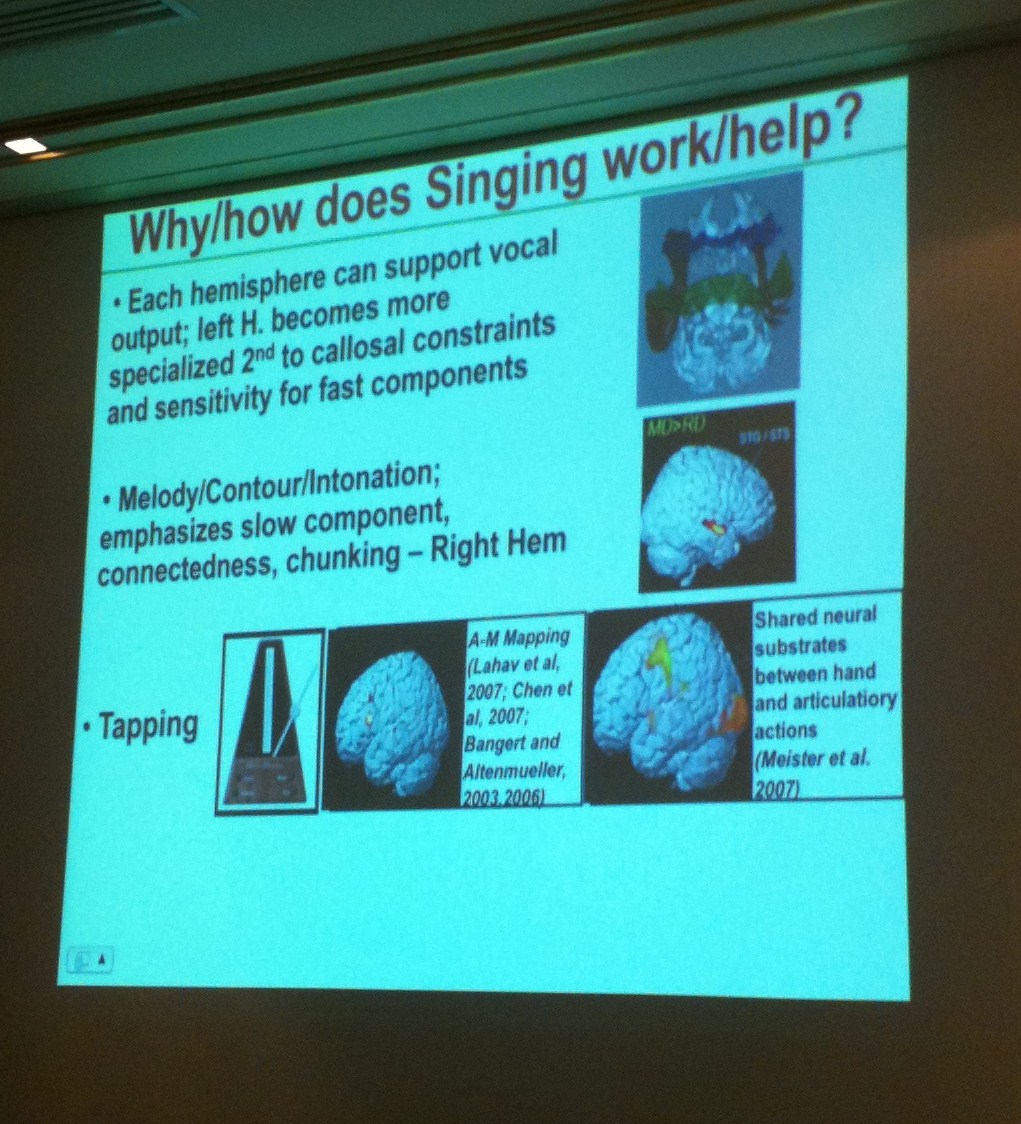
The remainder of the paper may be found here, but I will try to summarize the result. Basically, by actually singing the words or phrase, and not simply speaking or humming (referred to as ‘intoned speaking’), there occurred additional right lateralized activation of the superior temporal gyrus, inferior central operculum, and inferior frontal gyrus. What this means for the rest of us? This activation is now more than ever believed to be reason that while patients suffering from aphasia due to stroke or other varying brain damage may be unable to speak, they are able to sing.

That was in 2006. In a few short years, music therapy and the applied neuroscience of music have all but exploded-the question is, why? As many publications have noted, the idea that music can be used in rehabilitation has been around for a century or more. So what has caused such media coverage in the last few years? My simple theory is because through the popularization of these techniques’ success via persons in the public eye, everyone is beginning to understand that it just works.

Speaking of the public eye, a friend sent me this article from NPR this morning. Though I was vaguely familiar with this success story, it really surprised me to see it mentioned in national media. For those unaware, a current hot topic in science journalism is the method of therapy Gabrielle Giffords has chosen after she suffered massive brain trauma. I’ve run into cases similar to this one before, but it was what kind of music therapy that really caught my attention: Melodic Intonation Therapy. The reason this really caught my attention is because this is precisely the groundbreaking (and very successful) research Dr. Schlaug presented at the conference in Vienna, only his use was with nonverbal Autistic children. Though Schlaug’s research largely pertains to other faculties, he set out in this case to test AMMT (Auditory Motor Mapping Therapy, a kind of specifically targeted ASD therapy akin to Melodic Intonation Therapy used for stroke patients with aphasia) against normative Controlled Speech Therapy.

Without going too in-depth, what he and his team discovered was that patients who engaged in singing (as opposed to merely speaking or humming) showed additional right lateralized activation of the superior temporal gyrus, inferior central operculum, and inferior frontal gyrus. Due to this, a strong case can be made as to why aphasic patients with left-hemisphere brain lesions are able to sing the text of a song whilst being incapable of speaking the same words. What this means for the whole of this ‘Singing Therapy’ is that by being able to work with brain regions such as Broca’s area which may facilitate the mapping of sound to action, all kinds of different strides may be made linguistically in patients with left-hemisphere brain damage. People who suffer from neurological impairments or disorders that would otherwise be completely unable to communicate verbally may now have that chance. In the words of Dr. Schlaug, “When there is no left hemisphere, you need the right hemisphere to work.”
To get back to congresswoman Giffords, I’d like to take a moment to talk about what is so important and unique with her situation by looking at her case from point of impact to recovery. Nearly one year ago, Giffords sustained a massive head trauma via a bullet that went directly through her brain. Unfortunately, when the bullet entered in this way, it didn’t stop at destroying the tissue in its path (which was for her in the left hemisphere); it also damaged the surrounding neurons, causing the brain to quickly swell and put her in immediate fatal danger of hematomas and other complications. Because of this, surgery was necessary right away to remove a portion of her skull in order for the swelling to, as it were, breathe. The surgery Giffords took part in was the once risky decompressive hemicraniectomy. For more information on this procedure, there’s a fantastic post by Bradley Voytek over at Oscillatory Thoughts including some great data, analysis and images on the process. If the congresswoman’s circumstances are ringing any bells for anyone, it’s because it bears some resemblance to arguably one of the most famous head trauma cases in neuroscience and psychology as a whole-Phineas Gage. I shall soon share some thoughts on Gage, and why he remains so near and dear to my heart (and certainly to the heart of Antonio Damasio) in terms of emotional intelligence and neuroscience, but until then, some parting thoughts on Giffords.

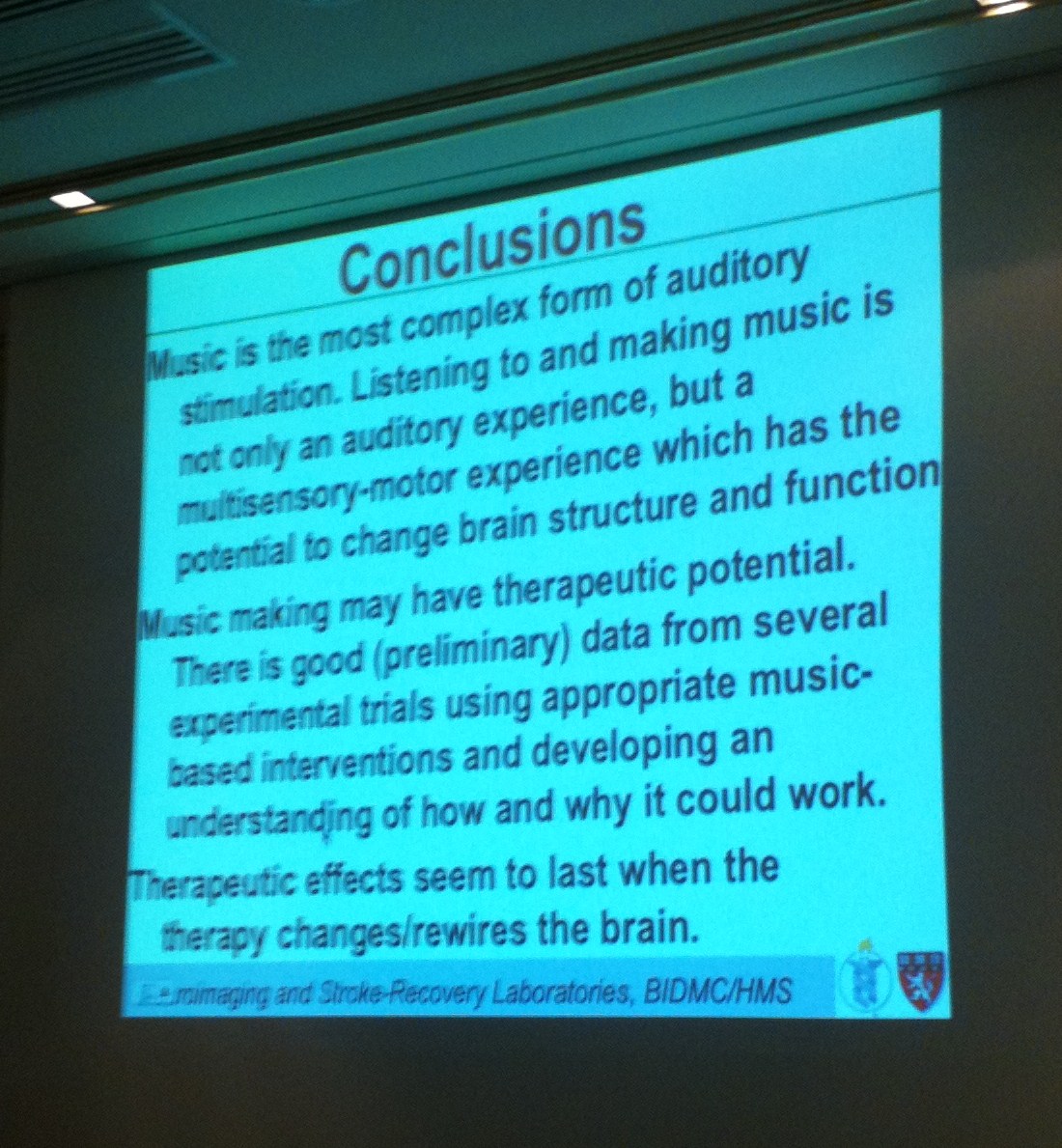
In the beginning of this road to recovery, most were skeptical that Giffords would ever be able to speak again, in any vein. However, through the process of working in Melodic Intonation Therapy with her music therapist, she has gone from singing short words and phrases (in minor thirds, the prominently used interval in this therapy) to singing Twinkle, Twinkle Little Star to more structurally complex and well-known jazz and rock standards such as I Can’t Give You Anything But Love and American Pie. She has made massive strides in her recovery process, and continues to make more every day. This is only one example of the effectiveness and hope this “Singing Therapy” is bringing to the medical field. Even after speaking to Dr. Schlaug inVienna and finding he has “absolutely no interest whatsoever” in psychological disorders, I continue to be enthusiastic in the strides he and his team are making in the applied neuroscience of music.
A note: I continue to be amused by what a small world the pragmatic combining of music and neuroscience remains. Upon reaching the end of the NPR article, I now know why it was already so familiar to me, and why I immediately thought of Schlaug’s work at Harvard and Beth Israel-it is because that’s precisely the team NPR is taking their data from! Brilliant.

 

Help me attend the Second World Congress of Clinical Neuromusicology!

The second world congress of clinical neuromusicology is taking place December 2-3 in Vienna, Austria. The lectures involve presentations and seminars by scholars in the fields of neurology, philosophy and neuroimaging from around the world. Here is a link to the program, which focuses on the applied neuroscience of music.

Though I am far from being a working clinician, I would be registered as a trainee. As I leave for the UK in a little over 24 hours to meet with various professionals in the field, this would be an enormous opportunity for myself. I’ve spent a couple hours online trying to find the very most inexpensive bus/train/plane/hostel to get me to this conference, and spoke with the head of the conference this morning-half in German! As it stands, I simply can’t afford it. I’m about 350$ short. This would pay for a low-cost flight, a room for one night and trainee entrance to the conference. It’s a very long shot, but I’ll be the first to emphatically proclaim you never know what you may achieve until you try. If you feel you are able, I would be so grateful for any small donation.

If anyone is interested as to why I love neuromusicology, I would love to speak with you about it! Or, you may read of it here.

Damasio: Prophetic Tones in Descartes’ Error

The postcriptum of Descartes’ Error contained an idea which pointed to the future of neurobiological research: the mechanisms of basic homeostasis constitute a blueprint for the cultural development of the human values which permit us to judge actions as good or evil, and classify objects as beautiful or ugly. At the time, writing about this idea gave me hope that a two-way bridge could be established between neurobiology and the humanities, thus providing the way for a better understanding of human conflict and for a more comprehensive account of creativity. I am pleased to report that some progress has been made toward building that sort of bridge. For example, some of us are actively investigating the brain states associated with moral reasoning while others are trying to discover what the brain does during aesthetic experiences. The intent is not ethics or aesthetics to brain circuitry but rather explore the threads that interconnect neurobiology to culture. I am even more hopeful today that such a seemingly utopian bridge can become reality and optimistic that we will enjoy its benefits without having to wait another century.

-Antonio Damasio, Descartes’ Error (preface, 2005)

The Neuroscience of Emotional Pain, and the Necessity of Perceived Control

Two nights ago, I read what I believe to be the most personally relevant and  meaningful article I’ve come in contact with in nearly a year. I do not say this lightly,  because I remember the last moment in time I felt this way. I read Halden’s post  entitled Bonhoeffer and the Theology of Romantic Love  not when it was originally  posted in 2008, but a couple of days after New Year’s Day, 2011. It came at the  perfect time-as does the one I’ve just read-because it is about love and loss; rejection and isolation. What  isn’t, after all? Love and death are the strongest of motivators and ordeals, and death  would seem sterile and void of strife were it not for love.

Unfortunately, great as the ups may be, so great are the downs. Having a fair bit of  recent exposure to both tribulations, I would like to share some insight I’ve found in  direct correlation to the more neuroscientific side of things.

At UCLA in 2003, a study was done explicitly on the neural correlates of social  rejection entitled Does Rejection Hurt? An fMRI Study of Social Exclusion. Obviously,  anyone with access to the internet and a free subscription to a science mag online  could tell you that these have been done before; it’s nothing new to observe the psychological underpinnings of pain when a child is picked last (or not at all) for a game of sport after school. It is new information to me, however, that the physiological aspects in the pain of rejection have now proven quite similar to any other type of physical pain: when we lose someone we love, for whatever reason it may be, it literally hurts. The abstract of this article below may better explain the premise:

A neuroimaging study examined the neural correlates of social exclusion and tested the hypothesis that the brain bases of social pain are similar to those of physical pain. Participants were scanned while playing a virtual ball-tossing game in which they were ultimately excluded. Paralleling results from physical pain studies, the anterior cingulate cortex (ACC) was more active during exclusion than during inclusion and correlated positively with self-reported distress. Right ventral prefrontal cortex (RVPFC) was active during exclusion and correlated negatively with self-reported distress. ACC changes mediated the RVPFC-distress correlation, suggesting that RVPFC regulates the distress of social exclusion by disrupting ACC activity.[1]

In the aforementioned, we see that this test was administered to children whilst playing in a ‘virtual ball tossing game’ where they were eventually excluded. If the ACC activity is ‘disrupted’ by such a common and (what many might view as childish experience) what can we say of the potential for anguish of those who lose a spouse? A parent? A child? Of those not only excluded, but abandoned? This brings me to the article in question. Though I’ve found the writing and vocal stylings to stem from a slightly more youthful (and charmingly so!) perspective than I’ve become accustomed in my daily journal fix, pain is pain is pain. We don’t need sappy (and wonderful) song lyrics from Blindside  to tell us that ultimately, at the end of the day, we’re in this together. All of us are searching for an open arm. I could go on forever in tangent about why I can’t wrap my head around referring to God as ‘big other’ or humanity as at last to be but cold, selfish and detached. There is something else at work here, when one experiences pain beyond a certain magnitude. Christie Wilcox does a fine job of breaking this process down for us:

 Evolutionary biologists would say that it’s not surprising that our emotions have hijacked the pain system. As social creatures, mammals are dependent from birth upon others. We must forge and maintain relationships to survive and pass on our genes. Pain is a strong motivator; it is the primary way for our bodies tell us that something is wrong and needs to be fixed. Our intense aversion to pain causes us to instantly change behavior to ensure we don’t hurt anymore. Since the need to maintain social bonds is crucial to mammalian survival, experiencing pain when they are threatened is an adaptive way to prevent the potential danger of being alone.

Christie goes on to state the unfortunate obvious: sometimes understanding the evolutionary biology or even rationale behind it all is simply not enough. We may now see the possibly the main hook for me in her article: she turns to music. We all know the studies on how exercise/having sex/listening to music/interacting with art, etc. are proven to release dopamine, arousing feelings of happiness and positive valence. The thing that really caught my attention is something I’m shocked I had not let sink in previously: music stimulates and creates a feeling of control. I cannot begin to list the litany of mental illnesses that include negative outcomes which seemingly stem directly from a perceived lack of impulse control, but just for effect, I will name a few:

A)    ASD (Autism, Asperger’s)

B)    Attention Deficit Disorder

C)    Manic Depression

D)    Paranoid Schizophrenia

E)    Obsessive-Compulsive Disorder

F)     Borderline Personality Disorder

G)    The paraphilias (exhibitionism and pedophilia)

H)    Various disorders advocating self-harming behaviors

The list plainly goes on and on. From the little I’ve observed in various interpersonal encounters in various stages of life, very few of us enjoy a major lack of control; those suffering from preconceived abandonment/loss apprehensions, even less. Here we have the ultimate tie-in that I seem to be making quite a lot lately: Chalk one more up for music psychology. I would be telling a blatant untruth if I refrained from admitting I too have found listening to music to be all of the above: exhilarating, liberating, calming, but more importantly creating the massive sensation of immediate…not necessarily peace, or ease, but control.

As I draw near to the day when I must nail down my precise research proposal for graduate school, I’ll again briefly show how this relates to what I want to do, and feel can be done. In that exact moment of conflict (commonly the amygdale hijack) our mental, emotional and physical actions are crucial. Countless sufferers of self-destructive behaviors including those who engage in self-inflicted physical pain, sexual promiscuity, domestic violence, and kleptomania suffer from a perceived lack of control-and will do anything to reclaim it. If one is in control, there is a (even if false) sense that everything will be okay; that everything’s not lost. I very simply believe that like many other (‘healthy’) activities that people engage in, music can be an instantaneous way for the patient to achieve, even if for a moment, control. 

I certainly here digress, but will continue this thought process further in future posts.


[1] Science 10 October 2003:
Vol. 302 no. 5643 pp. 290-292
DOI: 10.1126/science.1089134

She’s Lost Control: Amygdala Hijack?!

She’s Lost Control

In considering the why, and now the how of better implementing tools made available in music psychology, I am consistently struck by how very complex our musical preferences and responses are as humans.While avoiding the attempt to craft any groundbreaking expository theories,  I’d like to visit a motivation of mine in the field whilst bringing attention to an old Joy Division favorite. First, I will disaggregate the various schools of thought that overlap in this field of music psychology.  What do the following have in common?

1. Existential and phenomenological psychology

2. Jungian personality dichotomies

3. Psychological resilience

4. Malabou’s concept of neuroplasticity

5. Psychoanalysis

6. Advances in the neurological study of fear

7. Critical understandings of cultural and societal treatments of emotion

8. Music

In addition to composing the framework of my greatest motivators toward an existential understanding of life, I’d posit that not only do they contribute to the eventual pragmatic method I seek to establish in a clinical therapeutic setting, they are necessary in totality. The more I engage a dialogue regarding the concept as a whole, the more I am struck by just how much need be taken into consideration as well as shedding some light into my peculiar distaste for ‘music therapy’ as a solitary solution. Though music therapy practices have occasionally been proven effective for various wellness processes in young children as well as adults, I remain skeptical. I would argue that one need explore deeper into the psyche, history and personality of the patient. Far too often we see music therapy studies carried out on young adults in particular that prove completely blanketed – with the total exclusion of considerations such as gender, individual neuronal histories and variance in personality.

To come quickly to the point, I recently posed a vital question: In the occurrence of a (negative) amygdala “takeover”, what is the immediate goal? Is it to utilize music to objectify the patient’s feelings, or to quickly placate and soothe the individual’s distress (particularly if the patient suffers a history of auto-destructive behavior)? My response to the above is both, but objectively more as well. Here are a few thoughts to consider which barely skim the surface in composing the process of discerning what type of method and music should be used:

  1. History of Mental Illness (i.e. What are the immediate concerns? Has the patient demonstrated a capability or propensity for harm to self or others?)
  2. Medical and Psychiatric History (Has there been any type of surgery or modification in brain chemistry or anatomy?)
  3. Socioeconomic Background (What types of music to which the patient been exposed as a part of their ‘nurture’ upbringing, and the extent of music appreciation in their cultural worldview?)
  4. Religious/Familial/Educational background (i.e. unconscious and conscious conditioning-in what context has the patient learned or been taught to treat music? Is it a daily ritual, mainly a social luxury, rite of a religious tradition, utilized in education, etc.)
  5. Personality (What characteristics of extroverted or introverted personality types are being displayed?)
  6. Musical Preferences and Affect Regulation (How and to what extent are they affected by repetition, unfamiliar versus familiar rhythms and meters, Eastern/Western depictions of consonance and dissonance, ‘major’ versus ‘minor’ tonalities, etc.)
  7. Musical Propensity and Skill in Practice or Performance
  8. Existential values and spiritual/moral motivations of the patient

On the tip of the iceberg of gaining a general understanding of the patient, we see already that the answer lies beyond sitting down with a troubled teenage male, playing a bit of Mendelssohn and assuming to illicit the disclosure of an exhaustive account for discord with his father. Establishing a rapport and fluency over the course of time, making the effort to implement music he responds to, and eventually gain an empathetic understanding of how to meet him on his level, however, is something I’m interested in.

I’d like to now return for a moment to the ultimate motivator and the necessity for this type of process. When I speak of the amygdala hijack, I am referring to the very instance in which the fight or flight response occurs. Although the ‘limbic system’ was long perceived to be an emotional center of the brain, the amygdala has been found to be the main ‘limbic’ area involved clearly implicated in the processing of threats. A ‘hijack’ occurs when our brain responds to threats; devoid of reasonable consideration or logic. Typically, when we are presented a stimulus, three events occur: we sense (visual, aural, olfactory, touch, etc.), we process, and we react. These occur in rapid succession. At the moment the threat is processed, the amygdala can override the neo-cortex, a center of higher thinking which deals with sensory perception and motor commands, and initiate an impulsive response (which holds the potential of negatively producing instances of destructive behavior and emotional irrationality). Because it is easier for the amygdala to control the neo-cortex by arousing various brain areas than it is for the neo-cortex to control the amygdala, the ability to shut down anxiety producing hormones and emotions is no simple feat, and proves an exquisite challenge in undertakings of crafting a therapy.

One theory (enter elements of LeDoux, Goleman and Damasio) is that if we can slow or somehow manipulate this hijack process, we may buy ourselves the time it takes to properly process the stimulus, and respond in an appropriate, healthy fashion. LeDoux was hopeful about the possibility of learning to control the amygdala’s impulsive role in emotional outbursts: “Once your emotional system learns something, it seems you never let it go. What therapy does is teach you how to control it – it teaches your neocortex how to inhibit your amygdala. The propensity to act is suppressed, while your basic emotion about it remains in a subdued form.” My theory? We can do it with music.

In closing, I’d like to briefly provide an example of my conviction that the above considerations are essential for a beneficial psychologist/patient relationship. It would seem safe to assume that were we to randomly sample a group of 1,000 healthy, typically functioning women age 18-30, and narrow from there the women who have an extensive knowledge and listening history of the English ‘post-punk’ band Joy Division, we would be presented with an entire spectrum of emotional affect regarding participant’s specific and individual musical associations. Obviously this study is strictly hypothetical primarily in that were we to stop there, the comorbidity and variables would be obscene. My point is, it is almost guaranteed that there will be few in this clinical group who associate exclusively a strictly negative or strictly positive sentiment, and valence and arousal reaction to any one specific selected musical styling of Joy Division. Human experiences, associations and implicit reactions are unique, thus requiring a highly individualized method of interplay. I leave you now with a narrative appropriate to the study itself, with the hope of one day creating a methodical approach designed to alleviate the anxious and distressed of this very sentiment.

Why Beauty Exists: The Neuroscience of Curiosity

I’ve come across a wonderful post over at Lapidarium Notes this morning and cannot help but share. Originally written by Jonah Lehrer in his blog (The Frontal Cortex) Jonah puts forth an speculative (albeit intriguing) theory as to the literal faculty of why beauty exists.

Upon initial reading, I’m taken back to working through my introductory thought process on Hegel’s Philosophy of Art. At first glance, to be completely honest, not only does it seem a bit of a narcissistically beaten-horse, I’ve simply come so near to believing (more than once) that the whole discussion is better left to Kantian scholars of aesthetics; and for the good of the academy, I simply best stay out of it. Au contraire, enter the reason I love plasticity and neuroscience in the first place: with a little dissection, a lot of faith and a very open mind-the potential of our neuronal comprehension is, at this point at least, limitless.

It also brings into play a fundamental reason why I become giddy at the overlap of philosophy, psychology and neuroscience: pragmatism! “Speculative” as Jonah’s theory may be, the minute you bring in data from fMRI and PET scanners, things become a bit more serious. Neuroscience (for me) is a way of turning  highly theoretical abstracts (philosophy) into possibly more practical endeavors (clinical psychology).  Now, before I am the target of hate emails, I am not saying philosophy is not practical, by all means, I find it very much so. I’m speaking in the context more in the arena of bettering the all-encompassing, easily accessible acculturation of society by means we may find in a clinical (or neurologically educational) setting. Jonah has done (as per usual) a splendid job of combining the concepts of arousal, the ‘mental itch’ that is the curiosity of an inquisitive mind, and the usefulness of beauty as learning signal, emotional reminder, and motivational force.

Before I go on and let Jonah explain the study far better than myself, I will say one thing more. Ironically enough, I pin the very moment I knew I wanted to study music and neuroscience concurrently to him. I remember so clearly-a friend had sent me a blank email, except for the link to the post. I often ignore such things, but the respect I had for them academically prompted me to do otherwise. I’ll never forget that evening sitting at my laptop at the local pizza joint reading that article and knowing this is what I had to do. The post, entitled The Neuroscience of Music, can be found here.

The following is taken directly from Jonah’s blog post Why Does Beauty Exist?

Curiosity

“Here’s my (extremely speculative) theory: Beauty is a particularly potent and intense form of curiosity. It’s a learning signal urging us to keep on paying attention, an emotional reminder that there’s something here worth figuring out. Art hijacks this ancient instinct: If we’re looking at a Rothko, that twinge of beauty in the mOFC is telling us that this painting isn’t just a blob of color; if we’re listening to a Beethoven symphony, the feeling of beauty keeps us fixated on the notes, trying to find the underlying pattern; if we’re reading a poem, a particularly beautiful line slows down our reading, so that we might pause and figure out what the line actually means. Put another way, beauty is a motivational force that helps modulate conscious awareness. The problem beauty solves is the problem of trying to figure out which sensations are worth making sense of and which ones can be easily ignored.

Let’s begin with the neuroscience of curiosity, that weak form of beauty. There’s an interesting recent study from the lab of Colin Camerer at Caltech, led by Min Jeong Kang. (…)

The first thing the scientists discovered is that curiosity obeys an inverted U-shaped curve, so that we’re most curious when we know a little about a subject (our curiosity has been piqued) but not too much (we’re still uncertain about the answer). This supports the information gap theory of curiosity, which was first developed by George Loewenstein of Carnegie-Mellon in the early 90s. According to Loewenstein, curiosity is rather simple: It comes when we feel a gap “between what we know and what we want to know”. This gap has emotional consequences: it feels like a mental itch. We seek out new knowledge because we that’s how we scratch the itch.

The fMRI data nicely extended this information gap model of curiosity. It turns out that, in the moments after the question was first asked, subjects showed a substantial increase in brain activity in three separate areas: the left caudate, the prefrontal cortex and the parahippocampal gyri. The most interesting finding is the activation of the caudate, which seems to sit at the intersection of new knowledge and positive emotions. (For instance, the caudate has been shown to be activated by various kinds of learning that involve feedback, while it’s also been closely linked to various parts of the dopamine reward pathway.) The lesson is that our desire for more information – the cause of curiosity – begins as a dopaminergic craving, rooted in the same primal pathway that responds to sex, drugs and rock and roll.

I see beauty as a form of curiosity that exists in response to sensation, and not just information. It’s what happens when we see something and, even though we can’t explain why, want to see more. But here’s the interesting bit: the hook of beauty, like the hook of curiosity, is a response to an incompleteness. It’s what happens when we sense something missing, when there’s a unresolved gap, when a pattern is almost there, but not quite. I’m thinking here of that wise Leonard Cohen line: “There’s a crack in everything – that’s how the light gets in.” Well, a beautiful thing has been cracked in just the right way. (Italics mine)

Beautiful music and the brain

The best way to reveal the link between curiosity and beauty is with music. Why do we perceive certain musical sounds as beautiful? On the one hand, music is a purely abstract art form, devoid of language or explicit ideas. The stories it tells are all subtlety and subtext; there is no content to get curious about. And yet, even though music says little, it still manages to touch us deep, to tittilate some universal dorsal hairs.

We can now begin to understand where these feelings come from, why a mass of vibrating air hurtling through space can trigger such intense perceptions of beauty. Consider this recent paper in Nature Neuroscience by a team ofMontreal researchers. (…)

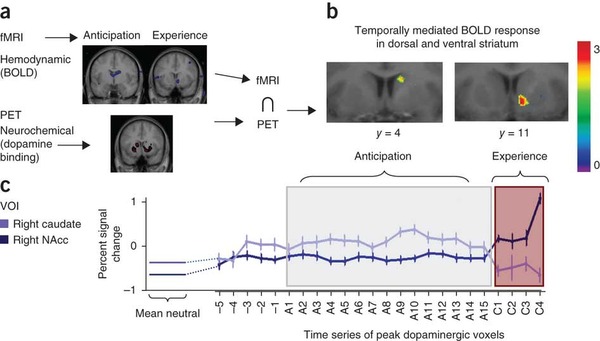
Because the scientists were combining methodologies (PET and fMRI) they were able to obtain a precise portrait of music in the brain. The first thing they discovered (using ligand-based PET) is that beautiful music triggers the release of dopamine in both the dorsal and ventral striatum. This isn’t particularly surprising: these regions have long been associated with the response to pleasurable stimuli. The more interesting finding emerged from a close study of the timing of this response, as the scientists looked to see what was happening in the seconds before the subjects got the chills.
I won’t go into the precise neural correlates – let’s just say that you should thank your right nucleus accumbens the next time you listen to your favorite song – but want to instead focus on an interesting distinction observed in the experiment:

fMRI and PET results,

In essence, the scientists found that our favorite moments in the music – those sublimely beautiful bits that give us the chills – were preceeded by a prolonged increase of activity in the caudate, the same brain area involved in curiosity. They call this the “anticipatory phase,” as we await the arrival of our favorite part:

Immediately before the climax of emotional responses there was evidence for relatively greater dopamine activity in the caudate. This subregion of the striatum is interconnected with sensory, motor and associative regions of the brain and has been typically implicated in learning of stimulus-response associations and in mediating the reinforcing qualities of rewarding stimuli such as food.

In other words, the abstract pitches have become a primal reward cue, the cultural equivalent of a bell that makes us drool. Here is their summary:

The anticipatory phase, set off by temporal cues signaling that a potentially pleasurable auditory sequence is coming, can trigger expectations of euphoric emotional states and create a sense of wanting and reward prediction. This reward is entirely abstract and may involve such factors as suspended expectations and a sense of resolution. Indeed, composers and performers frequently take advantage of such phenomena, and manipulate emotional arousal by violating expectations in certain ways or by delaying the predicted outcome (for example, by inserting unexpected notes or slowing tempo) before the resolution to heighten the motivation for completion.

While music can often seem (at least to the outsider) like an intricate pattern of pitches – it’s art at its most mathematical – it turns out that the most important part of every song or symphony is when the patterns break down, when the sound becomes unpredictable. If the music is too obvious, it is annoyingly boring, like an alarm clock. (Numerous studies, after all, have demonstrated that dopamine neurons quickly adapt to predictable rewards. If we know what’s going to happen next, then we don’t get excited.) This is why composers introduce the tonic note in the beginning of the song and then studiously avoid it until the end. They want to make us curious, to create a beautiful gap between what we hear and what we want to hear.

To demonstrate this psychological principle, the musicologist Leonard Meyer, in his classic book Emotion and Meaning in Music (1956), analyzed the 5th movement of Beethoven’s String Quartet in C-sharp minor, Op. 131. Meyer wanted to show how music is defined by its flirtation with – but not submission to – our expectations of order. To prove his point, Meyer dissected fifty measures of Beethoven’s masterpiece, showing how Beethoven begins with the clear statement of a rhythmic and harmonic pattern and then, in an intricate tonal dance, carefully avoids repeating it. What Beethoven does instead is suggest variations of the pattern. He is its evasive shadow. If E major is the tonic, Beethoven will play incomplete versions of the E major chord, always careful to avoid its straight expression. He wants to preserve an element of uncertainty in his music, making our brains exceedingly curious for the one chord he refuses to give us. Beethoven saves that chord for the end.

According to Meyer, it is the suspenseful tension of music (arising out of our unfulfilled expectations) that is the source of the music’s beauty. While earlier theories of music focused on the way a noise can refer to the real world of images and experiences (its “connotative” meaning), Meyer argued that the emotions we find in music come from the unfolding events of the music itself. This “embodied meaning” arises from the patterns the symphony invokes and then ignores, from the ambiguity it creates inside its own form. “For the human mind,” Meyer writes, “such states of doubt and confusion are abhorrent. When confronted with them, the mind attempts to resolve them into clarity and certainty.” And so we wait, expectantly, for the resolution of E major, for Beethoven’s established pattern to be completed. This nervous anticipation, says Meyer, “is the whole raison d’etre of the passage, for its purpose is precisely to delay the cadence in the tonic.” The uncertainty – that crack in the melody – makes the feeling.

Why the feeling of beauty is useful

What I like about this speculation is that it begins to explain why the feeling of beauty is useful. The aesthetic emotion might have begun as a cognitive signal telling us to keep on looking, because there is a pattern here that we can figure out it. In other words, it’s a sort of a metacognitive hunch, a response to complexity that isn’t incomprehensible. Although we can’t quite decipher this sensation – and it doesn’t matter if the sensation is a painting or a symphony –the beauty keeps us from looking away, tickling those dopaminergic neurons and dorsal hairs. Like curiosity, beauty is a motivational force, an emotional reaction not to the perfect or the complete, but to the imperfect and incomplete. We know just enough to know that we want to know more; there is something here, we just don’t what. That’s why we call it beautiful.”

 Jonah Lehrer, American journalist who writes on the topics of psychology, neuroscience, and the relationship between science and the humanities, Why Does Beauty Exist?, Wired science, July 18, 2011

As The Spirit Wanes, or The Hope of Plasticity

“As the spirit wanes, the form appears.”

I first came across these words four years ago, in the art blog of a dear friend. I’ve been in love with Charles H. Bukowski ever since. Though his lifestyle was not one I’d recommend, I cannot convey the number of times I found him not only utterly poignant, but encouraging.

When I began this blog, I promised to explain why I chose those specific words as my title. I suppose the “form” is finally fighting its way to the surface. There is no decorative or esoteric way to say this: the past few months have been the most challenging of my life. I never imagined that so many diverse manifestations of loss and grief existed. During the two weeks leading to August, I lost three separate individuals, all whom I loved very deeply. My father’s death has been the most horrifying by far.

During his final weeks in the oncology ward, I witnessed quite a few examples of how people deal with fear, pain and grief: often to a paralyzing extent. I’ll always remember Kay, the beautiful old woman staying with her husband in the room next to my dad’s. I must have walked past her room twenty times before I found the courage to say hello, and offer her a hug and condolences. We spoke a few times during my stay-why is it so hard, we wondered, to just let go? Love and death are the two most naturally-occurring phenomena we can know, and yet they never fail to leave us cold and nearly unable to breathe.

So why Music psychology? Why neuroscience or philosophy? Why “as the spirit wanes?” Though I experienced a good deal of physical and mental pain in the last year, I feel as if I have almost been numb a vast portion of the time. A sort of desperate numbness, to be sure, but numbness nevertheless. I was unaware of the potential for evolution, development, and vitality all around me. I do not know what’s happened, but then I suppose I do. My spirit has never been so broken, so trampled, or terrifically damaged. I have not been myself the past year, and I’m ready for it to change. The concepts I have recently come to grasp not only allow but demand for revolution such as this.

I’ll never forget during my junior year of college, I was required to take a philosophy course. I dreaded it beyond all else. Though my mother had given me exposure to Jungian psychology from the cradle, in terms of philosophy, I felt my brain just might not “work” that way.

However, within a day of the class I was addicted and desperate for more. I had been re-exposed to the most basic form of existentialism: if we are responsible for our actions, we also then have the freedom not only to choose, but to transcend. As someone who’d grown up alongside the great crusade of mania and depression, this was news to me. What did they mean, I could choose? Though I’d eventually declined, I’d once been told I might benefit from medication to control depression and emotionally-destructive impulses. Medication or not: for the very first time in my life, I found a freedom to transcend my demons: psychical, neural and emotional. I certainly felt and digested emotion in much the same way, but with a unique freedom in my reaction to discord. I was no longer bound in paralyzation or fear. A couple of years later, I have once more found a like freedom, only infinitely more radical in the concept of Brain Plasticity.

As this dares reach too long a confession, I shall save the specifics of why I have found hope in Neuroscience, plasticity and its potential courtship with music for future posts. But what I have learned, and lived, is this: As the spirit wanes, the form appears. It is truly when we are beaten near beyond the point of recognition that we are then forced to give up, or forced to continue. Inertia demands not only motion, but action; consciousness. One may remain static for only so long. I choose to go forward. We can no longer think of our brains, our neuronal selves, as but flexible and anonymous; as machine. We must affirm our capacity for change and confess our plasticity: evolutionary, adaptive, explosive. We must no longer consent to depression via disaffiliation; to be “blind to our own cinema.” Our brains tell us a story-whether we choose to listen or not. Karl Marx once stated “Humans make their own history, but they do not know that they make it.” And why not? What type of fear or unknown is stopping us from this earth-shattering consciousness of what our brains can do?

I will continue soon in conjunction with a more formulated response to Catherine Malabou’s pioneering work, “What Should We Do with Our Brain?” in speculation of a metaphorical and ideological critique of plasticity.

“…At bottom, neuronal man has not known how to speak of himself. It is time to free his speech.” -Catherine Malabou

The Artist’s Unconscious, The Metaphor of Birth and Waking Life

Every now and again during the inevitable agony of cultivating, constructing, and evaluating the creative process, the artist finds they’ve become “stuck.” Trapped in the limbo of their piece, somewhere between conception and establishment, they are striving for the “release” of sorts. Just as the actor or musician diligently prepares for a performance, somewhere between the realization and the execution, everything we’ve known and bred must be let go with the wind. This concept can seem painfully simple, cliché and worst of all, beaten to death. I can assure you, it is not the rudimentary discussion you might think.

It’s a beyond well-known fact that we as evolving humans use a shamefully small percentage of our potential intellect and brain-function capacity*; but how do we relate this to our unconscious? From beginning to end in the creative journey, how often do we actually realize to rely on and draw from unseen layers?

In this more in-depth analysis, Dr. Cheryl Arutt gives a fascinating discussion of the artist and the unconscious using the metaphor of birth that is truly carried out to the end. This article may be found here.

*Note: I am not trying to give way to the common myth that we only use ten percent of our brain (Beyerstein, 1999). However, we have approximately 100-150 billion neurons in our brain, with each neuron connecting to about 10,000 others. If every single neuron connected with every single other neuron, our brain would be roughly 12.5 miles in diameter (Nelson and Bower, 1990) and close to the size of London.

Channeling Emotional Intensity in the Creative Artist

Thanks to Cheryl Arutt for one of the best, most easily accessible articles I’ve seen on channeling pain in the artist, including some brief (albeit great) insight into the chemical process that stimulates fight-or-flight syndrome. Find it here.

WRAMTA Annual Conference

The American Music Therapy Association (Western Region Chapter) will be holding their annual conference in Long Beach this year. While many of the seminars look to be strictly music therapy (and less my cup of tea), the last CMTE course offered on the cognitive processing of music, emotions and pain looks to be grounded strongly in psychiatric studies and scientific research.

CMTE 6: Music, Pain, and the Brain: Research Developments and Music Therapy Applications Vanya Green, MA, MT-B

View conference program and information

2011 Annual Conference

Long Beach, CA Mar 31 – Apr 2

The Queen Mary Hotel

Institutes & CMTEs

Mar 29 – 31, Apr 3

Passages Conference Apr 3

The Queen Mary Hotel