Rev Neurol 2014 Mar 1;58(5):207-12
Musical hallucinations: perpetual music Hospital Donostia, 20014 San Sebastian, Spain
Musical hallucinations are a kind of auditory hallucinaion that are prevalent among the non-psychiatric population, but which have rarely been reported in the neurological literature. They occur most frequently in the elderly, in females and when there is a loss of hearing, but their pathophysiology has still to be unravelled.. We report here six cases (five females and one male) of musical hallucinations diagnosed in a general neurology clinic over a time-span of five years. In five cases there was also concurrent hypoacusis, to a greater or lesser extent, and one had been triggered by pentoxifylline. In most instances, the musical content of the hallucinations had its origins in music experienced in childhood and early youth. In the cases submitted to pharmacological treatment, the response was poor. Yet, after explaining to the patients that the condition was benign and had no connection with a psychotic pathology, the degree of acceptance of the symptoms was good. Musical hallucinations are a little-known pathology lying on the borderline between neurology, otorhinolaryngology and psychiatry which are often wrongly linked to mental disease. It is essential to explain to patients and relatives that these symptoms are not necessarily of a psychiatric nature, and to be aware of the potential capacity of some commonly used drugs to generate them.
Per gli Italiani:
Le allucinazioni musicali sono un tipo di allucinazione uditiva prevalente nella popolazione non psichiatrica, ma che raramente vengono riportate nella letteratura neurologica. Si manifestano in prevalenza nelle persone anziane, soprattutto donne, quando vi sia una perdita dell’udito, ma la loro fisiopatologia resta ancora oggi poco chiara. In questo studio gli Autori riportano 6 casi (5 donne e un uomo) di soggetti affetti da allucinazioni musicali diagnosticate in una clinica di neurologia generale in un periodo di cinque anni. In 5 casi i pazienti presentavano anche ipoacusia di grado variabile, in un caso scatenata dalla pentoxifillina. Nella maggior parte dei casi il contenuto musicale delle allucinazioni consisteva nell’udire musica relativa al periodo dell’infanzia o dell’adolescenza. Nei casi trattati farmacologicamente, la risposta è stata scarsa. Dopo che è stato spiegato ai pazienti che il sintomo era benigno e non aveva alcuna connessione con una patologia psicotica, il grado di accettazione dei sintomi è stato buono. In conclusione, le allucinazioni musicali sono una patologia poco conosciuta che si inserisce in un contesto borderline tra la neurologia, l’otorinolaringoiatria e la psichiatria, e viene spesso erroneamente associata ai disordini mentali. È essenziale spiegare ai pazienti e ai loro parenti che questi sintomi non sono necessariamente di natura psichiatrica, e tenere in considerazione il fatto che possono essere sollecitati da molti farmaci di uso comune.
Listening to sad music in adverse situations: How music selection strategies relate to self-regulatory goals, listening effects, and mood enhancement
Annemieke J.M. Van den Tol, School of Psychology, University of Kent, Keynes E-105, Canterbury, CT2 7NP, UK. Email: A.J.M.van-den-Tol@kent.ac.uk
Abstract
Adults’ (N = 220) reported motivations for listening to sad music after experiencing adverse negative circumstances were examined by exploring how their music selection strategies related to (a) their self-regulatory goals, and (b) reported effects of listening. The effects of music selection strategies, self-regulatory goals, and reported effects on the achievement of mood enhancement were also explored using a retrospective survey design. The findings indicate that music choice is linked to the individual’s identified self-regulatory goals for music listening and to expected effects. Additionally, the results show that if individuals had intended to achieve mood enhancement through music listening, this was often achieved by first experiencing cognitive reappraisal or distraction. The selection of music with perceived high aesthetic value was the only music selection strategy that directly predicted mood enhancement. Where respondents indicated that they chose music with the intention of triggering memories, this was negatively related to the self-regulatory goal of mood enhancement.
Source: neurosciencenews.com, Psychology of Music (SAGE)
Eckart Altenmüller1*, Susann Siggel1, Bahram Mohammadi2,3, Amir Samii3 and Thomas F. Münte2
1Institute of Music Physiology and Musicians’s Medicine, University of Music, Drama and Media, Hannover, Germany
2Department of Neurology, University of Lübeck, Lübeck, Germany
3CNS Laboratory, International Neuroscience Institute, Hannover, Germany
Background: Music can elicit strong emotions and can be remembered in connection with these emotions even decades later. Yet, the brain correlates of episodic memory for highly emotional music compared with less emotional music have not been examined. We therefore used fMRI to investigate brain structures activated by emotional processing of short excerpts of film music successfully retrieved from episodic long-term memory.
Methods: Eighteen non-musicians volunteers were exposed to 60 structurally similar pieces of film music of 10 s length with high arousal ratings and either less positive or very positive valence ratings. Two similar sets of 30 pieces were created. Each of these was presented to half of the participants during the encoding session outside of the scanner, while all stimuli were used during the second recognition session inside the MRI-scanner. During fMRI each stimulation period (10 s) was followed by a 20 s resting period during which participants pressed either the “old” or the “new” button to indicate whether they had heard the piece before.
Results: Musical stimuli vs. silence activated the bilateral superior temporal gyrus, right insula, right middle frontal gyrus, bilateral medial frontal gyrus and the left anterior cerebellum. Old pieces led to activation in the left medial dorsal thalamus and left midbrain compared to new pieces. For recognized vs. not recognized old pieces a focused activation in the right inferior frontal gyrus and the left cerebellum was found. Positive pieces activated the left medial frontal gyrus, the left precuneus, the right superior frontal gyrus, the left posterior cingulate, the bilateral middle temporal gyrus, and the left thalamus compared to less positive pieces.
Conclusion: Specific brain networks related to memory retrieval and emotional processing of symphonic film music were identified. The results imply that the valence of a music piece is important for memory performance and is recognized very fast.
Received: 29 April 2013; Accepted: 27 January 2014;
Published online: 18 February 2014.
This pilot study examined, whether long-term exposure of psychiatric patients to music that was individually adapted to brain rhythm disorders associated with psychoticism could act to ameliorate psychiatric symptoms. A total of 50 patients with various psychiatric diagnoses were randomised in a 1:1 ratio to listen to CDs containing either music adapted to brain rhythm anomalies associated with psychoticism – measured via a specific spectral analysis – or standard classical music. Participants were instructed to listen to the CDs over the next 18 months. Psychiatric symptoms in both groups were assessed at baseline and at 4, 8 and 18 months, using the Brief Symptom Inventory (BSI). At 18 months, patients in the experimental group showed significantly decreased BSI scores compared to control patients. Intriguingly, this effect was not only seen for symptoms of psychoticism and paranoia but also for anxiety, phobic anxiety and somatisation. Exposure to the adapted music was effective in ameliorating psychotic, anxiety and phobic anxiety symptoms. Based on the theories of neuroplasticity and brain rhythms, it can be hypothesised that this intervention may be enhancing brain-rhythm synchronisation and plasticity in prefrontal-hippocampal circuits that are implicated in both psychosis/paranoia and anxiety/phobic anxiety.
Per gli Italiani:
Questo studio pilota esamina se l’esposizione a lungo termine di pazienti psichiatrici alla musica, adattata ai disordini del ritmo cerebrale associati con la psicosi, possa servire a migliorare i sintomi psichiatrici. Cinquanta pazienti con diagnosi psichiatriche di vario tipo sono stati assegnati in modo randomizzato a due gruppi e sottoposti a due condizioni sperimentali. Un gruppo ascoltava CD contenenti musica adattata alle anomalie cerebrali associate con la psicosi (misurate con analisi spettrale specifica), mentre l’altro ascoltava musica classica standard. Ai partecipanti è stato chiesto di ascoltare la musica per i successivi 18 mesi. I sintomi psichiatrici sono stati indagati in entrambi i gruppi prima dello studio e dopo 4, 8 e 18 mesi usando il test Brief Symptom Inventory (BSI). Dopo 18 mesi, i pazienti del gruppo sperimentale mostravano un punteggio BSI significativamente diminuito rispetto ai soggetti di controllo. Interessante osservare che questa diminuzione non è stata riscontrata solo per sintomi di psicosi e paranoia, ma anche per l’ansia, le fobie e la somatizzazione. Basandosi sulle teorie di neuroplasticità e dei ritmi cerebrali, gli Autori ipotizzano che questo intervento possa aumentare la sincronizzazione dei ritmi cerebrali e la plasticità dei circuiti prefrontali-ippocampali coinvolti sia nella paranoia, sia nella psicosi/paranoia, sia nell’ansia/fobia.
I have a dear friend (we’ll call him Nathan). Though I haven’t seen him in years, we keep in touch as much as life’s seeming entropy permits. I met Nathan in college when I began voice lessons and needed an accompanist. As proved typical for me, I simply looked for the most dashing, accomplished pianist available to join me in practicing my Italian arias and favorites from Phantom. Though young, Nathan was a great musician, and though our personalities couldn’t be more opposite, I held a great amount of respect for him.
One day, a curious thing happened. I was driving on my way to school after grabbing coffee when I saw Nathan walking down the road about a mile out. I was already nearly late to class, so I rolled down my window and offered him a ride. When I became close enough to see his face, I understood immediately that Nathan would not be joining us in World History that day. We awkwardly mumbled something to each other, he declined the ride, and I reluctantly kept going. When I arrived in class, I discreetly explained to the professor that though I was unsure of the cause, something was very wrong with Nathan, and he would be absent for the day.
As time passed, Nathan and I became inseparable. As I was a couple years his senior and lived off campus, it became the unsaid ritual that after choir, we’d grab food. After ensemble, I’d kidnap him to Starbucks so he could tease me as I refused to budge until I had studied for my philosophy class for no less than 4-6 hours at a time. He tried to help me in music theory, and I tried to help him gain confidence in singing. Although like many pianists, he had a lovely but timid singing voice, I really never heard it until recently – some five years after meeting him.
A year or so into our friendship, Nathan transferred to a college back home. I was devastated, as I had lost my best pal. Who was I going to call for a long drive to do nothing but sit in silence and listen to Radiohead’s Videotape over and over when it felt like my existential world of faith was caving in? Who was going to teach me the rest of the Mendelssohn piece (by ear, mind you, as I refused to read the sheet music at the time)? Who was going to roll his eyes at me when I showed off in the ear training portion of collegiate, or play Chopin’s Fantasie Impromptu for me as only he could? I didn’t know. I eventually made new friends, but the uniting factor that brought us together was a bond so strong it was never replaced, and has never faded. The type of bond that although we haven’t seen each other in four years, he remains available for my call anytime, day or night, and I for his. That bond is the blinding desolation of loss, and the dogged, unyielding courage of resilience.
When Nathan tragically lost one of his best friends the day I found him slowly trodding down the side of the road, I somehow knew. Though up to that point, I’d only lost a few people in my life, I was no stranger to loss of the purest kind. As Nathan and I grew closer, we grew to develop a stronger empathy for one another – many demons that plagued him also plagued me, and sadly, the young friend Nathan lost that day was not the first, and would not be the last. Although the friend I lost to cancer at age 18 was nothing short of heartbreaking, it could not prepare me for the following loss of my gran, my father, and a dear friend taken far too young just last summer.
I have never written about that friend publicly, but as he was loved by so many, it was a terrible loss. I had shared many a silly, procrastinating evening listening intently to his outlandish stories in college, and have been affected in so many positive ways by his compassionate charisma. When I got the news, I knew outside of his family and immediately local friends, telling Nathan would prove the toughest, as it seems he is cruelly losing a loved one every time I turn around. I believe it is because of this, however, that we have remained the strongest of allies. There is no more universal plight than death, and a multitude of historical events simply show that trial, grief and hopeful resilience simply bring people together.
A couple of weeks ago, Nathan sent me his cover of a Say Something (A Great Big World feat. Christina Aguilera) with little explanation other than “Listen to this if you will – you can’t imagine the day I’ve had, and I’m sorry my voice is frail but this holds a lot of personal significance to me.” I received the email mid-lessons, and only remembered to put it on right before pulling into my apartment for the night. I figured I would hear a few moments, and then replay it later on when settled. However, for whatever reason, from the split second I heard the first four solo notes in complete isolation, I knew this was going to be a tough listen. As the song opened and the words “Say something, I’m giving up on you” fell from his mouth, my heart jumped to my throat. Nathan was currently going through a loss of the worst kind, and I knew immediately the type of “day” he had been referring to.
As the song played on, it fastly became one of those pieces you never forget the first time hearing. It was also the first time I’d truly heard Nathan sing, and it was beautiful, captivating, and utterly devastating. Surrounded by the common and simple vi IV I V progression, his voice radiated of pain and brokenness, but also of survival – he had recorded it, after all. After sitting stunned for what felt like ages, I went inside, dropped my books on the floor, immediately pulled up the lyrics for the song, played, recorded and sent the first portion of the song back to him.
Though the song was poignant and evocative then, it passed into vague memory until quite recently. I lost something myself, this time, that left me feeling like nothing more than a bewildered little girl hiding under the bed. As I wandered aimlessly around my apartment that evening, I remember the song Nathan had sent me, and the words came rushing back in my head like a merciless yet somehow relieving migraine. I made myself a cup of coffee to brave the chill of three in the morning out on my balcony, put my headphones on, and watched the video to Say Something for the first time. Maybe the most surprising thing was not even the almost at once literal depiction of the little girl hiding under the bed (a harsh but tender parallel indeed) but that the song depicted more than one type of loss. The two lovers, the scared, sad child, and the elderly man mourning his fading wife on her deathbed. I do not know what it is about such a simple song – maybe the slight, fleetingly frozen dissonance in the V chord, or maybe the emotion with which it is performed, but that song somehow brought to life everything that I could not.
I’ve since spoken to various people about the song’s effect, and have heard only the most positive things. “My boyfriend and I split this morning, and this song just helps me feel.” “I’m moving to a new city by myself, leaving all my friends behind, and I can’t stop listening to it.” “My dog died recently, and I know it’s silly, but it’s so pretty that it soothes me.” I also caught the video that recently went viral of the young boy moved to tears by the pop ballad. Though the dad was wise enough to request the ‘thumbs up’ to confirm the little guy was okay, 4-year-old Jackson was clearly and utterly moved by the music, as assuredly so many others around the globe have been. Does the young child have the capacity to intuitively understand what’s going on in the song or in his brain to evoke such elicit feelings of sadness? I don’t know. What I do know, is when the father provided the option to change the song, Jackson objected – he wanted to hear it.
Why is it that circumstances of loss and turmoil unite us so? Why is Banksy’s girl with the red balloon (always just out of reach) a personal favorite of thousands? Why was Adele’s Someone Like You a global affective phenomenon? Why was I glued to my phone and laptop nearly every moment of the Egyptian revolution a couple years ago? Why it is that Nathan and I always know exactly what to say to each other (which is often little more than solidarity’s knowing silence) when something dreadful happens? And above all, why does it so frequently involve or resort to music? Can music truly heal? I know it can, because I am a living attestation.
To speak plainly, sometimes the events of our lives can leave us feeling shattered in tiny pieces, strewn so haphazardly across the floor that Heaven only knows how or when we’ll find the strength to put them back together. Unfortunately, all the psychiatric drugs, diversions of the city, yoga classes and mindfulness apps in the world remain unable to glue us back together all at once. No, the process of feeling whole again can sometimes seem long, arduous and even hopeless. But if we make a little progress as often as we are able, slowly those little shards of who we are will begin to soften back into place, and the stiff and aching joints of defeat will begin to piece back together in a strengthened empathy and love. I am convinced now more than ever that music can be one of the most compassionate and brutal yet tender healers. I am overwhelmed with learning more of how this may be possible, and I intend to continue reporting my findings along the way.
Though we may always be able to see those little lines of glue reminding us of the time we nearly fell apart, healing is possible, and there is hope to be found.
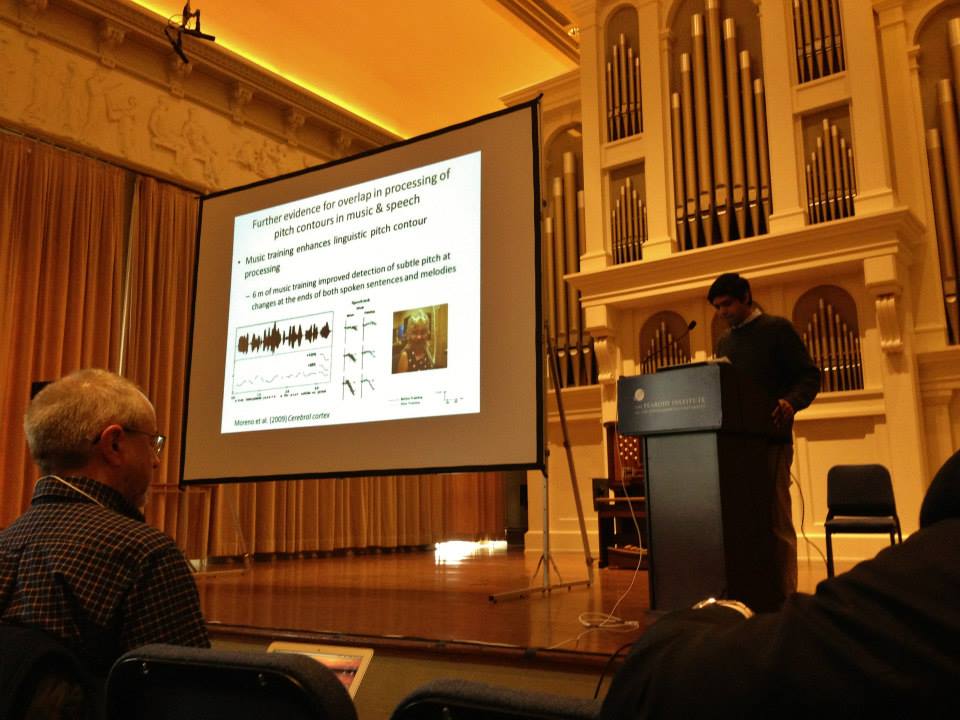
Friday commenced with the morning keynote delivered by Dr. Ani Patel, entitled Does instrumental musical training enhance the brain’s processing of speech? In Patel’s articulate and informative lecture, he began by drawing our attention to the following: “Music and language have important connections as cognitive and neural systems, and that has implications for theoretical debates about how the mind is organized – for evolutionary studies on the origins of these abilities, and practical issues about remediation of language disorders” (Patel, 2014). Though the parallels in music and language are less novel on account of the publication of his 2008 book Music, Language and the Brain, the implications of instrumental training lending to developments in language and speech are very much so. In conclusion, operating with his extended OPERA hypothesis, Patel emphasizes that regardless of the varying direction and debates these studies may undergo, “Comparative music and language research really does deepen our understanding of human communication.” (Patel, 2014).
Dr. Elizabeth Tolbert spoke next, providing an evolutionary perspective in Music, Meaning and Becoming Human. Approaching the co-evolution of music, meaning and social intelligence, Tolbert addressed music as a behavior, not object; of possessing a social ontology, and its implicational model as derived from social interaction, shared intentionality and social intelligence. Her overarching thesis states “the story of becoming human is the story of the development of a specifically human type of meaning rooted in social intelligence, and one that likely has its origins in proto-musical behavior.” (Tolbert, 2014).
Dr. Ian Cross’s lecture entitled Music, Participation and Interaction further expanded on the day’s existing idea of music not only as a “practice composed by the few and consumed by many,” but as the encompassment of interactive processes far beyond a role of abstract structures, symbolic realms or lofty themes. As uniquely flexible and socially cooperative creatures, humans are capable of utilizing music as not only a mode of communicating information and ideals, but at times as phatic organisms. Cross went on to explain with conviction that if this theory were more widely considered, the insinuation might result in music being given the proper chance to utilize it’s more pragmatic magic in resolving social uncertainties (and thus social anxiety), provide powerful effects on memory and social attitude, and “provide us with new perspectives on the investigation of music beyond the bounds of Western culture” (Cross, 2014).
The second keynote, Losing the Beat: A New Window on Human Rhythm was given Dr. Isabelle Peretz (University of Montreal). Peretz has published over two hundred and fifty five scientific papers regarding everything from perception, emotion and memory to singing and dancing. In Losing the Beat, Peretz explained that a defining characteristic of human interaction with music is “the identity and ability to move to the beat.” Although this universal faculty is typically formed early in life, her recent research shows that some individuals suffer from the inability to synchronize with beats in music. This disorder is referred to as beat deafness, a new form of congenital amusia. In her presentation, Peretz conveyed a strong sensibility for the cause of studying musical disorders in regard to “reverse-engineering of the musical brain” (Peretz, 2014).
Later in the afternoon, Andrea Halpern took the floor to share her work on auditory imagery, and to describe her study examining the neural loci of imagined music. Halpern is a pioneer in her long-standing devotion to the field from early in its development. She has contributed fundamental work on memory and perception of musical structure, including studies on earworms and the persistence of musical memories), effects of timbre and tempo change, and perception of emotion in sounded and imagined music. In her presentation Auditory Imagery: Linking Internal and External Music, Halpern presented the argument that although internal and external music experiences are distinctive encounters, they share a number of important similarities, which both musicians and nonmusicians can exploit to enhance the musical experience.
Photo 1 – Diana Hereld
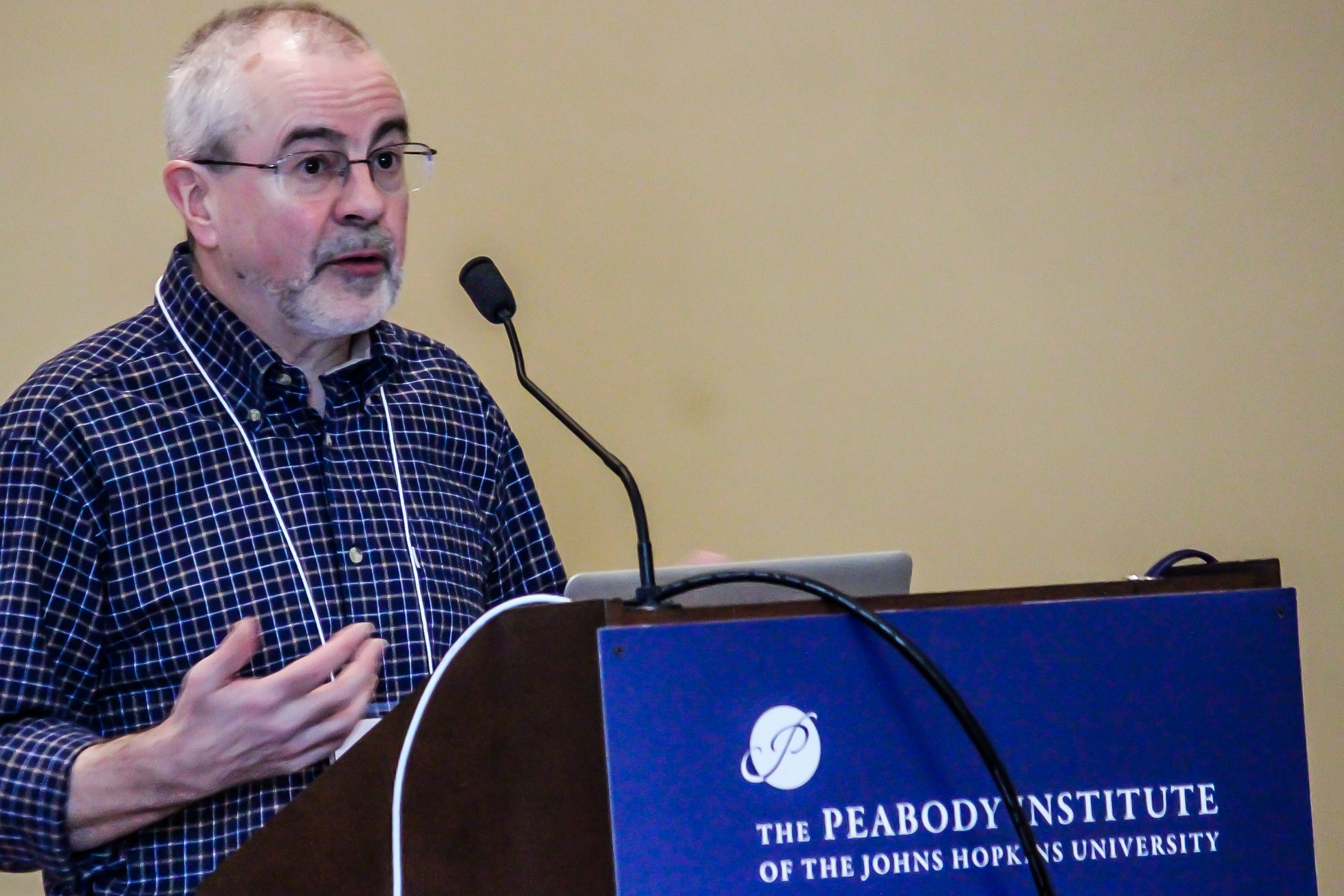
Photos 2, 3 – Scott Metcalfe
Note: I must include an apology for the delay in reporting on the conference this weekend. I simply found myself so wonderfully overwhelmed with information (but overwhelmed regardless) that I was unsure how to encapsulate the day’s culmination of so many brilliant minds in presentation of their most recent work. As a result, I’ve decided to report individually on each of them in the near future. A few other outlets have picked up specific coverage, and I will advise as those are released. I will also be sharing a summation of the conference’s concluding rountable featuring the speakers and performers, which was truly a thing to behold.
Apart from the seventy (yes, seventy) degree temperature shock going from Los Angeles to Baltimore, I had a wonderful evening at the opening of the Music, Mind and Meaning conference at the Peabody Institute. The evening began with rousing introductions all around, and I was wonderfully honored to finally meet some of my favorite scholars face to face.
At 7pm, Dr. David Huron took the floor for the keynote address. In his talk, “Emotions and Meanings in Music, he posed the question, “In what ways can music convey meaning?” Songs have lyrics, works have evocative titles, but most of music’s meaning comes from other sources including:
Cultural schemas
Learned expectations
Personal associations
In his over sixty minute presentation, Huron covered everything from how musical associations become universal cultural icons, to the psychoacoustics of intimacy (which contained brilliant perspectives I had never visualized), to an explicitly detailed account of how ethologists differentiate between signals versus cues, and what we can take from learning about hostile versus friendly behavior in animals to musical studies. Since my arrival, I’ve listened to one out of nine lectures, and am, at present, blown away. Let’s just say this: you know it’s good when you have world-class academics on either side murmuring in awe at what is being presented. I look very forward to recounting the full presentation when time permits.
Following Dr. Huron’s talk, a duo took the stage like I haven’t quite seen before. I’d venture it’s not uncommon, but when Grammy-nominated pianist and composer (and MacArthur genius fellowship recipient) Vijay Iyer improvises a single-song performance – for thirty-five minutes nonstop – one listens. Joined by Gary Thomas (Director of Jazz Studies, Peabody) on the saxophone followed by flute, the enigmatic chemistry that was created simply devoured the room like a thick trance. One of my favorite enigmas of the evening was simply glancing down the two rows of conference speakers to see who was bobbing side to side, or front to back; the eyes that were closed or engaged, or (my favorite) watching the woman who periodically plugged her ears as if to reimagine what she had just heard.
The evening closed with a reception lasting well past eleven in the Peabody library. Accompanied by a presentation of the exhibit from the personal collection of Eugene S. Flamm, the final talk included introducing some of the very oldest texts surrounding neurosurgery and the cradle of medicine known to exist. I look very forward to the continuance and development of the conference tomorrow morning.
In honor of the approaching Music, Mind and Meaning conference held at The Peabody Institute, I’d like to take a look into the work of a few select speakers. Dr. David Huron is a professor at Ohio State University where he researches in the field of music cognition. As his current research interest focuses on the ways in which music evokes emotion, I have found his unique exploration of cognitive science of particular interest.
I’d like to briefly visit a presentation given by Dr. Huron at the University of California, Berkeley in 1999 from the Ernest Bloch lectures entitled An Instinct for Music: Is Music an Evolutionary Adaptation? Within this talk, Dr. Huron provides an informative social account in regard to the origins of music specifically linked to the theory of evolution by natural selection.
As many originally Darwinian theories remain among the most resiliently powerful known bodies of work, it would seem prudent to apply these ideals to not only the physiological, but psychological (and thus emotional) realms. Evolution has affected far more than objective, corporeal progress. When we feel, we become alive. Huron makes a great point in that we “love life, fear death, and nurture our children” [1] as any person or group lacking these characteristics would compromise` their capacity for survival.
He then goes onto question: Does music have survival value? As many human behaviors are connected to endurance, it is only fitting to include those of music in addition. Any human manner that “enhances survival and procreation” should be taken into account. Although the answer to this question is obviously heavily disputed by intellectuals like Karl Popper, Antonio Damasio, Ani Patel and Steven Pinker (although I tend to strongly disagree with the latter), Huron argues that music’s unique presence in our lives remains an inquiry of just pursuit.
However, in the quest to extend a musical history, it is essential to recognize and take our current limitations into account. Although post hoc theories may eventually become a priori, one must exercise caution in jumping on one of the two bandwagons, which Huron introduces as
A) Music as a form of non-adaptive pleasure seeking or
If we look at some non-adaptive pleasure-seeking (NAPS) behaviors, the first examples that come to mind are food, and sex. Although these behaviors have specifically evolved to provide pleasure reward and thus encourage continuance, they may also be carried out in ways that do not directly pertain to survival. Where, then, does musical creation and enjoyment fall? To elucidate an “NAPS Theory of Music,” Huron states the following:
“If music itself has no survival value (and merely exploits an existing pleasure channel) then any disposition towards musical behaviors would tend to worsen one’s survival. Spending inordinate amounts of resources (such as time and money) on music might be expected to place music-lovers at an evolutionary disadvantage. In other words, if the NAPS Theory of Music is true, then we might predict that music appreciation would be correlated with marginal existence: as in the case of alcohol, people on “skid row” might be expected to be disproportionately music enthusiasts.
“If music is non-adaptive, then the likelihood is that music is a modern invention; otherwise music-lovers would have become extinct some time ago. As we will see, the archaeological evidence indicates that music is very old — much older than agriculture — and this great antiquity is inconsistent with music originating as a non-adaptive pleasure-seeking behavior. In short, there is little evidence that musical behaviors have been selected against. All of this suggests that there is little support for the NAPS Theory of Music.”
Huron goes on to describe several evolutionary theories of music: mate selection, social cohesion, group effort, auditory development, conflict reduction, safe time-passing, and transgenerational communication (mnemonic verse set to music, folk ballads, etc). In addition, one may consider a few of the varying types of currently consultable evidence: biological, biochemical (for example, pleasure mechanisms found in the release of endorphins that stimulate the brain’s opiate receptors), archeological, anthropological, ethological (in the studying of particular animal behaviors) and psychological. It is the final realm that I choose to focus on above all, and I’m very excited to move toward his views on social bonding and hormones, oxytocin and the underlying biology of social bonding, and most critical to my own interests: music and mood regulation.
Though it is evidentially apparent that music has revealed its antiquated roots far beyond what was once widely accepted, much remains to be said concerning the various hypotheses and evolutionary facets. I look very forward to sharing more of what I learn from Dr. Huron in his work and lecture later on this week.
[1] Huron, D. 1999, September. Is music an evolutionary adaptation. The Ernest Bloch Lectures. Lecture conducted from Music Department, University of California, Berkeley.
January 23, 2014—SILVER SPRING, MD— The American Music Therapy Association (AMTA) supports music for all and applauds the efforts of individuals who share their music-making and time; we say the more music the better! But clinical music therapy is the only professional, research-based discipline that actively applies supportive science to the creative, emotional, and energizing experiences of music for health treatment and educational goals. Below are a few important facts about music therapy and the credentialed music therapists who practice it:
Music therapists must have a bachelor’s degree or higher in music therapy from one of AMTA’s 72 approved colleges and universities, including 1200 hours of clinical training.
Music therapists must hold the MT-BC credential, issued through the Certification Board for Music Therapists, which protects the public by ensuring competent practice and requiring continuing education. Some states also require licensure for board-certified music therapists.
Music Therapy is an evidence-based health profession with a strong research foundation.
Music Therapy degrees require knowledge in psychology, medicine, and music.
These examples of therapeutic music are noteworthy, but are not clinical music therapy:
A person with Alzheimer’s listening to an iPod with headphones of his/her favorite songs
Groups such as Bedside Musicians, Musicians on Call, Music Practitioners, Sound Healers, and Music Thanatologists
Celebrities performing at hospitals and/or schools
A piano player in the lobby of a hospital
Nurses playing background music for patients
Artists in residence
Arts educators
A high school student playing guitar in a nursing home
A choir singing on the pediatric floor of a hospital
Finally, here are examples what credentialed music therapists do:
Work with Congresswoman Giffords to regain her speech after surviving a bullet wound to her brain.
Work with older adults to lessen the effects of dementia.
Work with children and adults to reduce asthma episodes.
Work with hospitalized patients to reduce pain.
Work with children who have autism to improve communication capabilities.
Work with premature infants to improve sleep patterns and increase weight gain.
Work with people who have Parkinson’s disease to improve motor function.
AMTA’s mission is to advance public awareness of the benefits of music therapy and increase access to quality music therapy services in a rapidly changing world. In consideration of the diversity of music used in healthcare, special education, and other settings, AMTA unequivocally recommends the unique knowledge and skill of board certified music therapists.
For more information on this topic please visit the American Music Therapy Association at http://www.musictherapy.org and click on the Research tab. To set up interviews with board certified music therapists please contact AMTA at (301)589-3300.
Clair, A. A., Lyons, K., & Hamburg, J. (2012). A feasibility study of the effects of music and movement on physical function, quality of life, depression, and anxiety in patients with Parkinson disease. Music and Medicine, 4 (1), 49-55.
At a time where buzzwords such as audio-visual entrainment, transcranial direct current stimulation (tDCS), electroencephalography (EEG) or hemoencephalography (HEG) permeate our media culture (Okay, “brain exercise” at least), short of attaining a postgraduate degree in neurophysiology or imaging, it can prove quite the challenge to sort through the data and Facebook advertising – and I hear it’s no cake walk even then. With companies here and abroad making the grandiose promise “Change your brain, change your life – with a few simple sessions!” for hundreds or thousands of dollars, we need to begin realizing our task cannot simply entail questions of which method or provider to go with, but to understand what they are as well. I’m not convinced everyone is approaching these treatments with quite enough healthy skepticism. Sure…you’re not going under the knife, but come on…you do realize in some of these they’re hooking wires up to your brain…right?
This ideal works on both ends, however. Take neurofeedback, for example. Due to the many unfortunate claims of finding the “cure” to autism or ADHD, (and somewhat failing to date), treatments like neurofeedback have from time to time been given somewhat of a bad rap. And why would it not? The pharmaceutical industry has little to gain from the moment the right person publishes the right study showing just how beneficial and life-changing (for some) these treatments really can be. Without delving too deeply just yet, here is a recent study I came across in regard to the process of learning to control one’s own brain activity. While it is essential to view everything with a skeptical eye, I have of late heard too many first-hand accounts of what neurofeedback has done to revolutionize the lives of the afflicted to stop at a setback largely at the fault of needy headlines and faulty business marketing. Necessitated by the how of neuroscience and why of psychology, I plan on making no small task of digging deeper in the near future.
Learning to modulate one’s own brain activity: the effect of spontaneous mental strategies
Using neurofeedback (NF), individuals can learn to modulate their own brain activity, in most cases electroencephalographic (EEG) rhythms. Although a large body of literature reports positive effects of NF training on behavior and cognitive functions, there are hardly any reports on how participants can successfully learn to gain control over their own brain activity. About one third of people fail to gain significant control over their brain signals even after repeated training sessions. The reasons for this failure are still largely unknown. In this context, we investigated the effects of spontaneous mental strategies on NF performance. Twenty healthy participants performed either a SMR (sensorimotor rhythm, 12-15 Hz) based or a Gamma (40-43 Hz) based NF training over ten sessions. After the first and the last training session, they were asked to write down which mental strategy they have used for self-regulating their EEG. After the first session, all participants reported the use of various types of mental strategies such as visual strategies, concentration, or relaxation. After the last NF training session, four participants of the SMR group reported to employ no specific strategy. These four participants showed linear improvements in NF performance over the ten training sessions. In contrast, participants still reporting the use of specific mental strategies in the last NF session showed no changes in SMR based NF performance over the ten sessions. This effect could not be observed in the Gamma group. The Gamma group showed no prominent changes in Gamma power over the NF training sessions, regardless of the mental strategies used. These results indicate that successful SMR based NF performance is associated with implicit learning mechanisms. Participants stating vivid reports on strategies to control their SMR probably overload cognitive resources, which might be counterproductive in terms of increasing SMR power.
(Taken from Frontiers in Human Neuroscience, open access). The complete study may be found here.
Learning to modulate one’s own brain activity: the effect of spontaneous mental strategies
Silvia E. Kober, Matthias Witte, Manuel Ninaus, Christa Neuper, Guilherme Wood
Front Hum Neurosci. 2013; 7: 695. Published online 2013 October 18. doi: 10.3389/fnhum.2013.00695 PMCID: PMC3798979


 Susann Siggel1,





 pathways in music
You must be logged in to post a comment.