
Author Archives: Diana Christine Hereld
Music & Mood Regulation Strategies: Download
Feel free to download this graphic I created for personal use or sharing with clients!

Music in Mood Regulation Strategies taken from:
Saarikallio, S. (2008). Music in mood regulation: Initial scale development. Musicae Scientiae, 12(2), 291- 309.
Saarikallio, S., & Erkkilä, J. (2007). The role of music in adolescents’ mood regulation. Psychology of music, 35(1), 88-109.
Hereld, D.C. (2016). Musical Intensity in Affect Regulation: Uncovering Hope and Resilience Through Heavy Music. UC San Diego.
Hereld, D. C. (2019). Music in the reduction of negative emotion: Three case studies. Music and Medicine, 11(3), 183-194.
A Brief Music App to Address Pain in the Emergency Department: Prospective Study
Abstract courtesy of Neuromusic News, Fondazione Mariani
J Med Internet Res 2020 May 20;22(5):e18537
A brief music app to address pain in the emergency department: prospective study
Chai PR1,2,3,4, Schwartz E5, Hasdianda MA6, Azizoddin DR2, Kikut A6, Jambaulikar GD6, Edwards RR5, Boyer EW1,4, Schreiber KL5
1 Division of Medical Toxicology, Department of Emergency Medicine, Brigham and Women’s Hospital, Boston, MA, USA; 2 Department of Psychosocial Oncology and Palliative Care, Dana Farber Cancer Institute, Boston, MA, USA; 3 The Koch Institute for Integrated Cancer Research, Massachusetts Institute of Technology, Boston, MA, USA; 4 The Fenway Institute, Boston, MA, USA; 5 Department of Anesthesiology, Perioperative, and Pain Medicine, Brigham and Women’s Hospital, Boston, MA, USA; 6 Department of Emergency Medicine, Brigham and Women’s Hospital, Boston, MA, USA
1 Division of Medical Toxicology, Department of Emergency Medicine, Brigham and Women’s Hospital, Boston, MA, USA; 2 Department of Psychosocial Oncology and Palliative Care, Dana Farber Cancer Institute, Boston, MA, USA; 3 The Koch Institute for Integrated Cancer Research, Massachusetts Institute of Technology, Boston, MA, USA; 4 The Fenway Institute, Boston, MA, USA; 5 Department of Anesthesiology, Perioperative, and Pain Medicine, Brigham and Women’s Hospital, Boston, MA, USA; 6 Department of Emergency Medicine, Brigham and Women’s Hospital, Boston, MA, USA
Emergency physicians face the challenge of relieving acute pain daily. While opioids are a potent treatment for pain, the opioid epidemic has ignited a search for nonopioid analgesic alternatives that may decrease the dose or duration of opioid exposure. While behavioral therapies and complementary medicine are effective, they are difficult to deploy in the emergency department. Music is a potential adjunctive therapy that has demonstrated effectiveness in managing pain. Our objective was to understand the feasibility and potential for an effect of a novel music app to address acute pain and anxiety in patients admitted to an emergency department observation unit. This prospective cohort study enrolled patients admitted to an emergency department observation unit with pain who had received orders for opioids. We gathered baseline pain and psychosocial characteristics including anxiety, sleep disturbance, and pain catastrophizing using validated questionnaires. Participants received a smartphone-based music intervention and listened to the music in either a supervised (research assistant-delivered music session 3 times during their stay) or unsupervised manner (music used ad lib by participant). The app collected premusic and postmusic pain and anxiety scores, and participants provided qualitative feedback regarding acceptability of operating the music intervention. We enrolled 81 participants and randomly assigned 38 to an unsupervised and 43 to a supervised group. Mean pain in both groups was 6.1 (1.8) out of a possible score of 10. A total of 43 (53%) reported previous use of music apps at home. We observed an overall modest but significant decrease in pain (mean difference -0.81, 95% CI -0.45 to -1.16) and anxiety (mean difference -0.72, 95% CI -0.33 to -1.12) after music sessions. Reduction of pain and anxiety varied substantially among participants. Individuals with higher baseline pain, catastrophizing (about pain), or anxiety reported greater relief. Changes in pain were correlated to changes in anxiety (Pearson ρ=0.3, P=.02) but did not vary between supervised and unsupervised groups. Upon conclusion of the study, 46/62 (74%) reported they liked the music intervention, 57/62 (92%) reported the app was easy to use, and 49/62 (79%) reported they would be willing to use the music intervention at home. A smartphone-based music intervention decreased pain and anxiety among patients in an emergency department observation unit, with no difference between supervised and unsupervised use. Individuals reporting the greatest reduction in pain after music sessions included those scoring highest on baseline assessment of catastrophic thinking, suggesting there may be specific patient populations that may benefit more from using music as an analgesic adjunct in the emergency department. Qualitative feedback suggested that this intervention was feasible and acceptable by emergency department patients.
and for our Italian friends…
I medici di emergenza affrontano la sfida di alleviare il dolore acuto ogni giorno. Nonostante gli oppioidi siano un potente trattamento per il dolore, l’epidemia di oppioidi ha dato il via alla ricerca di alternative analgesiche che possano ridurre la dose o la durata dell’esposizione agli oppioidi. Se da un lato le terapie comportamentali e la medicina complementare sono efficaci, dall’altro sono difficili da implementare nei dipartimenti di emergenza. La musica è una potenziale terapia aggiuntiva che ha dimostrato efficacia nella gestione del dolore. L’obiettivo degli Autori era comprendere la fattibilità e il potenziale di effetto di una nuova app musicale per affrontare il dolore acuto e l’ansia nei pazienti ricoverati in un’unità di osservazione del dipartimento di emergenza. Questo studio prospettico di coorte ha arruolato pazienti ricoverati in un’unità di osservazione del pronto soccorso con dolore che avevano ricevuto prescrizioni di oppioidi. Gli Autori hanno raccolto dati sul dolore di base e le caratteristiche psicosociali tra cui ansia, disturbi del sonno e dolore catastrofico usando questionari validati. I partecipanti hanno ricevuto un intervento musicale basato su smartphone e hanno ascoltato la musica in modo supervisionato (fornito da un assistente di ricerca 3 volte durante il loro soggiorno) o in modo non supervisionato (musica utilizzata a piacere dal partecipante). L’app raccoglieva i punteggi di dolore e ansia pre-musica e post-musica e i partecipanti fornivano un feedback qualitativo sull’accettabilità dell’utilizzo dell’intervento musicale. Gli Autori hanno arruolato 81 partecipanti e assegnati casualmente 38 a un gruppo non supervisionato e 43 a un gruppo supervisionato. Il dolore medio in entrambi i gruppi era 6,1 (1,8) su un possibile punteggio di 10. Un totale di 43 (53%) ha riferito di un precedente utilizzo di app musicali a casa. Gli Autori hanno osservato una riduzione complessivamente modesta ma significativa del dolore (differenza media da -0,81, 95% Cl da -0,45 a -1,16) e dell’ansia (differenza media da -0,72, 95% Cl da -0,33 a -1,12) dopo le sessioni di musica. La riduzione del dolore e dell’ansia variava sostanzialmente tra i partecipanti. Gli individui con dolore basale più elevato, pensiero catastrofico (riguardo al dolore) o ansia hanno riportato un maggiore sollievo. I cambiamenti nel dolore erano correlati ai cambiamenti dell’ansia (Pearson p=0,3, P=.02), ma non variavano tra gruppi supervisionati e non supervisionati. Al termine dello studio, 46/62 (74%) hanno riferito di apprezzare l’intervento musicale, 57/62 (92%) hanno riferito che l’app era facile da usare e 49/62 (79%) hanno riferito che sarebbero stati disposti a usare l’intervento musicale a casa. Un intervento musicale basato su smartphone ha ridotto il dolore e l’ansia tra i pazienti in un’unità di osservazione del dipartimento di emergenza, senza alcuna differenza tra l’uso supervisionato e non supervisionato. Gli individui che hanno riportato la maggiore riduzione del dolore dopo le sessioni di musica includevano quelli che hanno ottenuto il punteggio più alto nella valutazione basale del pensiero catastrofico, suggerendo che potrebbero esserci popolazioni specifiche di pazienti che potrebbero trarre maggiori benefici dall’uso della musica come aggiunta analgesica nel dipartimento di emergenza. Il feedback qualitativo ha suggerito che questo intervento era fattibile e accettabile dai pazienti del pronto soccorso.
Published on 20.05.20 in Vol 22, No 5 (2020): May
Chai PR, Schwartz E, Hasdianda MA, Azizoddin DR, Kikut A, Jambaulikar GD, Edwards RR, Boyer EW, Schreiber KL
A Brief Music App to Address Pain in the Emergency Department: Prospective Study
J Med Internet Res 2020;22(5):e18537
URL: https://www.jmir.org/2020/5/e18537
DOI: 10.2196/18537
PMID: 32432550
PMCID: 7270860
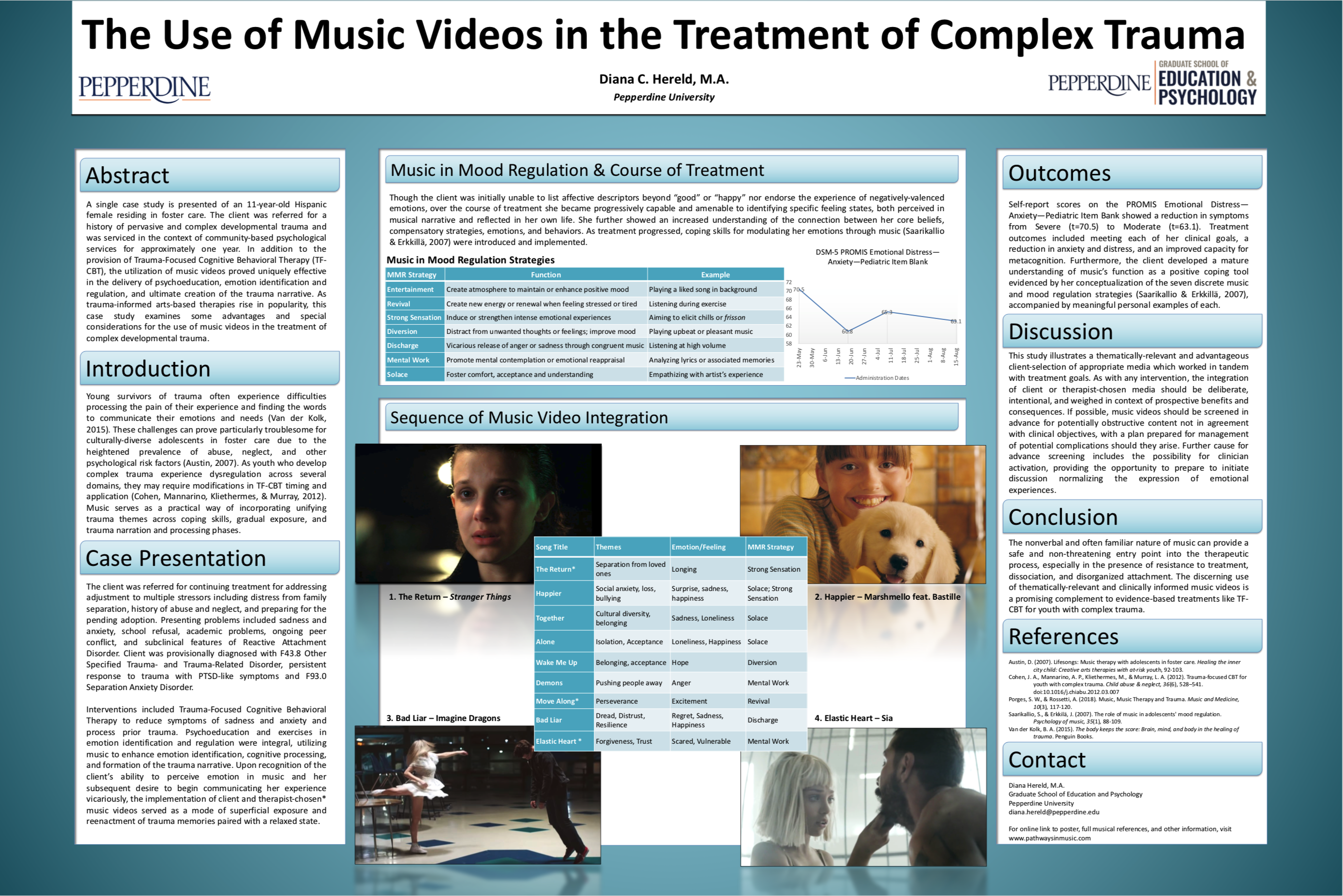
LACPA Convention Poster: The Use of Music Videos in the Treatment of Complex Trauma
 Hereld LACPA POSTER 2019 PDF
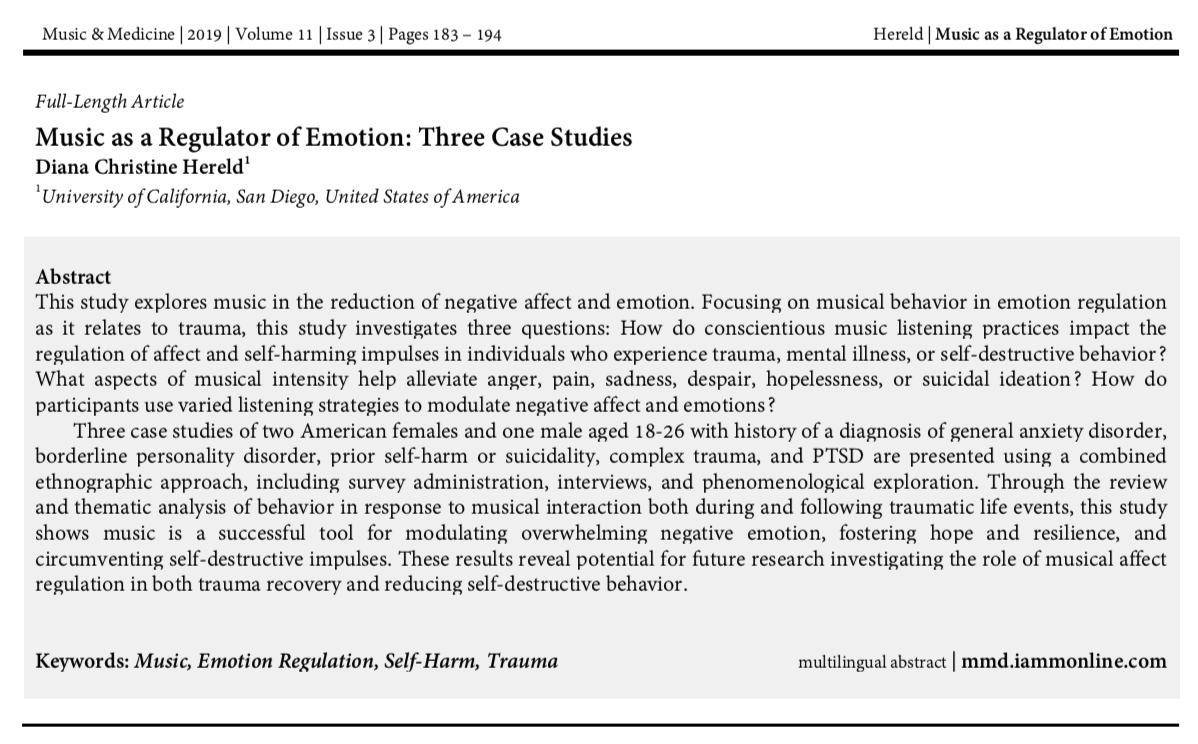
Music as a Regulator of Emotion: Three Case Studies
Happy to share my first academic publication from the July issue of Music & Medicine! Article includes my work from UC San Diego on musical intensity and self-harming behaviors as well as 3 case studies illustrating how music can be used in life-preserving ways. Conducting this research was one of the most challenging and meaningful endeavors of my life, and I’m honored to see these individuals’ powerful stories shared.
Music and dementia: individual differences in response to personalized playlists
Abstract courtesy of Neuromusic News, Fondazione Mariani
Music and dementia: individual differences in response to personalized playlists
Journal of Alzheimers Disease 2018 Jun 23
Garrido S, Stevens CJ, Chang E, Dunne L, Perz J
MARCS Institute for Brain, Behaviour & Development, Western Sydney University, Sydney, Australia
Personalized music playlists are increasingly being used in health-care contexts to address the psychological and behavioral symptoms in people with dementia. However, there is little understanding of how people with different mental health histories and symptoms respond differently to music. A factorial experiment was conducted to investigate the influence of depression, anxiety, apathy, and cognitive decline on affective response to music. Ninety-nine people with dementia listened to three music playlists based on personal preferences. Activation of facial action units and behavioral observation were measured continuously. Results demonstrated that people with high levels of depression and with symptoms of Alzheimer’s type dementia demonstrated increased levels of sadness when listening to music. People with low depression but high levels of apathy demonstrated the highest behavioral evidence of pleasure during music listening, although behavioral evidence declined with severity of cognitive decline. It is concluded that as well as accounting for personal preferences, music interventions for people with dementia need to take mental health history and symptoms into account.
And for our Italian friends:
Una playlist di musica personalizzata è un metodo sempre più utilizzato nei contesti di cura per risolvere problemi di natura psicologica o comportamentale in persone con demenza. Tuttavia, non è chiaro come persone con differenti storie di malattia mentale rispondano in modo diverso alla musica. È stato condotto un esperimento fattoriale per investigare il ruolo della depressione, dell’ansia, dell’apatia e del declino cognitivo nella risposta emotiva alla musica. 99 soggetti affetti da demenza sono stati esposti all’ascolto di tre diverse playlist musicali basate sulle preferenze personali. L’attivazione di unità di azione facciale e l’osservazione comportamentale sono state misurate di continuo. I risultati evidenziano che le persone con alti livelli di depressione e con segni tipici della demenza di Alzheimer mostravano un incremento dei segni di tristezza quando ascoltavano la musica. Le persone con basso punteggio di depressione, ma con alto livello di apatia mostravano la più significativa evidenza di piacere durante l’ascolto della musica, sebbene gli indici comportamentali declinassero con l’aumento del declino cognitivo. Gli Autori concludono che, oltre a considerare le preferenze personali, gli interventi musicali per i pazienti affetti da Alzheimer debbano tenere in considerazione anche la loro storia clinica e i sintomi.
DOI: 10.3233/JAD-180084
Journal: Journal of Alzheimer’s Disease, vol. 64, no. 3, pp. 933-941, 2018
SMPC 2017 Photo Recap

This year, I had the privilege of serving as event photographer and social media chair for the annual meeting of the Society for Music Perception and Cognition. I am happy to share that the official #SMPC2017 flickr is now online! Feel free to download, tag, and share your memories from this year’s conference. Link for sharing: https://flic.kr/s/aHsm5Qgj2M
Here’s the slideshow I put together of the conference photos. If you were in attendance, it was the video shown during the banquet Wednesday night.
Hope everyone had a blast at SMPC 2017! Happy viewing!

Abstract: Nonmusician with severe Alzheimer’s dementia learns a new song
|
Via Fondazione Mariani, from Neurocase 2017 Feb;23(1):36-40 A nonmusician with severe Alzheimer’s dementia learns a new song Baird A, Umbach H, Thompson WF The hallmark symptom of Alzheimer’s Dementia (AD) is impaired memory, but memory for familiar music can be preserved. We explored whether a non-musician with severe AD could learn a new song. A 91 year old woman (NC) with severe AD was taught an unfamiliar song. We assessed her delayed song recall (24 hours and 2 weeks), music cognition, two word recall (presented within a familiar song lyric, a famous proverb, or as a word stem completion task), and lyrics and proverb completion. NC’s music cognition (pitch and rhythm perception, recognition of familiar music, completion of lyrics) was relatively preserved. She recalled 0/2 words presented in song lyrics or proverbs, but 2/2 word stems, suggesting intact implicit memory function. She could sing along to the newly learnt song on immediate and delayed recall (24 hours and 2 weeks later), and with intermittent prompting could sing it alone. This is the first detailed study of preserved ability to learn a new song in a non-musician with severe AD, and contributes to observations of relatively preserved musical abilities in people with dementia. For our Italian friends: Il sintomo caratteristico della demenza senile di Alzheimer (AD) è la memoria compromessa, ma i ricordi di melodie familiari possono essere preservati. Gli Autori hanno indagato se un non-musicista affetto da una grave forma di AD potesse imparare una nuova canzone. A una donna di 91 anni (NC) malata gravemente di AD è stata insegnata una canzone che non conosceva. I ricercatori hanno valutato il tempo di recupero differito della canzone (24 ore e 2 settimane), la cognizione della musica, il richiamo di due parole (presentate all’interno del testo di una canzone a lei familiare, in un proverbio famoso oppure come la radice di una parola da completare), e la capacità di completare un testo e un proverbio. La cognizione musicale di NC (percezione dell’altezza e del ritmo, riconoscimento di una musica familiare, completamento del testo delle parole) si è dimostrata relativamente conservata. La paziente ha recuperato 0 parole su 2 presentate nel testo della canzone o nei proverbi, ma è riuscita a richiamare 2 su 2 radici delle parole, suggerendo quindi funzioni intatte della memoria implicita. Ha potuto cantare sia eseguendo sul momento la canzone appena imparata, sia dopo un richiamo ritardato (24 ore e 2 settimane dopo) e, con un prompt intermittente, è riuscita a cantare da sola. Questo è il primo studio dettagliato sull’abilità conservata di imparare una nuova canzone nei non musicisti affetti da severe forme di AD, e fornisce un contributo alle osservazioni relative alle preservate abilità musicali nelle persone affette da demenza.
Full article may be found here. Baird, A., Umbach, H., & Thompson, W. F. (2017). A nonmusician with severe Alzheimer’s dementia learns a new song. Neurocase, 23(1), 36-40. |
V.S. Ramachandran, Ralph Keeling join San Diego March for Science April 22
 San Diego’s scientific prowess to be on display amid historic rally for science
On April 22, thousands will gather downtown to represent San Diego in the nearly 500-city strong March For Science, a once-in-a-lifetime science outreach event. In just a few short months, an innocuous internet comment has morphed into a massive, volunteer-led celebration of science across America and throughout 6 continents. Amid this historic event, San Diegans will gather to hold up our region’s scientific prowess as second to none.
8,000 San Diegans have already responded online to converge in downtown San Diego on April 22 for this family-friendly, nonpartisan, educational event. Neuroscientist V.S. Ramachandran, Scripps CO2 Program Director Ralph Keeling, and others will speak at the event, and we will host a pop-up science expo showcasing San Diego’s most exciting science.
The mission of MFS-SD is two-fold. Our first goal is to encourage face-to-face conversations between scientists and the public. We want scientists to come show who they are and what they do, and for all San Diegans to come show what science means to them. We believe building trust is prerequisite for our second goal – public policy that both supports and is supported by scientific research.
This is a nonpartisan event. We are gathering to show what we are for, not to protest against. We believe that science belongs to all of us, and the best solutions come from combining scientifically-supported ideas from across the political spectrum. We applaud the long tradition of bipartisan, public support for science, and we are marching to bolster this support from all sides.
What: March for Science – San Diego will include an educational set of speakers at both the beginning and end, a short (about 1 mile) march between the two points, and a mini science expo at the end. The family-friendly science expo will feature exhibits from the Fleet Science Center, San Diego Natural History Museum, Mad Science, Taste of Science, and leading scientists from across San Diego sharing what they do every day.
Who: March for Science – San Diego is a nonpartisan group of scientists, engineers, students, teachers, and STEM enthusiasts, with all backgrounds and beliefs. 8,000 local science enthusiasts have already confirmed their attendance at our march, representing San Diego’s scientific prowess among nearly 500 sister marches across the nation and the world.
When: Saturday, April 22 at 10:00 a.m.
Where: The march will begin at the San Diego Civic Center, 1100 Third Ave, San Diego, CA 92101 and walk about 1 mile to Waterfront Park, 1600 Pacific Highway.
Why: The spontaneous emergence of nearly 500 volunteer-run Marches for Science, across America and around the globe, in just a few weeks, shows that motivations run much deeper than any single trigger. Many people clearly hold long-growing concerns about the role of science in our society, including continued investment in research and education, freedom of speech for scientists, climate change, vaccination, and genetic engineering. However, the broad support for these marches also demonstrates a unique opportunity – science is cool! Science tangibly saves lives, creates jobs, and powers our technology, but it also inspires, amazes, bubbles, and fizzes. If we can unite around anything, it’s science.
Why Here: Our city is a powerful core of scientific innovation. San Diego hosts a world-renowned community of research institutes, universities, tech and biotech companies, medical centers, and aerospace industry leaders. Our city’s non-profit research institutions alone generate a 4.6 billion dollar total economic impact on the regional economy (San Diego Regional Economic Development Council).
For more information, contact Diana Hereld at media@marchforsciencesd.com
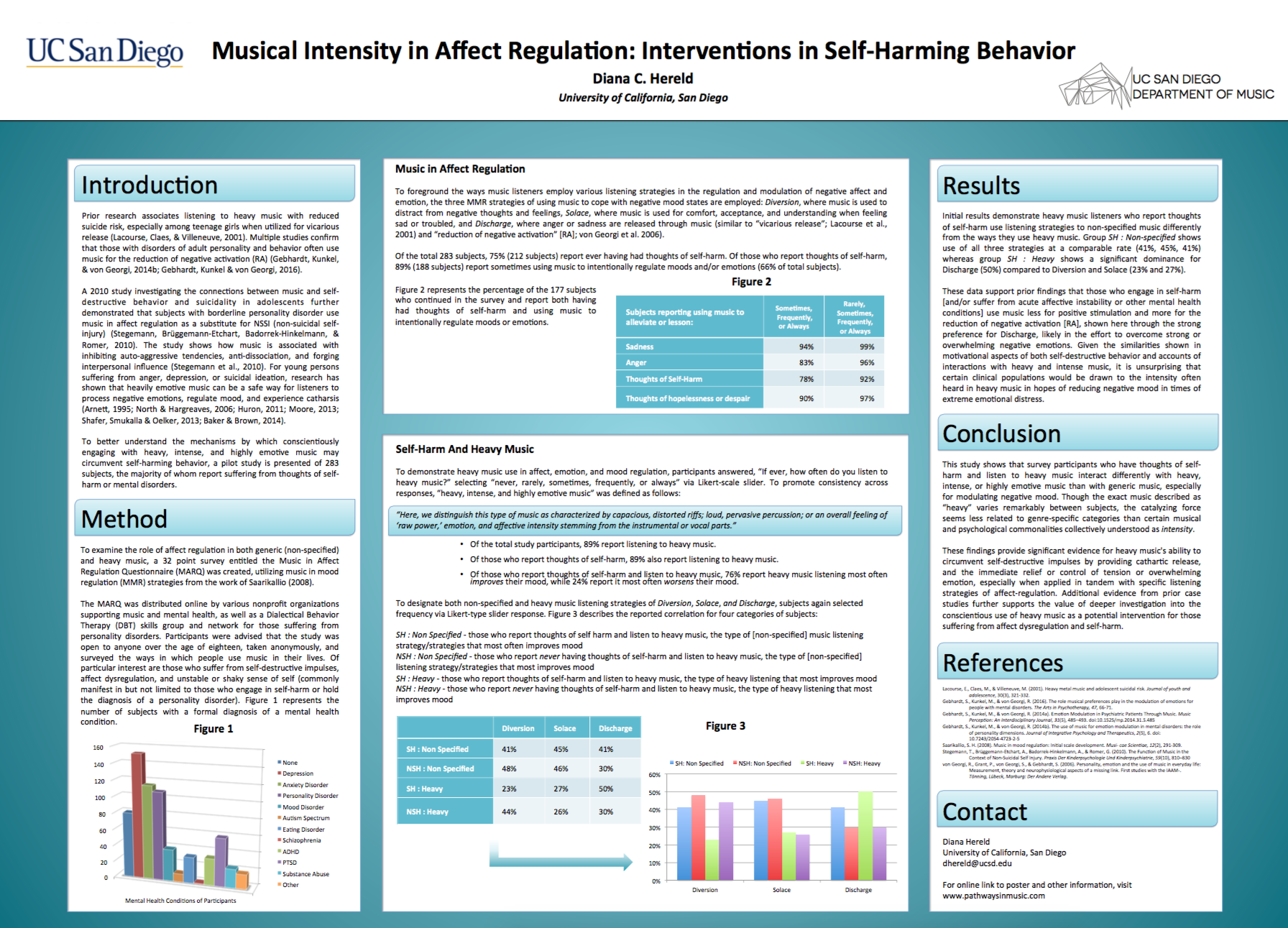
ICMPC Poster: Musical Intensity in Affect Regulaton: Interventons in Self-Harming Behavior
In partial fulfillment of my graduate thesis, this poster represents the findings of my study conducted at the University of California, San Diego. Presented July 5, 2016 at the 14th International Conference on Music Perception and Cognition in San Francisco.
For full study, see chapter 2 of my thesis.
For PDF, see HERELD poster ICMPC.
Abstract:
Prior research associates listening to heavy music with reduced suicide risk, especially among teenage girls when utilized for vicarious release. Nevertheless, few studies consider the active use of heavy music in self-regulation for those who suffer from thoughts of self-harm and/or mental illness. In order to to better understand the mechanisms by which engaging with heavy and intense music may circumvent self-harming behavior, a pilot study is presented of 283 subjects. The majority of those surveyed report suffering from thoughts of self-harm or mental disorders. To examine the use of affect regulation via both generic (non-specified) and heavy, intense, and highly emotive music, we created the Music in Affect Regulation Questionnaire (MARQ), utilizing music in mood regulation (MMR) strategies from the work of Saarikallio. We identify heavy music by the presence of capacious, distorted riffs; loud, pervasive percussion; or an overall feeling of ‘raw power,’ emotion, and affective intensity stemming from the instrumental or vocal parts. Our findings collectively show that heavy music listeners (and those who have thoughts of self-harm, in particular) interact with definitively heavy, intense, or highly emotive music differently than with generic music, especially in the use of modulating negative mood. These findings seem less related to genre-specific categories than certain musical commonalities collectively understood as intensity, and provide significant evidence for heavy music’s ability to circumvent self-destructive impulses, especially when applied in tandem with specific listening strategies of affect-regulation. Additional evidence from prior case studies further suggests the value of deeper investigation of the conscientious use of heavy music as a potential intervention for those suffering from affect dysregulation and self-harm.
Musical Intensity in Affect Regulaton: Interventons in Self-Harming Behavior
 pathways in music
You must be logged in to post a comment.