When Knowledge of the Music Industry Isn’t Enough

Recently, Tommy Darker (Think Beyond The Band) concluded a series in 3 parts entitled The Rise of the Musicpreneur. His articles have been given considerable notice over at Hypebot.com, and the last of the 3 parts is no less noteworthy.

In this article, Darker concisely explains why it is no longer sufficient to draw knowledge exclusively from within the music industry to succeed in the business. Now more than ever, there are elements from fields such as sociology, the neuroscience of marketing and persuasion, the study of  causal events behind media going viral, and the psychology of human behavior which may be used to better understand and market one’s music.

The full article may be found here.

ASCAP Spotlight: Ali Isabella

Teenage Dream – p_0115Part 1

By Diana Hereld | @christypaffgen

At the 8th annual ASCAP Expo, over 2,000 songwriters, composers and publishers gathered to take part in three days of lectures, workshops and live showcases specifically designed to promote knowledge and networking in their craft. Although all levels of accomplishment and success were represented, hallways and rooms bustled with people seeking their next break. The question at the front of everyone’s mind is constantly this: in an industry that’s progressively moving toward an age of D.I.Y. methods-how does one break through?

Throughout the Expo, many had the pleasure of meeting Ali Isabella, one of the events youngest guests-and headline artists. At just seventeen years old, Isabella has performed in many of the top clubs in New York as well as headlined two pre-Grammy parties-one honoring Quincy Jones and Stevie Wonder celebrating the 54th and for St. Jude’s hospital the 55th annual Grammy awards. In 2012, she impressively became the youngest musician to ever perform in Wembley Arena in London, opening for country music superstars Reba McIntire and Lonestar. Isabella released her first album in 2012 “Say You’ll Be Mine” in the UK. In the US, her debut single, “New York City Country Girl” reached #14 on the Billboard Hot 100 chart and was #1 for four weeks on the Billboard Hot Country Singles chart.

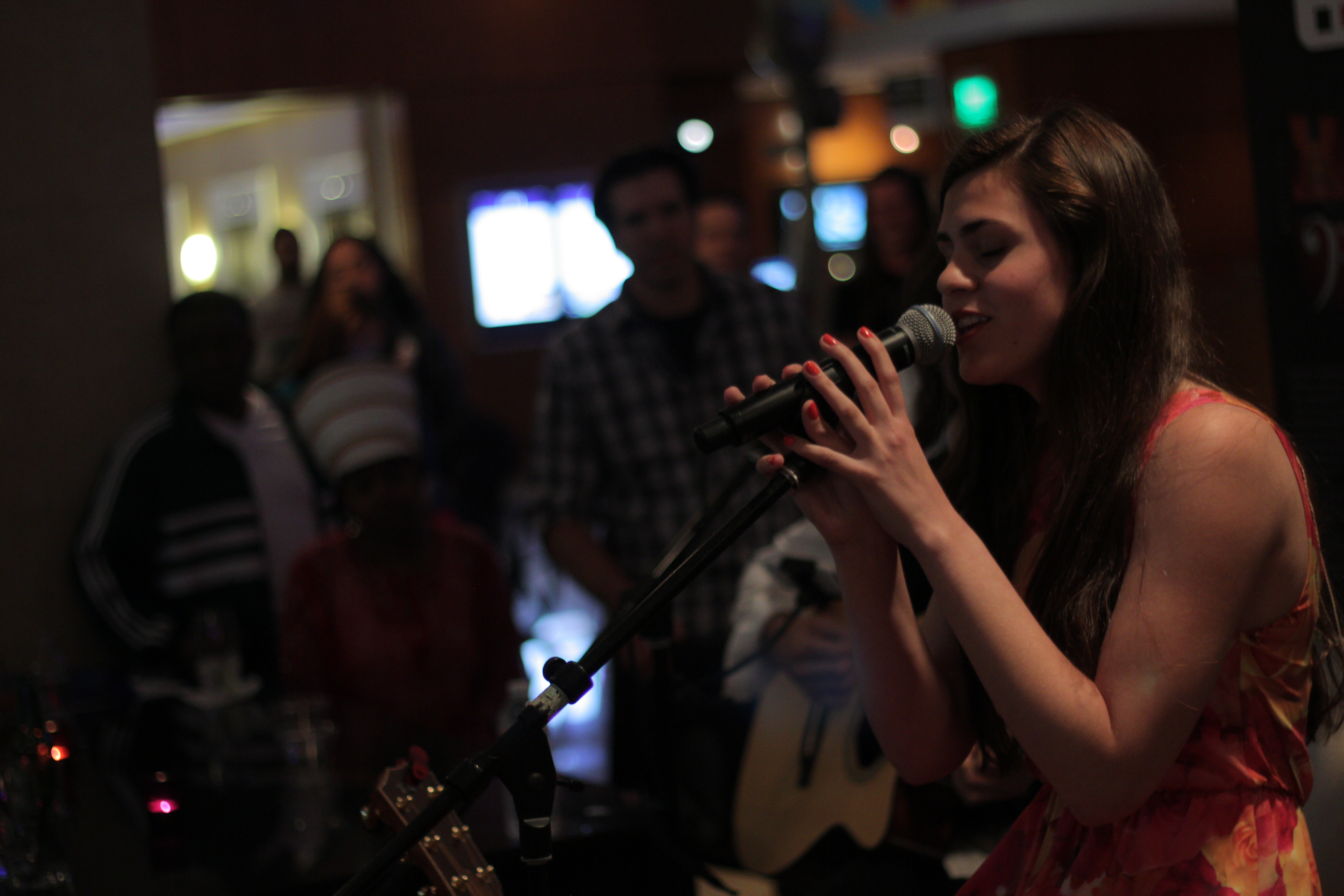
On Thursday evening, Isabella performed at the showcase in Loews Hollywood Hotel for the Women’s International Music Network (WiMN), an organization created to bring women together in the music industry. Upon hearing Isabella sing, one’s immediate reaction may in regard to the clarity and strength of her powerful voice. She has been dubbed “the next Taylor Swift,” and her performance did not disappoint. Watching Ali sing was the most natural thing on earth – in front of leading industry specialists, executive producers and composers, she was simply at home in her music.

Possibly the most refreshing element of Isabella’s identity stems from her humility. Found on the receiving end of bullying in high school, Isabella is quick to exhibit compassion and resilience regarding her experience without an ounce of smugness at her professional success. On being the youngest ever musician to perform at Wembley Arena, she spoke of being anxious, but in tradition to the sensation many singer-songwriters experience, once she was on stage, what she was born to do took over:

“When I go back to it and think about it, I don’t even really remember it because it was all so overwhelming…I mean, the stage is like my home because before I go on, I’m really nervous but once I go up there I’m just comfortable and I’m able to forget about it.”

On the journey to where she has come from, Isabella speaks highly of everyone involved. Initially discovered as a singer-songwriter via a chance meeting via her father in a New York Starbucks, Ali has come a long way. Her powerhouse team composed of her band, publicists and management function more as a familial unit than a management force. One thing is to be sure, however-they know exactly what they are doing. Armed up-front with publicist Andrea Pagano, manager John Velasco (Direction by Appointment, Inc.) has an impressive resume, including having represented Tina Turner, and having managed and/or published Marvin Gay, Hal David and John Denver.

A bit further down the line, not only is Isabella getting publicity via multiple live performances, an app well-designed to keep fans updated with everything they need, and a sponsorship with Casio, she is also pioneering ways to keep an active presence online. Her internet broadcast series will soon be released. She states:  “We just go around and interview people in the entertainment industry-people that have helped me along the way, people that I’ve met-I just think it’s a great way to be informed about people behind the scenes because they’re the ones that make everything happen along the way.”

Ali Isabella’s fresh yet endearing catalogue will catch one’s attention from the beginning. Songs like “What If” and “Crazy Beautiful Life” written by Ali herself exhibit a fresh, raw honesty. The goal of releasing her much-anticipated new album is set for this summer. When Ali speaks of being an encouragement to those who once shared the shoes of being nothing but a singer-songwriter with a guitar and a dream, she shares a unique insight into her character.

“I think it’s really important to write your own songs and tell your own story,” she says. “I think it tells people much more about yourself than just singing songs that people wrote for you, and I think people just appreciate that when you tell your own story because that takes a lot of courage to get up there and be singing about pretty deep stuff.”

What does this say about success for singer-songwriters in the music industry today? In a world where business ventures of all kinds are turning increasingly to D.I.Y. methods for marketing and promotion, the “traditional” music business model (which many of ASCAP’s largest successes have stemmed from) is still one that continues to prevail. However, there is much to learn from young Isabella’s story-any initial break is only the beginning of the equation. An artist must possess the qualities to not only acquire but also maintain their fans-which is the precise moment the online and social media tactics of D.I.Y. come in.

Check out Ali Isabella here:

https://www.facebook.com/IMAliIsabella
https://twitter.com/imaliisabella
http://www.youtube.com/user/AliIsabella


Diana Hereld (@christypaffgen) is a Los Angeles based singer-songwriter and music psychology/neuroscience researcher.

The State of Music Psychology

The State of Music Psychology

By Diana C. Hereld | @pathwaysinmusic

The psychological conversation surrounding music has boomed.

In a few short years, the studies of music therapy and the applied neuroscience of music have hugely invaded the mainstream — the question is, why? As many publications have noted, the initiative that music may be used in rehabilitation has been around for a century or more. What then has catalyzed the influx of media coverage in the last few years? One reason may simply be that as the success of these techniques become popularized via persons in the public eye, many of us are beginning to understand that music may be used for far more than we had ever imagined.

During the 2nd World Congress of Clinical Neuromusicology in Vienna last November, research was presented by Dr. Gottfried Schlaug (Harvard Medical School), who had performed an experiment to test the shared neural correlation of singing and speech. It was found that by actually singing the words or phrase, and not simply speaking or humming (referred to as ‘intoned speaking’), there occurred additional right lateralized activation of the superior temporal gyrus, inferior central operculum, and inferior frontal gyrus. What this means for the rest of us?  This activation is now more than ever believed to be reason that while patients suffering from aphasia due to stroke or other varying brain damage may be unable to speak, they are able to sing.

It was less than a year ago that NPR released the news story on the effectiveness and use of singing therapy on stroke patients. You may recall the Gabrielle Giffords story with regard to her suffering major brain trauma and later a surprising recovery. This story immediately caught my attention as this was precisely the groundbreaking research Dr. Schlaug presented at the conference in Vienna (originally tested and performed on nonverbal autistic children). It is through the sharing of success stories such as this via the media that the infusion of music, psychology, and neuroscience are coming to light.

Medical resilience, however, is only one facet of this field. In addition to all of the rehabilitative functions music is being found to support, there exist many others. For the music industry, it may prove profitable to look toward music psychology as a potential market sector. Companies such as Prescriptive Music develop “branded-music” programming which they believe can increase sales.

Marketing through music is a relatively new advertising theme. That being said, experts in neuroscience and emotion studies are being called upon more and more as sales consultants in a variety of venues including hotels, restaurants, and major retailers. Previous studies have shown increases in sales in resultants when the right music is carefully selected; one test conducted by marketing professor Ronald E. Milliman exhibited an 11.6% sales increase when up-tempo music was played during the lunch hour.

What does this mean for the music industry? Is it possible that via the study of our decision making, analysts will be able to discern the types of music that affect consumer behavior in a wide variety of markets? Diana Hereld for Sidewinder.fm has asked Dr. Victoria Williamson, a music psychology lecturer and course co-director on the “Music, Mind, and Brain” program at Goldsmiths, University of London, for her take on these questions.

* * *

Fifty years ago, people might appear at a loss if you mentioned “music psychology,” or simply the act of synthesizing music and neuroscience, or music and psychology. What exactly is this field, and how has it become a mainstream topic in recent years?

Dr. Victoria Williamson: People are still often a little lost when you mention music and psychology/neuroscience together although it is of course more well-known now than it was fifty years ago. I come from a psychological interest and I wrote an article called “Thank You for the Music” a few years ago that outlined the kind of things that are studied in this field and why. Essentially, music is a universal human activity whether we chose to play or to listen. Therefore, as a psychologist, music is my chosen tool for learning more about the human mind and behavior. Studying the way we perceive, process, generate, and respond to music can therefore tell us something unique about what it means to be human.

What are some of the field’s most impacting accomplishments?

Dr. Victoria Williamson: Tricky one. I like to think that using music in psychological paradigms has taught us a great deal about how we learn both as babies and adults, how our memories work (or don’t work sometimes!) and how our emotions can impact on cognition. Using music in brain imaging has revealed a lot about the activity of the mind both when we are listening to sounds and when we are simply thinking about them. And there are a number of cases, such as with autism, where studying music psychology has given us new insights into different people’s worlds. The new horizon for music psychology, which is just beginning to be touched upon, is the power of music to help us deal with both everyday and extraordinary life situations.

Along with all of the neurological and therapeutic implications of the field, knowledge is become wider spread of the power of music to influence the minds and behavior of consumers. These behaviors can obviously affect their purchasing decisions, inside and outside of the music industry. Who is driving this research? Is there market incentive from large corporations?

Dr. Victoria Williamson: I can only answer for the UK, but this is actually a relatively small field of research with few published papers. It is hard to do genuine consumer research because it requires long-term and effective collaboration between academia and industry, which can be tricky to manage from both sides. The situation may change in the future but in most cases commercial interests are happy to learn from the music psychology that has been conducted in more controlled conditions and extrapolate the findings to their own environments.

One important point I want to make here is that when you talk about the influence of music it should be clear that there is no evidence that I know of that music can make people want to do something they do not want to do. Music has a subtle influence that works in combination with all the other factors in the environment. It is no magic bullet.

As a leading researcher in the field, what are some of the long-term goals this field hopes to accomplish? Do you think music psychology has the potential to become a major sector in the music industry?

Dr. Victoria Williamson: My long term aim is to learn more about the human mind and behavior by studying how we interact with music. From this level of understanding will come the tools for improved communication, wellbeing, and happiness. I think the music industry could learn a lot from interacting with music psychologists and of course vice versa. Most music psychologists (including me) know very little about the process by which music is produced as a commercial product and it would be really interesting to know more about how decisions are made, artists are chosen, and end products compiled. I think the potential is there for many exciting collaborations that will reveal more about how and why we are such a musical animal.

(Photo Credit: Flickr)

Diana Hereld (@christypaffgen) is a Los Angeles based singer-songwriter and music psychology/neuroscience researcher. She blogs at As The Spirit Wanes The Form Appears.
All That Jazz

As I’ve recently scored some jazz gigs and representation in Los Angeles, here’s a couple of tunes I’ve been rehearsing for my first gig this Wednesday:


In case you’d like to keep up with what I’m working on, you can follow my ‘artist page’ here.

Cheers


Music Therapy Advocacy Month is here!

I’m not sure who declared it, but January would seem to be Social Media Advocacy Month, and thus many have taken strides to in turn declare Music Therapy Advocacy month. Though I tend to work in the realm of music and psychology or music and neuroscience, the fields are extremely interconnected and this is a source of great excitement. We are very lucky to have renowned musician Ben Folds recently tweeting under the hashtag #FollowMTWeek and bringing attention to the field in general during this time. Many conversations and stories have begun to surface through this call to awareness, and I would encourage you to pop over to Twitter to see what’s going on.

Three lovely women over at Wholesome Harmonies, LLC have created the joint AMTA/CBMT Social Media Advocacy project to help spread the word about music therapy as well as create traffic to colleagues’ websites. If you are a working professional or researcher in the field, I would strongly encourage you to have a look at what is going on over there-very exciting stuff.

Here are some of my personal favorite resources for more information on the field:

Music Psychology -Dr. Victoria Williamson

American Music Therapy Association

Certification Board for Music Therapists

SEMPRE – Society for Education, Music and Psychology Research 

Finally, for a bit of introductory information, there is the piece I wrote on the current state of music psychology.

Let’s do this!

calling moon and moon, shoot the big bad hand

Moon and Moon (Bat for Lashes cover)

played/sung by myself


I’m not sure why it’s taken me 27 years to learn this, but there exists an incomparable chasm between the act of losing someone forever due to natural causes, and the forced question of letting another go. There is nothing more painful than the unresolve.

Request For Feedback – When Tragedy Strikes: A Music Behavioral Analysis

Dear friends,

Thus far, my research interests have lain in the children I’ve tested and taught in person, and I have had little use for gathering data from anyone over the age of 18. As I craft together my first pitch, however, I’d like to ask for some feedback. I’ve been given the opportunity to write about two subjects I find very fascinating. In fact, I believe anyone else has yet to combine them in quite this way. I’m attempting to piece together the music industry and psychological resilience. In the end, it all boils down to music behavior analysis. In this vein, I find myself happily at home. When venturing toward the music industry and modern practice, however, I’m treading on new ground.

 So I ask you, dear reader, if you have ever gone through a period of immense stress (i.e. one’s senior year of college or an audit at work), lost a loved one due to natural or unnatural causes, or experienced a major trial of any kind, to lend me your feedback. If you have ever streamed music using Spotify, Grooveshark, Songza, 8track, LastFM (etc.), or elected not to, I ask for your feedback. 


It’s been a few weeks since I really sat down on meditated on these concepts. This weekend, however, tragedy struck. A friend of mine lost his father, and I lost someone very dear to me. I suppose now is as good a time as ever, then, to write about loss, and how we respond to it.

I am interested in the way we respond to trauma/loss through the psychological lenses of music behavior with a special emphasis on playback. Because the debate of ownership vs. streaming is relatively new, there is precious little data available in the area I’m seeking. In terms of loss, this natural phenomenon has always existed. As for the modes and vices with which we counter this loss, our outlets would seem to expand on a daily basis. We grow at the speed of modern technology.

How has the ability to stream music affected stress/pain culture in the industry? Has it been altered in the least in terms of our music listening habits (ownership vs. access)? Is streaming saved for the young in age and young at heart, those without the worries of time and weather? In occasions of strife, do we turn to a new and fresh outlet which resigns our need and right of control? Or in a subconscious search for the regulation of external chaos do we flee from such an idea, clinging heavily to those old safe tunes proven time and time again to get us through?


I would appreciate any and all feedback in the aid of my essay. You may leave a comment, or if you wish to reach me privately, you may contact me on Facebook.


If I don’t fall apart, Will my memory stay clear?

If I keep holding out

Will the light shine through?
Under this broken roof
It’s only rain that I feel
I’ve been wishin’ out the days
Come back

I have been planning out
All that I’d say to you
Since you slipped away
Know that I still remain true
I’ve been wishin’ out the days
Please say that if you hadn’t have gone now
I wouldn’t have lost you another way
From wherever you are
Come back

And these days, they linger on, yeah, yeah
And in the night, I’ve been waiting for
A real possibility that I may meet you in my dreams
I go to sleep

If I don’t fall apart
Will my memory stay clear?
So you had to go
And I had to remain here
But the strangest thing to date
So far away and yet you feel so close
I’m not going to question it any other way
It must be an open door for you
To come back

And the days they linger on, yeah
Every night I’m waiting for
The real possibility that I may meet you in my dreams
Sometimes you’re there and you’re talking back to me
Come the morning I could swear you’re next to me
And it’s ok

It’s ok, it’s ok

I’ll be here
Come back, come back

Neuroscientist David Sulzer turns brain waves into music

Thanks so much to Vicky Williamson for bringing this to my attention. More and more these days are professors of neuroscience and music finding ways to tap into the unknown capabilities of what we can accomplish not just psychologically, but neurologically with music. Like so many other projects happening at present, I found this fascinating:

Columbia neurophysiologist David Sulzer took his first piano lessons at the age of 11 and was playing his violin and guitar in bars by age 15. Later he gained a national following as a founder of the Soldier String Quartet and the Thai Elephant Orchestra—an actual orchestra of elephants in northern Thailand—and for playing with the likes of Bo Diddley, the Velvet Underground’s John Cale and the jazz great Tony Williams.

It was only after arriving at Columbia, however, that the musician-turned-research-scientist embarked on perhaps his most exotic musical venture—using a computer to translate the spontaneous patterns of his brain waves into music.

With the help of Brad Garton, director of Columbia’s Computer Music Center, Sulzer has performed his avant-garde brain wave music in solo recitals and with musical ensembles.

Last spring, Sulzer presented a piece entitled Reading Stephen Colbert at a conference in New York City sponsored by Columbia and the Paris-based IRCAM (Institut de Recherche et Coordination Acoustique/Musique), a global center of musical research.

Sulzer, a professor in the departments of Psychiatry, Neurology and Pharmacology, wore electrodes attached to his scalp to measure voltage fluctuations in his brain as he sat in a chair reading a book by the comedian. Those fluctuations were fed into a computer program created by Garton, which transformed them into musical notes. “I tried to forget I was in front of people and they could see my brain waves on a screen and listen to the music as I read the book,” says Sulzer. “Luckily, the book was funny and I laughed, which changed the music.”

The Brainwave Music Project grew out of an invitation in 2008 from the Graduate Center of the City University of New York to lecture on how the brain interprets rhythm. Sulzer, whose main research focus is the chemical transmission of brain signals and the neuroscience of neurological and psychiatric disorders, had heard about measurement of brain waves of drummers playing together using electroencephalography (EEG), a technique that measures electrical activity in the brain. The longer the drummers jammed, the more their brain waves began to synch up. Why not see if the musicians could use their own brain waves to make new music together?

Sulzer asked Garton, who had spent his younger years in New York’s downtown music scene and had followed the neuroscientist’s previous career with the Soldier String Quartet, if he knew a graduate student who might be interested in helping him develop software for his lecture. Garton volunteered to do it himself.  “I knew the digital synthesis and audio side of things, he had the knowledge of neurotechnology and brain waves—it was the perfect match,” Garton says.

When brain cells are active, they communicate with the cells around them by emitting electrical spikes that vary in frequency and amplitude. A single sensory stimulus will cause a series of brain cells to fire, which will excite the cells around them and lead to a chain reaction of cell firings that ripple through the brain like the waves that ripple out from a pebble tossed into a pond.

“I take the signals, digitize them and then turn them into signals in the computer that control the sound,” Garton says. “A project where you can make sound just by thinking about it is pretty cool. It’s great fun.”

Garton and Sulzer have tried a number of ways to make music from these waves. Sometimes they program specific musical notes to play every time the EEG sensors detect brain cells firing at specific frequencies or amplitudes. Other times, they assign an array of prerecorded sounds or notes to specific neural patterns.

Sulzer cautions against taking the project too seriously. It’s more of a “didactic tool,” he says, that he usually pairs with his pop science lectures on brainwaves and brain function or with Garton’s on computerized music.

“Part of it is didactic, part of it is satirical,” Sulzer says. “Sometimes I’m making fun of attitudes towards music. For instance, I’ll say ‘this shows you can be a conscious composer’ because you can try to manipulate brain waves. Or you can be an unconscious composer. Reading Stephen Colbert is an example of that.” Sulzer is skeptical the technique will ever result in better music than that which the brain is already capable of producing through the tongue and fingers.

“Trying to play music using brain waves is like trying to play the piano using boxing gloves,” he says. “The level of detail that the current brain scanning technology can pick up is simply too crude.”

The full article may be found at: http://medicalxpress.com/news/2012-08-neuroscientist-david-sulzer-brain-music.html#jCp