Krzysztof Penderecki, Jonny Greenwood, Mental Illness and Encephalography

I ran across something rather intriguing the other day, thanks to this friend and music enthusiast. It is a collaboration between two highly respected musicians:  Krzysztof Penderecki and Jonny Greenwood. Imaginative, provocative and innovate as these string arrangements may be, it is in a very small component of the composing process which lies the real fascination for me:

Penderecki’s Polymorphia also had a fascinating birth. The composer played a recording of Threnody for patients with mental illnesses at the Krakow Medical Center while the patients had encephalographs (brain-wave charts) made; he then based Polymorphia‘s musical lines around the shapes on their charts. In his reply to Polymorphia, Greenwood takes up that big, glorious and triumphant C Major chord — and then shatters that harmonic glow into smithereens. He begins with a strangely Bach-reminiscent chorale (“Es Ist Genug,” or “It Is Enough,” which is also the name of a famous Bach chorale) that Greenwood then distorts and dissolves over and over again. He builds tension and lets it drain away, takes up an idea and then lets it go in swirling eddies of motion.

The original article on NPR may be found here.

The “Anatomy of a Tear-Jerker” and my cover of Adele

In futile effort of keeping up with the Joneses of pop culture and music psychology, consider this my token post on Adele. Why?

 A) She’s fabulous

B) She just won big at the Grammys

C) WSJ Online has just released a major post largely on her hit Someone Like You entitled Anatomy of a Tear-Jerker 

D) I have covered her countless times, and her piano songs are a part of my teaching repertoire

In terms of the post WSJ released, I strongly recommend giving it a good read. The research was originally conducted at McGill, a university widely celebrated for their Music Perception and Cognition program, and home to celebrity writer Daniel Levitin, author of This Is Your Brain on Music. In light of Adele’s recent superstardom and the widening knowledge and appreciation of music psychology as a whole, I’d wager this article is going to get some serious attention. While I wholeheartedly agree with it’s main premise, I find something deeply awry here, and it is found the in subtitle itself:

Why does Adele’s ‘Someone Like You’ make everyone cry? Science has found the formula.

As a twenty-something young woman who has not only sung since age three, composed angsty love ballads on the piano for years but also been left by a lover in the worst way, I love Adele. Let me be clear on this: I love Adele. Someone Like You and Hometown Glory (as well as Rollin’ In The Deep, which I will teach tomorrow) are also favorites of my young vocal and piano students. However, I think if we look at that tag line again of this post-‘science has found the formula’- we will see that something is very wrong. I may be alone in my feeling here, but I doubt it. With the way EEG, MRI, fMRI and now even rtfMRI are developing, we know more about the human brain and it’s reactions to stimuli than ever before-more than we ever dreamed possible. I have a couple problems with the way the article glorifies grace notes and appoggiaturas-but most of all, how they glorify her. Yes, she and Dan Wilson have crafted a brilliant combination of soul, melodic intonation and dissonance in all the right suspended instances-but at the end of the day, I would be cautious in how objective we lean in quantifying beauty. There is a line to be drawn-there necessarily is. In saying “science has found the formula,” we have inadvertently taken the ‘magic’ (for lack of a better word) out of her song, and made it just that: a scientific formula. It should not be a commercial marketing scheme, however, and God forgive us should we ever make it one. It’s a great article, yes, and I hope everyone reads it. I only hope we can all take a step back from the science behind every mathematical placement of every ornamentation and remember why this lovely woman crafted the song in the first place.

And now, just for fun, a rough cover I did of Adele’s Hometown Glory in 2011.

Neural systems for speech and song in autism

In commencement of the administration of my pilot study (as well as my primary investigator’s full experiments) in working memory, autism and music, here is an interesting article I came across today. The idea simply drives forward what we already know: where subjects who suffer from aphasia and other language difficulties falter in normative speech patterns, music provides a far higher stimulation in areas of the brain (this study concentrating on the left inferior frontal gyrus in particular) and thus lends to speech development which ordinarily may not have been possible.

Abstract:

Despite language disabilities in autism, music abilities are frequently preserved. Paradoxically, brain regions associated with these functions typically overlap, enabling investigation of neural organization supporting speech and song in autism. Neural systems sensitive to speech and song were compared in low-functioning autistic and age-matched control children using passive auditory stimulation during functional magnetic resonance and diffusion tensor imaging. Activation in left inferior frontal gyrus was reduced in autistic children relative to controls during speech stimulation, but was greater than controls during song stimulation. Functional connectivity for song relative to speech was also increased between left inferior frontal gyrus and superior temporal gyrus in autism, and large-scale connectivity showed increased frontal–posterior connections. Although fractional anisotropy of the left arcuate fasciculus was decreased in autistic children relative to controls, structural terminations of the arcuate fasciculus in inferior frontal gyrus were indistinguishable between autistic and control groups. Fractional anisotropy correlated with activity in left inferior frontal gyrus for both speech and song conditions. Together, these findings indicate that in autism, functional systems that process speech and song were more effectively engaged for song than for speech and projections of structural pathways associated with these functions were not distinguishable from controls.

The open access html doc may be found here and for those interested:

DOI: 10.1093/brain/awr335

As I begin my very first experimental session, I’ll do my best to keep a log here, simply because I very much enjoy the feedback, and it helps to keep my thoughts aligned.

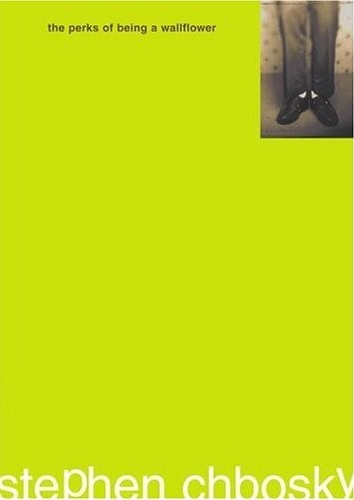
Sing me to sleep: The Perks of Being a Wallflower


We accept the love we think we deserve

 

            How does one interpret reality? Psychologically speaking, one may take a number of viewpoints. Countless factors come to play, first and foremost being the common argument of ‘nature or nurture.’ Aspects such as religion, race, culture, gender, sexuality, economic status, and mental health history can all work together to create vastly differing versions of reality. In stories, “narratives help us impose order on the flow of experience so that we can make sense of events and actions in our lives. They allow us to interpret reality because they help us decide what a particular experience ‘is about’ and how the various elements of our experience are connected.” (Foss, 399).

When someone reads a story, listens to a song, or watches a film, what determines their overall opinion and stance on what has transpired? As we mature from children into adolescents and adults, our methods of discernment have the capacity to shift radically. Not only upbringing and the norms of childhood, but also life experiences contribute to the process of modification in how one perceives their world.

Many narratives are chronologically organized, that is, organized in a time-observant sequence of events, while others may focus more on a specific character or theme. Narratives may come in the form of graphic novels, films, television, conversation with others, speeches, short stories, graffiti, music and other folklore. The use of symbols throughout the different forms are what arguably best categorize them as such, and to demonstrate this, I’d like to look at a poignant and inspiring ‘coming of age’ narrative entitled The Perks of Being A Wallflower. How does one interpret reality; but even more importantly, how is the construction of a narrative used to determine how we interpret reality?

Set in Pittsburgin the early 90s, Stephen Chbosky’s The Perks of Being a Wallflower is a story of the transformation of desperate introversion in an extroverted high school universe. Throughout the novel, the protagonist Charlie anonymously writes letters to an undisclosed recipient detailing the meaningful and turbulent journey through his freshman year. As the narrative begins, Charlie’s best (and only) friend has just committed suicide. Due to this, Charlie’s introversion and acute timidity as a new student are greatly challenged as he meets a spectrum of new friends along the way, not least of all, his English teacher Bill. As his relationship develops with this mentor, he is introduced via his surroundings to music, literature, love, sex and drugs. Throughout the novel, the reader is constantly subjected to perceptions of reality from many different perspectives. Sam, the beautiful and popular but taken woman of Charlie’s affection, her gay stepbrother and Charlie’s new best friend Patrick, and others including his family and peers make up the vastly different interpretations that all come together to challenge and question Charlie’s previously understood ideas and worldview. As Charlie as introduced to new musicians like The Smiths, Ride, Nick Drake, Smashing Pumpkins, Nirvana, U2 and Nat King Cole, his journey becomes increasingly personally psychoanalytic as he learns to relate, in one way or another, to these musicians.

To begin analysis, I’d like to start by looking at our main question: how does the author use the narrator and protagonist’s surroundings and cultural arena to construct a perception of reality? Charlie begins his textually prominent setting of high school in the immediate aftermath of an incredibly traumatic event: losing his best and only friend to suicide. Not only do we commence our journey in what is known already to be a daunting period, we also begin through the eyes of a painfully shy boy who is emotionally damaged and alone. Our opening and lasting impression of him describes the death of his favorite aunt, and later in life, dear friend.

Throughout the first portion of our novel, we see Charlie’s more intellectual habits develop-the way he rereads books twice to more fully understand them; the way he accepts all the extra essay assignments from his English teacher (and later mentor) Bill with a vigor. In the beginning, our perception of reality is formed through the eyes of an overachieving boy who simply wants to get through, and possibly fit in. His definition of reality is one of survival-of holding it all in as long as he possibly can.

The second way we are introduced to his existence is the mode in which he meets new people. Through his surrounding of stronger, more single dimension characters such as Sam, Patrick, his family and teacher Bill, we are shown how Charlie slowly enables himself to become a somewhat social being. In a largely stable environment, however, Charlie remains the wildcard, frequently being prone to crying over what is termed “silly things” and repressed feelings of guilt from the tragic death of his aunt in particular. The deeper in to the narrative we go, the more objective our surroundings seem, and the more subjective Charlie’s character dimension and experience prove. As a deliberately vague description of what happened between his aunt and he at a young age reappears throughout the work, we begin to slowly understand this trauma has played a far larger role in shaping who he is than previously thought. It is himself, and his aunt that prove to be the most round and conflicted characters of the narrative, thus allowing them the greatest space for growth. Charlie is a radically dynamic figure growing in knowledge, experience, and maturity more and more until he finally accepts his loss of innocence.

Another way we can examine Charlie’s social worldview is by asking what parts of his culture are privileged, and what parts are repressed. Through Charlie’s friend Patrick’s secret homosexual relationship with the quarterback of the football team, Charlie’s heightened embarrassment over his frequent display of emotion in crying and his family’s unrealistic expectations of Charlie’s older brother’s college success, we may see his culture is not too far from our own. The ‘popular’ kids in school remain those in financially advantageous situations; the outcasts remain the quiet or socially awkward. In Charlie’s world, blending into the crowd is desirable, while individuality and deviance is highly discouraged. In this way, Sam is able to retain a strong sense of acceptance due to her beauty and class status, while her brother falls socially down when word gets out of his sexual identity. What this says about their system of ethics is that the patriarchy reigns. The privileged prevail while the less privileged do not. The beautiful thing in Charlie’s developing social situation is that these lines become more and more blurred as he is able to find true acceptance from the outcasts and privileged alike.

Lastly, I’d like to talk about Charlie’s point of view as narrator. Chbosky has given Charlie a very human and humble tone, beginning quietly and ending more confidently. As the overall theme of the work is coming of age, loss of innocence and psychological resilience, it should be noted what Charlie learns, and most importantly, what he realizes in the end. As a child, Charlie was repeatedly molested by his favorite aunt. He only comes to understand this in the final pages-in the epilogue, no less. Through all of his pain, loss and personal turmoil, Charlie tells us a story of hope through friendship, love and music, how to get by in the tough world of adolescence, and the upside of being a wallflower. Charlie is not omniscient or omnipresent-he is just a boy, trying to figure out how to become a man. In Charlie’s indirect narration, we are shown a world of people who are tangible and relatable to every era. His story is trustworthy, reliable and raw. By the sense of established confidence in Charlie’s letters, we are shown a brilliant world of living splendidly through trial.

In conclusion, applying a narrative criticism best illuminates this artifact because it allows the reader and critic to more closely examine what is revealed about the individual’s or culture’s identity. It allows us to ask probing questions into their worldview and motives for action by looking at subjectivity in character dimensions. Narrative criticism enables one not only to analyze the content of the worldview, but the form and structure of that worldview as well. By looking deeply into the sexual and emotional trauma Charlie has undergone, by looking at all of the external factors including ethical, cultural, religious (or lack thereof), social, economical, and intellectual combined with his internal processing revealed to us by the author, we can truly appreciate what constitutes this hopeful ‘reality’ our protagonist has found.
Rhetorical Criticism: Exploration and Practice. Ed. Sonja K. Foss. Prospect Heights: Waveland Press, Inc. 1996.
Musical training proven again to enhance P3a and P3b plasticity

The following is an excerpt from a recent project done in Finland regarding plasticity of the P300 ERP for infrequent target sounds, and whether or not the short-term plasticity of the P3a and P3b responses are enhanced in musicians. What did they find? Musicians were better than nonmusicians at discriminating target deviants. Not only this, but regardless of musical training, a higher working memory function also produced better discrimination.

Why this is important: This means, in line with our current knowledge of musical training, short-term plasticity, and working memory, this is just one more study to concrete the fact that musical training enhances P3a and P3b plasticity.I find this interesting largely due to my current research at the university regarding ASD, working memory models and music.


Music training enhances the rapid plasticity of P3a/P3b event-related brain potentials for unattended and attended target sounds (Seppänen, Pesonen, and Tervaniemi, 2012) 

Institute of Behavioural Sciences/Cognitive Brain Research Unit, University of Helsinki, P.O. Box 9 (Siltavuorenpenger 1 B), FI-00014, Helsinki, Finland.

Neurocognitive studies have shown that extensive musical training enhances P3a and P3b event-related potentials for infrequent target sounds, which reflects stronger attention switching and stimulus evaluation in musicians than in nonmusicians. However, it is unknown whether the short-term plasticity of P3a and P3b responses is also enhanced in musicians. We compared the short-term plasticity of P3a and P3b responses to infrequent target sounds in musicians and nonmusicians during auditory perceptual learning tasks. Target sounds, deviating in location, pitch, and duration with three difficulty levels, were interspersed among frequently presented standard sounds in an oddball paradigm. We found that during passive exposure to sounds, musicians had habituation of the P3a, while nonmusicians showed enhancement of the P3a between blocks. Between active tasks, P3b amplitudes for duration deviants were reduced (habituated) in musicians only, and showed a more posterior scalp topography for habituation when compared to P3bs of nonmusicians. In both groups, the P3a and P3b latencies were shortened for deviating sounds. Also, musicians were better than nonmusicians at discriminating target deviants. Regardless of musical training, better discrimination was associated with higher working memory capacity. We concluded that music training enhances short-term P3a/P3b plasticity, indicating training-induced changes in attentional skills.


And for my Italian friends:

Gli studi neurocognitivi hanno mostrato che una estensiva istruzione musicale aumenta le risposte dei potenziali evocati evento-correlati P3a e P3b per suoni non frequenti, riflettendo una maggiore capacità di attenzione e di valutazione nei confronti dello stimolo musicale nei musicisti, piuttosto che nei non musicisti. Non si conosce ancora in ogni caso se anche le risposte a breve termine siano aumentate nei musicisti, per questo gli Autori hanno comparato le risposte P3a e P3b durante un test di apprendimento percettivo nei musicisti e non. I suoni target, differenti per localizzazione, toni e durata secondo tre differenti livelli di difficoltà, sono stati mischiati con suoni frequenti in un paradigma oddball (con uno stimolo deviante inserito in una serie di stimoli uguali). Gli Autori hanno rilevato che durante l’esposizione passiva ai suoni i musicisti presentavano un certo grado di adattamento (diminuzione) nel potenziale P3a, mentre i non musicisti mostravano un aumento della risposta tra i vari blocchi di suoni. Tra un test e l’altro, le ampiezze di P3b per le deviazioni di durata sono state ridotte in conseguenza dell’adattamento solo nei musicisti, e mostravano una topografia posteriore nello scalpo se comparate alle risposte dei non musicisti. In entrambi i gruppi, le latenze P3a e P3b erano ridotte nei confronti dei suoni devianti, ma i musicisti avevano una migliore capacità di discriminare i target devianti. Indipendentemente dal training musicale, una migliore discriminazione era associata a una più alta capacità di memoria di lavoro. Gli Autori hanno concluso che il training musicale aumenta la plasticità a breve termine P3a/P3b, indicando che esistono dei cambiamenti attentivi indotti dal training musicale.

On the origin of my PhD topic, Music Intervention as Psychotherapeutic Approach

Thanks to Pravin Jeya for his inquiry as to the origin of my PhD topic.                      Many of you have asked, and without going too in depth into my  passionate affair with fight or flight and the amygdala, I have tried to explain where it began. The post may be found here, and I would encourage you to check it out in conjunction with Pravin’s work.

If one were to ask for my academic or intellectual rationale for choosing music psychology, I would most likely rattle off something matter-of-factly about how I’ve grown up around music and psychology. My parents were psychologists; my mother has two doctorates so academic achievement was always very important. Yet they always stressed the cultural and intellectual importance of music. Music is what I do, and I have a lazy passion for the more philosophical side of things, so it simply ‘made sense,’ as it were.

As to my intellectual rationale for music psychology, it started exactly a year ago. From the time I discovered Dr. Victoria Williamson’s research in the applied neuroscience of music, I’ve been completely enamored with the field. Since I was a young child, I’ve been devoted to the pursuit of music in any way possible. I’ve been involved in music theatre, music video production and engineering, music composition, and music marketing in radio and television. As my emotional intelligence developed, however, I found I also had an intense desire to understand people and their motives. In high school and college, I took classes in philosophy, psychology and ethics. My first emphasis in college was music and psychology. But as I was strongly discouraged from pursuing majors with such ‘different focuses,’ I chose music alone. In line with this, I never resolved to solely do one or the other, and eventually it was cause for a year break before enrolling in a graduate programme. I found I simply could not be happy studying only music or only psychology. Enter my absolute elation upon discovering the Music, Mind and Brain programme at Goldsmiths College, University of London. I believe that their programme’s careful integration of music perception, neuroscience and statistical methods combined with a faculty of such encouragement and expertise will be just the training I seek in preparation of a PhD and a career in the field.

If someone were to ask to explain or justify my ‘non-academic’ journey into exactly what I have chosen to pursue, I still find myself needing to pause and really think it through. One catalyst for this is that my rationale is not static but dynamic, changing and evolving daily into something slightly new and adjusted. I suppose that that should say something in and of itself – the pursuit of music psychology has become my life blood – it’s what I think about most moments of every day. The more I’ve reflected on my own listening habits over the years, the more I realize there are few times I am without music. I use it advantageously in every possible situation. As an ENFJ (extroverted, intuitive, feeling, judging) Jungian personality type, being able to calm and put people at ease is one of my greatest joys, and strengths. Music can turn a moment of happiness into a moment of memorable bliss that stays with you always. It can also turn a slightly vague and uncomfortable memory into a transparent lake of psychoanalytical outpouring. Music is in everything, and it has the power to heal people.

If one were to ask the truly cementing factor in my life that secured music psychology, however, it is most of all the following. Last summer, I lost my step-sister, my father, and my best friend within two weeks of each other. Though I’d dealt with a fair share of hardship in adolescence, I’d never gone through anything of this magnitude. Through the process of witnessing my family’s grief (and my own) in spending time in hospitals and hospice, I felt more than ever an acute desire to help people through their pain. I never cease to be amazed at music’s capacity to bring about a mental resilience. I know music to be a healing tool, because I am a living attestation. There are many who would disagree with my personal ethic, but I continued to teach my private music lessons to children in the morning after I lost my father, and missed not a single lesson until several months later. I’m finding my time now to be alone and to grieve, but I honestly believe that the joy of working with kids in music sustained me through the more terrible moments, and as I said, I’ve kept in reserve the strength to maintain my lessons and lead a research project at the university. I wish to practice music psychology because I know it works. I now desire to delve further into the why, and the how.

My long-term goal is to complete a PhD in using music as a therapeutic tool in those who struggle with self-harm. From there exist many options I’d like to pursue, such as research and music therapy in a clinical setting. Though I have many different interests in listening behavior, emotional intelligence and applied neuroscience, the concept of psychological resilience remains of the most consequence to me, and I’ve many ideas how to pair this with music.

Diana Hereld holds a Bachelor’s degree in Music and Communication. She works currently as a psychology researcher at California State University, music tutor in piano and voice, and teacher for an early childhood music company. When she is not working, she spends her time independently researching all things music psychology and neuroscience, and theology/philosophy when it pertains to the former. Her interest is particularly in the way varied personality types respond emotionally to music, whether that can change over time in consequence of plasticity, and the implications for psychological resilience. She has just been accepted into the Music, Mind and Brain MSc programme at Goldsmiths College University of London for Fall 2012. You can follow her on Twitter @christypaffgen and subscribe to her blog, As the Spirit Wanes: The Form Appears.

2011: How I Got Over

Like many of my blogosphere friends, I intended on doing an ‘end-of-year-bests’ list. Unfortunately, (not unlike so many other aspirations of late not immediately pertinent to my health and/or professional obligations) this did not happen! On that note, I’d like to briefly leave you with my Five Piece Survival Kit, or,

How I Got Through 2011.

5. Basketball-This may seem a slightly out-of-place addition to this list in a music psychology blog, but I can’t count the times that the excitement of the insane upsets during March Madness, or simply playing at a local street court with friends just “got me through.” My friend’s own interpretation of The NBA’s 2011 Dunk Contest also led to arguably the most hilarity I experienced all year.

4. Dredg-Going to see Dredg live was the humble highlight of an otherwise very difficult summer. It signified a major turning point for me, and it was completely embodied in seeing them play in Hollywood. I have listened to the following song more than any other single song this year, very possibly exceeding 300 times. I suspect themes of loss and death, and facing new possibilities maybe for the first time has played a role in this.

3. The Millenium Trilogy-I can’t say enough about this story. I first marathoned the Swedish films around the end of the summer, and repeated the marathon 3 or 4 times after. Lisbeth’s character development has been a bit of an obsession for some time, and I have yet to tire of trying to work it out. I’ve also been looking forward to the American interpretation of Girl With The Dragon Tattoo for quite some time, and was able to catch it last night. Although I didn’t enjoy the way in which it conformed to Americanized emotion culture in the end, it was Craig at his best, and very well played. Also, Karen O singing to Trent Reznor’s arrangement of Led Zepplin? Yes, please.

2. The Roots How I Got Over- This album came out in 2010, but I really got in to it early this year, and just never let go. Somehow these guys create rhymes that resonate, and I can’t let it go. Noteworthy track-The Fire. Lyrically, dynamically, poetically perfect. Also the first instance in my life that I have enjoyed the use of John Legend.

1. Catherine Malabou’s What Should We Do With Our Brain? – Early this summer, a friend was reading this. During the course of going back and forth from Seattle to LA (3 times over the course of a month and a half) I borrowed this book. For whatever reason, however, I never made it past the introduction until my travels had ceased in the beginning of August. I picked it up very randomly one day in the aftermath of loss and shock, and I haven’t put it down since. It has radically altered the course of my life. Months later, I’ve had the privilege of briefly speaking with Catherine, and remain very encouraged. When in the work she asks “What must we be conscious of (and not merely acquainted with) concerning brain plasticity? What is the nature of its meaning…” She replies as follows:

 We will respond, without playing on words, by saying that the consciousness we want to raise on the subject of plasticity has to do with its power to naturalize consciousness and meaning (9).

Happy New Year’s, Everybody.

Autism, Gabrielle Giffords, and the Neuroscience Behind “The Singing Therapy”

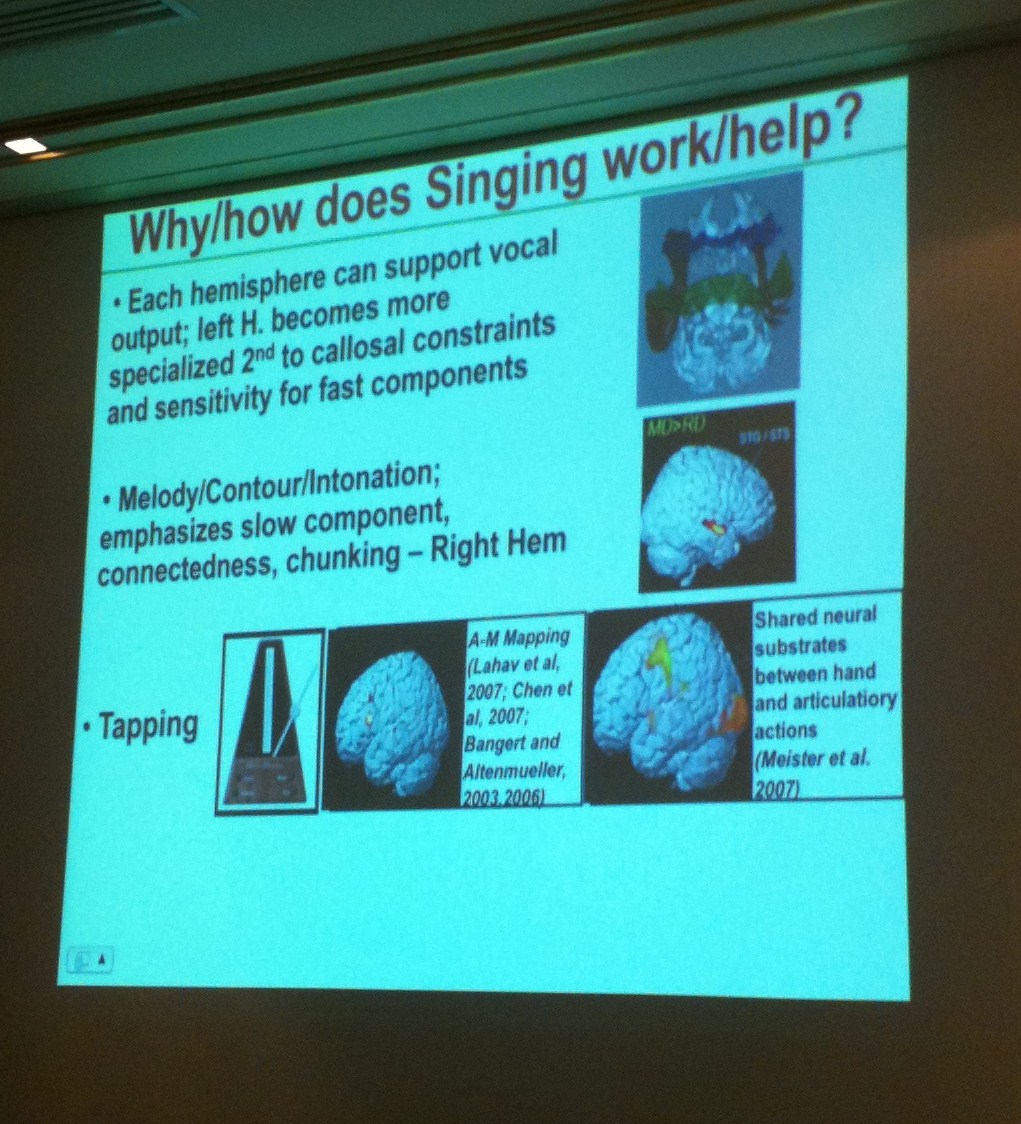
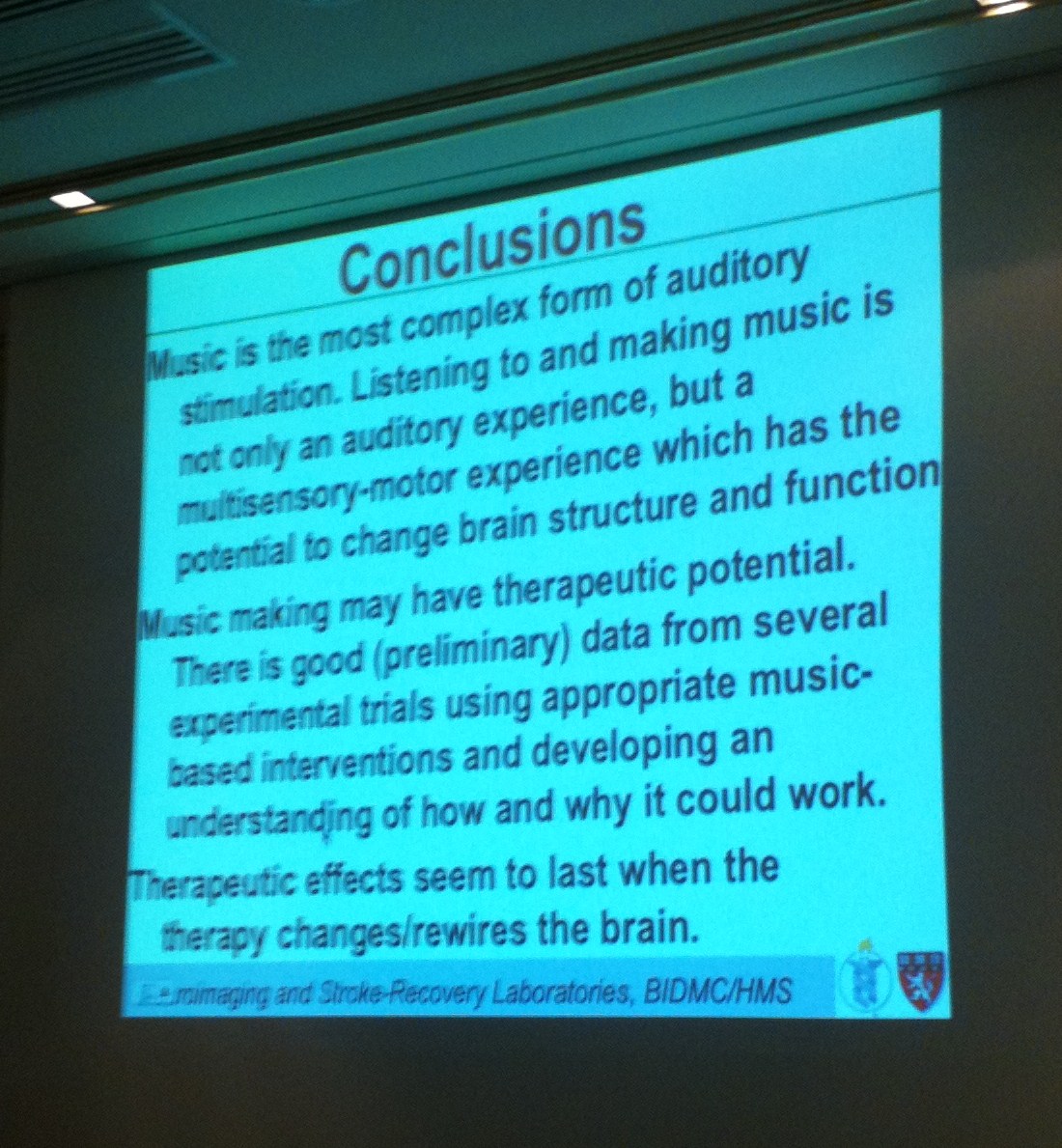
As many of you know, I recently attended the Second World Congress of Clinical Neuromusicology in Vienna. Though there were many intriguing presentations, one presentation in particular stood out. In 1996, Dr. Gottfried Schlaug (Boston, Harvard Medical School) performed an experiment to test the shared neural correlation of singing and speech. A portion of the abstract follows:

Using a modified sparse temporal sampling fMRI technique, we examined both shared and distinct neural correlates of singing and speaking. In the experimental conditions, 10 right-handed subjects were asked to repeat intoned (“sung”) and non-intoned (“spoken”) bisyllabic words/phrases that were contrasted with conditions controlling for pitch (“humming”) and the basic motor processes associated with vocalization (“vowel production”) (Özdemir, Norton, and Schlaug, 2006).

The remainder of the paper may be found here, but I will try to summarize the result. Basically, by actually singing the words or phrase, and not simply speaking or humming (referred to as ‘intoned speaking’), there occurred additional right lateralized activation of the superior temporal gyrus, inferior central operculum, and inferior frontal gyrus. What this means for the rest of us? This activation is now more than ever believed to be reason that while patients suffering from aphasia due to stroke or other varying brain damage may be unable to speak, they are able to sing.

That was in 2006. In a few short years, music therapy and the applied neuroscience of music have all but exploded-the question is, why? As many publications have noted, the idea that music can be used in rehabilitation has been around for a century or more. So what has caused such media coverage in the last few years? My simple theory is because through the popularization of these techniques’ success via persons in the public eye, everyone is beginning to understand that it just works.

Speaking of the public eye, a friend sent me this article from NPR this morning. Though I was vaguely familiar with this success story, it really surprised me to see it mentioned in national media. For those unaware, a current hot topic in science journalism is the method of therapy Gabrielle Giffords has chosen after she suffered massive brain trauma. I’ve run into cases similar to this one before, but it was what kind of music therapy that really caught my attention: Melodic Intonation Therapy. The reason this really caught my attention is because this is precisely the groundbreaking (and very successful) research Dr. Schlaug presented at the conference in Vienna, only his use was with nonverbal Autistic children. Though Schlaug’s research largely pertains to other faculties, he set out in this case to test AMMT (Auditory Motor Mapping Therapy, a kind of specifically targeted ASD therapy akin to Melodic Intonation Therapy used for stroke patients with aphasia) against normative Controlled Speech Therapy.

Without going too in-depth, what he and his team discovered was that patients who engaged in singing (as opposed to merely speaking or humming) showed additional right lateralized activation of the superior temporal gyrus, inferior central operculum, and inferior frontal gyrus. Due to this, a strong case can be made as to why aphasic patients with left-hemisphere brain lesions are able to sing the text of a song whilst being incapable of speaking the same words. What this means for the whole of this ‘Singing Therapy’ is that by being able to work with brain regions such as Broca’s area which may facilitate the mapping of sound to action, all kinds of different strides may be made linguistically in patients with left-hemisphere brain damage. People who suffer from neurological impairments or disorders that would otherwise be completely unable to communicate verbally may now have that chance. In the words of Dr. Schlaug, “When there is no left hemisphere, you need the right hemisphere to work.”

To get back to congresswoman Giffords, I’d like to take a moment to talk about what is so important and unique with her situation by looking at her case from point of impact to recovery. Nearly one year ago, Giffords sustained a massive head trauma via a bullet that went directly through her brain. Unfortunately, when the bullet entered in this way, it didn’t stop at destroying the tissue in its path (which was for her in the left hemisphere); it also damaged the surrounding neurons, causing the brain to quickly swell and put her in immediate fatal danger of hematomas and other complications. Because of this, surgery was necessary right away to remove a portion of her skull in order for the swelling to, as it were, breathe. The surgery Giffords took part in was the once risky decompressive hemicraniectomy. For more information on this procedure, there’s a fantastic post by Bradley Voytek over at Oscillatory Thoughts including some great data, analysis and images on the process. If the congresswoman’s circumstances are ringing any bells for anyone, it’s because it bears some resemblance to arguably one of the most famous head trauma cases in neuroscience and psychology as a whole-Phineas Gage. I shall soon share some thoughts on Gage, and why he remains so near and dear to my heart (and certainly to the heart of Antonio Damasio) in terms of emotional intelligence and neuroscience, but until then, some parting thoughts on Giffords.

In the beginning of this road to recovery, most were skeptical that Giffords would ever be able to speak again, in any vein. However, through the process of working in Melodic Intonation Therapy with her music therapist, she has gone from singing short words and phrases (in minor thirds, the prominently used interval in this therapy) to singing Twinkle, Twinkle Little Star to more structurally complex and well-known jazz and rock standards such as I Can’t Give You Anything But Love and American Pie. She has made massive strides in her recovery process, and continues to make more every day. This is only one example of the effectiveness and hope this “Singing Therapy” is bringing to the medical field. Even after speaking to Dr. Schlaug inVienna and finding he has “absolutely no interest whatsoever” in psychological disorders, I continue to be enthusiastic in the strides he and his team are making in the applied neuroscience of music.

A note: I continue to be amused by what a small world the pragmatic combining of music and neuroscience remains. Upon reaching the end of the NPR article, I now know why it was already so familiar to me, and why I immediately thought of Schlaug’s work at Harvard and Beth Israel-it is because that’s precisely the team NPR is taking their data from! Brilliant.


The Sound of Prose: Omensetter’s Luck

For anyone interested in music theory in terms of form and analysis, musical syntax or the ‘sound of prose’ and how it may work closely with its more literary neighbors, there’s a great post just up at An und für sich already yielding some interesting discussion. This post (On Some Sentences of William Gass) is part of a book event on William H. Gass’s Omensetter’s Luck of which I will soon be submitting. As someone indulging in a bit of literary analysis from a music background of sorts, I’ve already found it quite interesting, and wager you will as well.

Go Long, Final Go

Much remains to write about from my trip, my new vocational experiences as vocalist and researcher, and life in general, but until I may finally settle down (very possibly tomorrow, as I will fly home to Seattle for a week) I will share something personal that I have done since being back.

A year or so ago, a friend showed me this song by Joanna Newsom. It was the first thing I ever heard her do. Sometime shortly after, I fell in love with her and covered her myself on my little 2 track. It was suggested it was rather nice, and that I record it professionally. Here is the rough track from Dec 17, 2011. This song will never be mixed, or mastered. I will not cover her again, I’m finished now. But I couldn’t let her go without one last hoorah.

The following is my cover of one of the saddest and heartfelt songs I have ever heard. For the other two of hers that never fail to leave me completely wrecked and in awe, please go here and here. I hope you enjoy it.

Go Long (Vocal and Piano by Diana Hereld, originally recorded by Joanna Newsom)


Last night, again,
you were in my dreams
several expendable limbs were at stake
you were a prince, spinning rims
all sentiments indian-given
and half-baked
I was brought
in on a palanquin
made of the many bodies
of beautiful women
brought to this place to be examined,
swaying on an elephant:
a princess of india

We both want the very same thing.
We are praying
I am the one to save you
But you don’t even own,
your own violence
Run away from home-
your beard is still blue
with the loneliness of you mighty men,
with your jaws, and fists, and guitars
and pens, and your sugarlip,
but I’ve never been to the firepits with you mighty men

Who made you this way?
Who is going to bear your beautiful children?
Do you think you can just stop,
when you’re ready for a change?
Who will take care of you
when you’re old and dying?

You burn in the Mekong,
to prove your worth,
Go Long! Go Long!
Right over the edge of the earth!
You have been wronged,
tore up since birth.
You have done harm.
Others have done worse.

Will you tuck your shirt?
Will you leave it loose?
You are badly hurt.
You’re a silly goose.

You are caked in mud,
and in blood, and worse.
Chew your bitter cud,
Grope your little nurse.

Do you know why
my ankles are bound in gauze
(sickly dressage:
a princess of kentucky)?
In the middle of the woods
(which were the probable cause),
we danced in the lodge
like two panting monkeys.

I will give you a call, for one last hurrah.
If this tale is tall, forgive my scrambling.
But you keep palming along the wall,
moving at a blind crawl,
but always rambling.

Wolf-spider, crouch in your funnel nest,
If I knew you, once,
now I know you less,
In the sinking sand,
where we’ve come to rest,
have I had a hand in your loneliness?

When you leave me alone
in this old palace of yours,
it starts to get to me. I take to walking,
What a woman does is open doors.
And it is not a question of locking
or unlocking.

Well, I have never seen
such a terrible room-
gilded with the gold teeth
of the women who loved you!
Now, though I die,
Magpie, this I bequeath:
by any other name
a jay is still blue

with the loneliness
of you mighty men,
with your mighty kiss
that might never end,
while, so far away,
in the seat of the west,
burns the fount
of the heat
of that loneliness.

There’s a man
who only will speak in code,
backing slowly, slowly down the road.
May he master everything
that such men may know
about loving, and then letting go.