Request For Feedback – When Tragedy Strikes: A Music Behavioral Analysis

Dear friends,

Thus far, my research interests have lain in the children I’ve tested and taught in person, and I have had little use for gathering data from anyone over the age of 18. As I craft together my first pitch, however, I’d like to ask for some feedback. I’ve been given the opportunity to write about two subjects I find very fascinating. In fact, I believe anyone else has yet to combine them in quite this way. I’m attempting to piece together the music industry and psychological resilience. In the end, it all boils down to music behavior analysis. In this vein, I find myself happily at home. When venturing toward the music industry and modern practice, however, I’m treading on new ground.

 So I ask you, dear reader, if you have ever gone through a period of immense stress (i.e. one’s senior year of college or an audit at work), lost a loved one due to natural or unnatural causes, or experienced a major trial of any kind, to lend me your feedback. If you have ever streamed music using Spotify, Grooveshark, Songza, 8track, LastFM (etc.), or elected not to, I ask for your feedback. 


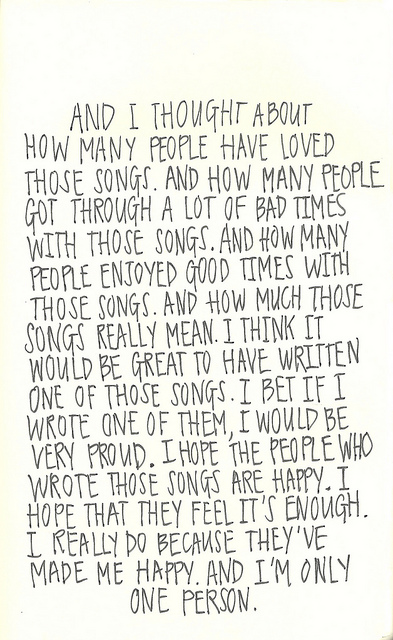
It’s been a few weeks since I really sat down on meditated on these concepts. This weekend, however, tragedy struck. A friend of mine lost his father, and I lost someone very dear to me. I suppose now is as good a time as ever, then, to write about loss, and how we respond to it.

I am interested in the way we respond to trauma/loss through the psychological lenses of music behavior with a special emphasis on playback. Because the debate of ownership vs. streaming is relatively new, there is precious little data available in the area I’m seeking. In terms of loss, this natural phenomenon has always existed. As for the modes and vices with which we counter this loss, our outlets would seem to expand on a daily basis. We grow at the speed of modern technology.

How has the ability to stream music affected stress/pain culture in the industry? Has it been altered in the least in terms of our music listening habits (ownership vs. access)? Is streaming saved for the young in age and young at heart, those without the worries of time and weather? In occasions of strife, do we turn to a new and fresh outlet which resigns our need and right of control? Or in a subconscious search for the regulation of external chaos do we flee from such an idea, clinging heavily to those old safe tunes proven time and time again to get us through?


I would appreciate any and all feedback in the aid of my essay. You may leave a comment, or if you wish to reach me privately, you may contact me on Facebook.


My pilot in music and autism: thoughts on empathy, mirroring and rapport

I’ve been employed at California State University, Northridge since last September as a research assistant in the psychology department working on a study in autism, working memory and music. I completed my training and began administration of the study in January of this year. I’ve tested ten clinical subjects, three control subjects, and loved nearly every moment. What I’d like to speak about is a fairly recent observation.

It’s nothing short of ironic that I am almost identically following in the academic footsteps of my mother. Despite the fact that she was not satisfied until the completion of her second doctorate in phenomenological and existential psychology, she spent a great deal of time before and after as an independently contracted school diagnostician. When I told her I was to be trained on how to properly administer the Wechsler Intelligence Scale for children, she was beside herself. I suppose it should not be ironic, then, that the one thing I’ve come to enjoy most in the process is what I’d heard years of stories pertaining to when I was a child. That aspect is the outcome when one properly executes and achieves psychological rapport.

The concept of rapport can obviously be applied in a number of contexts and situation, and like most things, can be pursued and established for good or ill. It is a technique used in manipulation, in sales, and in seduction. It can also used to coax out life-saving information from victims in the midst trauma, to bond with strangers in a new environment, and closest to home for me, to comfort and elicit high performance qualities from nervous children brought in for an extensive battery of psychoeducational evaluation. As they frequently wonder “What is wrong with me?” or “Why am I here?” I have learnt a bit of understanding and reaching out can go for miles. One of the most interesting features  I’ve observed thus far as that the children on the ASD scale-children thought to commonly possess a ‘faulty’ mirror neuron system that would keep them from typically developed empathy responses- should seem so sensitive to their surroundings.

Every child, with the exception of one (who in the end did not meet the criteria for the study), has not only displayed a warm demeanor and trusting disposition, but also has volunteered to sing back to me in my pilot study. After testing my first two control subjects, I realized that asking high school boys to sing to me may as well have been climbing Mt.Everest (or so I thought).  However, nine out of ten of my clinical subjects, after my initial singing the pilot study to them, felt comfortable enough to sing it right back to me, as my original protocol dictates. This reasoning can be due to a number of things, but it’s an achievement I was unable to make with any control subjects. All I know is had the first autistic male not simply asked that instead of speaking the phrases after me, “Can I sing it out loud like you did?” I never would have continued the pilot in that manner, and heard the other 8 boys sing.

It is small testing group thus far to be sure. I’m still sorting through data, and trying to discern exactly what it shows about the empathy, musicianship and working memory of the young, high-functioning autistic population. Until I do, I simply wanted to share the portion of it that made me so incredibly happy. While the most difficult part of the project was reading through each individual IEP and noting every social and emotional setback the child had experienced, the easiest part was talking and joking with the boys about how much they played video games, that they were eating all the oreos and juice set aside for their parents, and what lovely singing voices they had. I do not always love the computational administration, or working with personnel who do not share my passion for children. I do, however, love these kids, and have all the hope for them in the world. Rapport does not have to be a dangerous method of transference and countertransference that sets the psychologist on the path of no return. It does not have to be an empty therapeutic tactic to secure a goal with little regard of what the patient really needs. It really can just be taking a short amount of time out of your day, and looking at life through another’s perspective. One will often be amazed with what they find.

Krzysztof Penderecki, Jonny Greenwood, Mental Illness and Encephalography

I ran across something rather intriguing the other day, thanks to this friend and music enthusiast. It is a collaboration between two highly respected musicians:  Krzysztof Penderecki and Jonny Greenwood. Imaginative, provocative and innovate as these string arrangements may be, it is in a very small component of the composing process which lies the real fascination for me:

Penderecki’s Polymorphia also had a fascinating birth. The composer played a recording of Threnody for patients with mental illnesses at the Krakow Medical Center while the patients had encephalographs (brain-wave charts) made; he then based Polymorphia‘s musical lines around the shapes on their charts. In his reply to Polymorphia, Greenwood takes up that big, glorious and triumphant C Major chord — and then shatters that harmonic glow into smithereens. He begins with a strangely Bach-reminiscent chorale (“Es Ist Genug,” or “It Is Enough,” which is also the name of a famous Bach chorale) that Greenwood then distorts and dissolves over and over again. He builds tension and lets it drain away, takes up an idea and then lets it go in swirling eddies of motion.

The original article on NPR may be found here.

The “Anatomy of a Tear-Jerker” and my cover of Adele

In futile effort of keeping up with the Joneses of pop culture and music psychology, consider this my token post on Adele. Why?

 A) She’s fabulous

B) She just won big at the Grammys

C) WSJ Online has just released a major post largely on her hit Someone Like You entitled Anatomy of a Tear-Jerker 

D) I have covered her countless times, and her piano songs are a part of my teaching repertoire

In terms of the post WSJ released, I strongly recommend giving it a good read. The research was originally conducted at McGill, a university widely celebrated for their Music Perception and Cognition program, and home to celebrity writer Daniel Levitin, author of This Is Your Brain on Music. In light of Adele’s recent superstardom and the widening knowledge and appreciation of music psychology as a whole, I’d wager this article is going to get some serious attention. While I wholeheartedly agree with it’s main premise, I find something deeply awry here, and it is found the in subtitle itself:

Why does Adele’s ‘Someone Like You’ make everyone cry? Science has found the formula.

As a twenty-something young woman who has not only sung since age three, composed angsty love ballads on the piano for years but also been left by a lover in the worst way, I love Adele. Let me be clear on this: I love Adele. Someone Like You and Hometown Glory (as well as Rollin’ In The Deep, which I will teach tomorrow) are also favorites of my young vocal and piano students. However, I think if we look at that tag line again of this post-‘science has found the formula’- we will see that something is very wrong. I may be alone in my feeling here, but I doubt it. With the way EEG, MRI, fMRI and now even rtfMRI are developing, we know more about the human brain and it’s reactions to stimuli than ever before-more than we ever dreamed possible. I have a couple problems with the way the article glorifies grace notes and appoggiaturas-but most of all, how they glorify her. Yes, she and Dan Wilson have crafted a brilliant combination of soul, melodic intonation and dissonance in all the right suspended instances-but at the end of the day, I would be cautious in how objective we lean in quantifying beauty. There is a line to be drawn-there necessarily is. In saying “science has found the formula,” we have inadvertently taken the ‘magic’ (for lack of a better word) out of her song, and made it just that: a scientific formula. It should not be a commercial marketing scheme, however, and God forgive us should we ever make it one. It’s a great article, yes, and I hope everyone reads it. I only hope we can all take a step back from the science behind every mathematical placement of every ornamentation and remember why this lovely woman crafted the song in the first place.

And now, just for fun, a rough cover I did of Adele’s Hometown Glory in 2011.

Neural systems for speech and song in autism

In commencement of the administration of my pilot study (as well as my primary investigator’s full experiments) in working memory, autism and music, here is an interesting article I came across today. The idea simply drives forward what we already know: where subjects who suffer from aphasia and other language difficulties falter in normative speech patterns, music provides a far higher stimulation in areas of the brain (this study concentrating on the left inferior frontal gyrus in particular) and thus lends to speech development which ordinarily may not have been possible.

Abstract:

Despite language disabilities in autism, music abilities are frequently preserved. Paradoxically, brain regions associated with these functions typically overlap, enabling investigation of neural organization supporting speech and song in autism. Neural systems sensitive to speech and song were compared in low-functioning autistic and age-matched control children using passive auditory stimulation during functional magnetic resonance and diffusion tensor imaging. Activation in left inferior frontal gyrus was reduced in autistic children relative to controls during speech stimulation, but was greater than controls during song stimulation. Functional connectivity for song relative to speech was also increased between left inferior frontal gyrus and superior temporal gyrus in autism, and large-scale connectivity showed increased frontal–posterior connections. Although fractional anisotropy of the left arcuate fasciculus was decreased in autistic children relative to controls, structural terminations of the arcuate fasciculus in inferior frontal gyrus were indistinguishable between autistic and control groups. Fractional anisotropy correlated with activity in left inferior frontal gyrus for both speech and song conditions. Together, these findings indicate that in autism, functional systems that process speech and song were more effectively engaged for song than for speech and projections of structural pathways associated with these functions were not distinguishable from controls.

The open access html doc may be found here and for those interested:

DOI: 10.1093/brain/awr335

As I begin my very first experimental session, I’ll do my best to keep a log here, simply because I very much enjoy the feedback, and it helps to keep my thoughts aligned.

Sing me to sleep: The Perks of Being a Wallflower


We accept the love we think we deserve

 

            How does one interpret reality? Psychologically speaking, one may take a number of viewpoints. Countless factors come to play, first and foremost being the common argument of ‘nature or nurture.’ Aspects such as religion, race, culture, gender, sexuality, economic status, and mental health history can all work together to create vastly differing versions of reality. In stories, “narratives help us impose order on the flow of experience so that we can make sense of events and actions in our lives. They allow us to interpret reality because they help us decide what a particular experience ‘is about’ and how the various elements of our experience are connected.” (Foss, 399).

When someone reads a story, listens to a song, or watches a film, what determines their overall opinion and stance on what has transpired? As we mature from children into adolescents and adults, our methods of discernment have the capacity to shift radically. Not only upbringing and the norms of childhood, but also life experiences contribute to the process of modification in how one perceives their world.

Many narratives are chronologically organized, that is, organized in a time-observant sequence of events, while others may focus more on a specific character or theme. Narratives may come in the form of graphic novels, films, television, conversation with others, speeches, short stories, graffiti, music and other folklore. The use of symbols throughout the different forms are what arguably best categorize them as such, and to demonstrate this, I’d like to look at a poignant and inspiring ‘coming of age’ narrative entitled The Perks of Being A Wallflower. How does one interpret reality; but even more importantly, how is the construction of a narrative used to determine how we interpret reality?

Set in Pittsburgin the early 90s, Stephen Chbosky’s The Perks of Being a Wallflower is a story of the transformation of desperate introversion in an extroverted high school universe. Throughout the novel, the protagonist Charlie anonymously writes letters to an undisclosed recipient detailing the meaningful and turbulent journey through his freshman year. As the narrative begins, Charlie’s best (and only) friend has just committed suicide. Due to this, Charlie’s introversion and acute timidity as a new student are greatly challenged as he meets a spectrum of new friends along the way, not least of all, his English teacher Bill. As his relationship develops with this mentor, he is introduced via his surroundings to music, literature, love, sex and drugs. Throughout the novel, the reader is constantly subjected to perceptions of reality from many different perspectives. Sam, the beautiful and popular but taken woman of Charlie’s affection, her gay stepbrother and Charlie’s new best friend Patrick, and others including his family and peers make up the vastly different interpretations that all come together to challenge and question Charlie’s previously understood ideas and worldview. As Charlie as introduced to new musicians like The Smiths, Ride, Nick Drake, Smashing Pumpkins, Nirvana, U2 and Nat King Cole, his journey becomes increasingly personally psychoanalytic as he learns to relate, in one way or another, to these musicians.

To begin analysis, I’d like to start by looking at our main question: how does the author use the narrator and protagonist’s surroundings and cultural arena to construct a perception of reality? Charlie begins his textually prominent setting of high school in the immediate aftermath of an incredibly traumatic event: losing his best and only friend to suicide. Not only do we commence our journey in what is known already to be a daunting period, we also begin through the eyes of a painfully shy boy who is emotionally damaged and alone. Our opening and lasting impression of him describes the death of his favorite aunt, and later in life, dear friend.

Throughout the first portion of our novel, we see Charlie’s more intellectual habits develop-the way he rereads books twice to more fully understand them; the way he accepts all the extra essay assignments from his English teacher (and later mentor) Bill with a vigor. In the beginning, our perception of reality is formed through the eyes of an overachieving boy who simply wants to get through, and possibly fit in. His definition of reality is one of survival-of holding it all in as long as he possibly can.

The second way we are introduced to his existence is the mode in which he meets new people. Through his surrounding of stronger, more single dimension characters such as Sam, Patrick, his family and teacher Bill, we are shown how Charlie slowly enables himself to become a somewhat social being. In a largely stable environment, however, Charlie remains the wildcard, frequently being prone to crying over what is termed “silly things” and repressed feelings of guilt from the tragic death of his aunt in particular. The deeper in to the narrative we go, the more objective our surroundings seem, and the more subjective Charlie’s character dimension and experience prove. As a deliberately vague description of what happened between his aunt and he at a young age reappears throughout the work, we begin to slowly understand this trauma has played a far larger role in shaping who he is than previously thought. It is himself, and his aunt that prove to be the most round and conflicted characters of the narrative, thus allowing them the greatest space for growth. Charlie is a radically dynamic figure growing in knowledge, experience, and maturity more and more until he finally accepts his loss of innocence.

Another way we can examine Charlie’s social worldview is by asking what parts of his culture are privileged, and what parts are repressed. Through Charlie’s friend Patrick’s secret homosexual relationship with the quarterback of the football team, Charlie’s heightened embarrassment over his frequent display of emotion in crying and his family’s unrealistic expectations of Charlie’s older brother’s college success, we may see his culture is not too far from our own. The ‘popular’ kids in school remain those in financially advantageous situations; the outcasts remain the quiet or socially awkward. In Charlie’s world, blending into the crowd is desirable, while individuality and deviance is highly discouraged. In this way, Sam is able to retain a strong sense of acceptance due to her beauty and class status, while her brother falls socially down when word gets out of his sexual identity. What this says about their system of ethics is that the patriarchy reigns. The privileged prevail while the less privileged do not. The beautiful thing in Charlie’s developing social situation is that these lines become more and more blurred as he is able to find true acceptance from the outcasts and privileged alike.

Lastly, I’d like to talk about Charlie’s point of view as narrator. Chbosky has given Charlie a very human and humble tone, beginning quietly and ending more confidently. As the overall theme of the work is coming of age, loss of innocence and psychological resilience, it should be noted what Charlie learns, and most importantly, what he realizes in the end. As a child, Charlie was repeatedly molested by his favorite aunt. He only comes to understand this in the final pages-in the epilogue, no less. Through all of his pain, loss and personal turmoil, Charlie tells us a story of hope through friendship, love and music, how to get by in the tough world of adolescence, and the upside of being a wallflower. Charlie is not omniscient or omnipresent-he is just a boy, trying to figure out how to become a man. In Charlie’s indirect narration, we are shown a world of people who are tangible and relatable to every era. His story is trustworthy, reliable and raw. By the sense of established confidence in Charlie’s letters, we are shown a brilliant world of living splendidly through trial.

In conclusion, applying a narrative criticism best illuminates this artifact because it allows the reader and critic to more closely examine what is revealed about the individual’s or culture’s identity. It allows us to ask probing questions into their worldview and motives for action by looking at subjectivity in character dimensions. Narrative criticism enables one not only to analyze the content of the worldview, but the form and structure of that worldview as well. By looking deeply into the sexual and emotional trauma Charlie has undergone, by looking at all of the external factors including ethical, cultural, religious (or lack thereof), social, economical, and intellectual combined with his internal processing revealed to us by the author, we can truly appreciate what constitutes this hopeful ‘reality’ our protagonist has found.
Rhetorical Criticism: Exploration and Practice. Ed. Sonja K. Foss. Prospect Heights: Waveland Press, Inc. 1996.
She’s Lost Control: Amygdala Hijack?!

She’s Lost Control

In considering the why, and now the how of better implementing tools made available in music psychology, I am consistently struck by how very complex our musical preferences and responses are as humans.While avoiding the attempt to craft any groundbreaking expository theories,  I’d like to visit a motivation of mine in the field whilst bringing attention to an old Joy Division favorite. First, I will disaggregate the various schools of thought that overlap in this field of music psychology.  What do the following have in common?

1. Existential and phenomenological psychology

2. Jungian personality dichotomies

3. Psychological resilience

4. Malabou’s concept of neuroplasticity

5. Psychoanalysis

6. Advances in the neurological study of fear

7. Critical understandings of cultural and societal treatments of emotion

8. Music

In addition to composing the framework of my greatest motivators toward an existential understanding of life, I’d posit that not only do they contribute to the eventual pragmatic method I seek to establish in a clinical therapeutic setting, they are necessary in totality. The more I engage a dialogue regarding the concept as a whole, the more I am struck by just how much need be taken into consideration as well as shedding some light into my peculiar distaste for ‘music therapy’ as a solitary solution. Though music therapy practices have occasionally been proven effective for various wellness processes in young children as well as adults, I remain skeptical. I would argue that one need explore deeper into the psyche, history and personality of the patient. Far too often we see music therapy studies carried out on young adults in particular that prove completely blanketed – with the total exclusion of considerations such as gender, individual neuronal histories and variance in personality.

To come quickly to the point, I recently posed a vital question: In the occurrence of a (negative) amygdala “takeover”, what is the immediate goal? Is it to utilize music to objectify the patient’s feelings, or to quickly placate and soothe the individual’s distress (particularly if the patient suffers a history of auto-destructive behavior)? My response to the above is both, but objectively more as well. Here are a few thoughts to consider which barely skim the surface in composing the process of discerning what type of method and music should be used:

  1. History of Mental Illness (i.e. What are the immediate concerns? Has the patient demonstrated a capability or propensity for harm to self or others?)
  2. Medical and Psychiatric History (Has there been any type of surgery or modification in brain chemistry or anatomy?)
  3. Socioeconomic Background (What types of music to which the patient been exposed as a part of their ‘nurture’ upbringing, and the extent of music appreciation in their cultural worldview?)
  4. Religious/Familial/Educational background (i.e. unconscious and conscious conditioning-in what context has the patient learned or been taught to treat music? Is it a daily ritual, mainly a social luxury, rite of a religious tradition, utilized in education, etc.)
  5. Personality (What characteristics of extroverted or introverted personality types are being displayed?)
  6. Musical Preferences and Affect Regulation (How and to what extent are they affected by repetition, unfamiliar versus familiar rhythms and meters, Eastern/Western depictions of consonance and dissonance, ‘major’ versus ‘minor’ tonalities, etc.)
  7. Musical Propensity and Skill in Practice or Performance
  8. Existential values and spiritual/moral motivations of the patient

On the tip of the iceberg of gaining a general understanding of the patient, we see already that the answer lies beyond sitting down with a troubled teenage male, playing a bit of Mendelssohn and assuming to illicit the disclosure of an exhaustive account for discord with his father. Establishing a rapport and fluency over the course of time, making the effort to implement music he responds to, and eventually gain an empathetic understanding of how to meet him on his level, however, is something I’m interested in.

I’d like to now return for a moment to the ultimate motivator and the necessity for this type of process. When I speak of the amygdala hijack, I am referring to the very instance in which the fight or flight response occurs. Although the ‘limbic system’ was long perceived to be an emotional center of the brain, the amygdala has been found to be the main ‘limbic’ area involved clearly implicated in the processing of threats. A ‘hijack’ occurs when our brain responds to threats; devoid of reasonable consideration or logic. Typically, when we are presented a stimulus, three events occur: we sense (visual, aural, olfactory, touch, etc.), we process, and we react. These occur in rapid succession. At the moment the threat is processed, the amygdala can override the neo-cortex, a center of higher thinking which deals with sensory perception and motor commands, and initiate an impulsive response (which holds the potential of negatively producing instances of destructive behavior and emotional irrationality). Because it is easier for the amygdala to control the neo-cortex by arousing various brain areas than it is for the neo-cortex to control the amygdala, the ability to shut down anxiety producing hormones and emotions is no simple feat, and proves an exquisite challenge in undertakings of crafting a therapy.

One theory (enter elements of LeDoux, Goleman and Damasio) is that if we can slow or somehow manipulate this hijack process, we may buy ourselves the time it takes to properly process the stimulus, and respond in an appropriate, healthy fashion. LeDoux was hopeful about the possibility of learning to control the amygdala’s impulsive role in emotional outbursts: “Once your emotional system learns something, it seems you never let it go. What therapy does is teach you how to control it – it teaches your neocortex how to inhibit your amygdala. The propensity to act is suppressed, while your basic emotion about it remains in a subdued form.” My theory? We can do it with music.

In closing, I’d like to briefly provide an example of my conviction that the above considerations are essential for a beneficial psychologist/patient relationship. It would seem safe to assume that were we to randomly sample a group of 1,000 healthy, typically functioning women age 18-30, and narrow from there the women who have an extensive knowledge and listening history of the English ‘post-punk’ band Joy Division, we would be presented with an entire spectrum of emotional affect regarding participant’s specific and individual musical associations. Obviously this study is strictly hypothetical primarily in that were we to stop there, the comorbidity and variables would be obscene. My point is, it is almost guaranteed that there will be few in this clinical group who associate exclusively a strictly negative or strictly positive sentiment, and valence and arousal reaction to any one specific selected musical styling of Joy Division. Human experiences, associations and implicit reactions are unique, thus requiring a highly individualized method of interplay. I leave you now with a narrative appropriate to the study itself, with the hope of one day creating a methodical approach designed to alleviate the anxious and distressed of this very sentiment.

As The Spirit Wanes, or The Hope of Plasticity

“As the spirit wanes, the form appears.”

I first came across these words four years ago, in the art blog of a dear friend. I’ve been in love with Charles H. Bukowski ever since. Though his lifestyle was not one I’d recommend, I cannot convey the number of times I found him not only utterly poignant, but encouraging.

When I began this blog, I promised to explain why I chose those specific words as my title. I suppose the “form” is finally fighting its way to the surface. There is no decorative or esoteric way to say this: the past few months have been the most challenging of my life. I never imagined that so many diverse manifestations of loss and grief existed. During the two weeks leading to August, I lost three separate individuals, all whom I loved very deeply. My father’s death has been the most horrifying by far.

During his final weeks in the oncology ward, I witnessed quite a few examples of how people deal with fear, pain and grief: often to a paralyzing extent. I’ll always remember Kay, the beautiful old woman staying with her husband in the room next to my dad’s. I must have walked past her room twenty times before I found the courage to say hello, and offer her a hug and condolences. We spoke a few times during my stay-why is it so hard, we wondered, to just let go? Love and death are the two most naturally-occurring phenomena we can know, and yet they never fail to leave us cold and nearly unable to breathe.

So why Music psychology? Why neuroscience or philosophy? Why “as the spirit wanes?” Though I experienced a good deal of physical and mental pain in the last year, I feel as if I have almost been numb a vast portion of the time. A sort of desperate numbness, to be sure, but numbness nevertheless. I was unaware of the potential for evolution, development, and vitality all around me. I do not know what’s happened, but then I suppose I do. My spirit has never been so broken, so trampled, or terrifically damaged. I have not been myself the past year, and I’m ready for it to change. The concepts I have recently come to grasp not only allow but demand for revolution such as this.

I’ll never forget during my junior year of college, I was required to take a philosophy course. I dreaded it beyond all else. Though my mother had given me exposure to Jungian psychology from the cradle, in terms of philosophy, I felt my brain just might not “work” that way.

However, within a day of the class I was addicted and desperate for more. I had been re-exposed to the most basic form of existentialism: if we are responsible for our actions, we also then have the freedom not only to choose, but to transcend. As someone who’d grown up alongside the great crusade of mania and depression, this was news to me. What did they mean, I could choose? Though I’d eventually declined, I’d once been told I might benefit from medication to control depression and emotionally-destructive impulses. Medication or not: for the very first time in my life, I found a freedom to transcend my demons: psychical, neural and emotional. I certainly felt and digested emotion in much the same way, but with a unique freedom in my reaction to discord. I was no longer bound in paralyzation or fear. A couple of years later, I have once more found a like freedom, only infinitely more radical in the concept of Brain Plasticity.

As this dares reach too long a confession, I shall save the specifics of why I have found hope in Neuroscience, plasticity and its potential courtship with music for future posts. But what I have learned, and lived, is this: As the spirit wanes, the form appears. It is truly when we are beaten near beyond the point of recognition that we are then forced to give up, or forced to continue. Inertia demands not only motion, but action; consciousness. One may remain static for only so long. I choose to go forward. We can no longer think of our brains, our neuronal selves, as but flexible and anonymous; as machine. We must affirm our capacity for change and confess our plasticity: evolutionary, adaptive, explosive. We must no longer consent to depression via disaffiliation; to be “blind to our own cinema.” Our brains tell us a story-whether we choose to listen or not. Karl Marx once stated “Humans make their own history, but they do not know that they make it.” And why not? What type of fear or unknown is stopping us from this earth-shattering consciousness of what our brains can do?

I will continue soon in conjunction with a more formulated response to Catherine Malabou’s pioneering work, “What Should We Do with Our Brain?” in speculation of a metaphorical and ideological critique of plasticity.

“…At bottom, neuronal man has not known how to speak of himself. It is time to free his speech.” -Catherine Malabou

Channeling Emotional Intensity in the Creative Artist

Thanks to Cheryl Arutt for one of the best, most easily accessible articles I’ve seen on channeling pain in the artist, including some brief (albeit great) insight into the chemical process that stimulates fight-or-flight syndrome. Find it here.